Agacalti Church
Ağaçaltı Church in Ihlara Valley
Ağaçaltı Church is one of the first rock-cut sanctuaries visitors encounter after descending the main staircase into Ihlara Valley. Its free-cross plan, domed central space and early painted program provide a strong introduction to the architecture and religious art of the southern valley.
The church is also identified in some sources as Daniel Church or Daniel Pantonassa Church. These names are connected with the prominent image of Daniel among the lions and the church's Marian imagery, but they should not automatically be treated as a securely preserved original dedication.
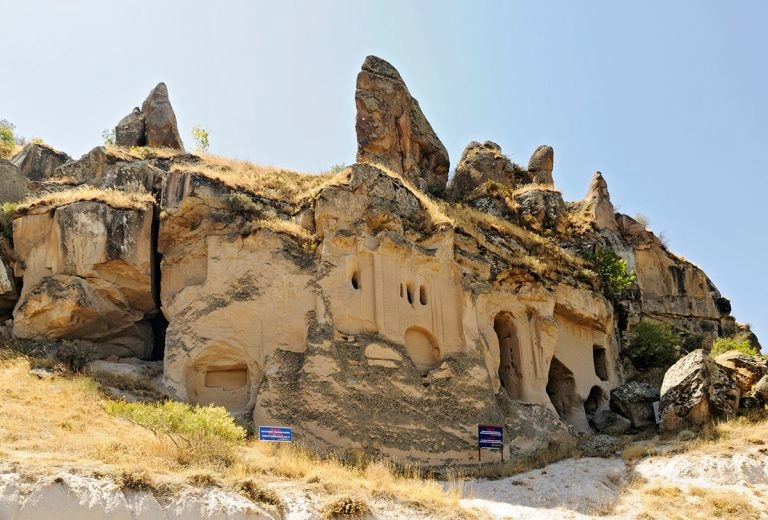
Most visitors should allow approximately 20 to 40 minutes inside and around the church. This does not include the long staircase descent, the return climb or time spent continuing along the riverside trail.
Opening hours, ticket conditions, photography rules and access to individual spaces can change. Check current official information before traveling and follow all signs inside the valley.
Why Ağaçaltı Church Is Important
Ağaçaltı is one of the best-known early painted churches in the southern section of Ihlara Valley.
Its importance comes from the relationship between a free-cross architectural plan and a painted program that includes the Ascension, Daniel among the lions, scenes from the childhood of Christ, the Baptism and several decorative traditions.
The interior also preserves crosses, flowers, rosettes, interlaced designs and griffin-like figures.
This combination shows that early medieval Cappadocian church decoration could bring together biblical narrative, symbolic geometry, plant forms and imagery with eastern or regional parallels.
The church should not be reduced to one famous dome painting. Its architecture, apses, decorative phases and valley position are equally important.
How to Plan a First Visit
Visit Ağaçaltı shortly after descending the main Ihlara staircase, before the riverside walk becomes the main focus.
Allow your eyes time to adjust. The contrast between bright canyon light and the darker interior can hide small figures and decorative bands during the first moments.
Begin with the central space and look upward toward the Ascension before moving through the cross arms.
Wear shoes with secure grip. The route includes a long staircase, uneven rock, worn thresholds and potentially wet surfaces.
Carry only a compact bag. Large backpacks, tripods and loose straps are difficult to manage near painted walls and narrow visitor areas.
Keep the entrance clear when groups arrive. The church is close to a major valley access point and can become crowded during organized tour hours.
Ağaçaltı Church at a Glance
| Feature | Main Importance | What to Notice |
|---|---|---|
| Location | Near the main staircase below Ihlara village | Easy inclusion at the beginning of a southern valley walk |
| Architecture | Free-cross plan with a domed square center | North, south and west arms with three eastern apses |
| Main Fresco | Ascension in the central dome | Christ, angels and surrounding sacred figures |
| Dating | Early figurative phase with later decorative additions | Why different surfaces may not belong to one campaign |
This table provides a visitor framework. The precise dating of individual surfaces remains a matter of scholarly interpretation.
Where Is Ağaçaltı Church?
The church is located close to the main stair entrance near Ihlara village.
After descending into the canyon, visitors reach it with only a short additional walk.
This makes Ağaçaltı one of the most practical churches for travelers who do not plan to complete a long valley hike.
The church is separate from the later monuments around Belisırma, which lie farther north along the Melendiz River.
Map applications can display several entrances and route lines. Use the main Ihlara village staircase when planning the most direct approach.
The Main Ihlara Staircase
The main entrance requires a long descent into the canyon and the same climb back when visitors return to the starting point.
The church may be close to the bottom, but the total physical effort includes the staircase.
Visitors with knee, heart, balance or mobility concerns should consider the return climb before descending.
Take breaks without blocking the stairs and use available handrails where provided.
Wet weather, snow and ice can make individual steps more difficult than the general trail description suggests.
Ağaçaltı, Daniel and Pantonassa Names
The modern Turkish name Ağaçaltı means beneath the tree.
Some publications call the monument Daniel Church because of the image of Daniel among the lions.
The name Pantonassa is associated with the Virgin Mary as Queen of All or Sovereign of All within Byzantine devotional language.
Using more than one modern or scholarly name does not prove that all names were used by the original community.
The strongest approach identifies the church clearly while separating visible imagery from an uncertain medieval dedication.
History and Dating
Ağaçaltı is commonly treated as one of the earlier painted churches in Ihlara Valley.
Its architecture and principal figurative paintings are often associated with a pre-iconoclastic or early medieval phase, sometimes placed around the 7th century.
Some crosses, geometric forms and plant decoration have been connected with later phases, including the 9th century.
The church may therefore preserve more than one decorative campaign.
One date should not be applied automatically to every carved wall, apse, painted figure and geometric motif.
The precise chronology remains debated because style, architecture, surface layers and later repair do not always provide one simple sequence.
Pre-Iconoclastic and Later Decorative Phases
The term pre-iconoclastic refers to the period before the first major Byzantine Iconoclast controversy began in the 8th century.
Figurative scenes such as the Ascension, Baptism, Nativity and Daniel among the lions can be connected with an early Christian painted program.
Later cross and plant decoration may reflect changing religious, artistic or practical conditions.
However, the presence of crosses does not by itself prove that a surface was painted during Iconoclasm.
Crosses remained central Christian symbols before, during and after the Iconoclast periods.
Dating should therefore combine motif, technique, position and comparison with other documented churches.
Why One Exact Date Is Difficult
Rock-cut churches can be carved, painted, repaired and reused over several generations.
A new decorative layer may cover or interact with an older painting.
Damage can remove the physical boundary between phases.
Later visitors may add crosses, inscriptions or repairs to an earlier program.
Modern conservation can reveal sections that were previously hidden by soot or deposits.
The safest description presents the proposed 7th-century context and later decorative phases without claiming that every element was completed in one year.
Related Tours
Popular experiences for this destination
 Green Tour
Green Tour Cappadocia
Explore Derinkuyu underground city, the beautiful Ihlara Valley, and S…
Vip Mix Tour Cappadocia
Experience the ultimate Cappadocia highlights in comfort-historic vall…
 Blue Tour
Blue Tour Cappadocia
Explore hidden valleys, ancient churches, and cultural gems on Cappado…
 Adventure
Trekking Tours Cappadocia
Hike Cappadocia’s spectacular valleys, fairy chimneys, and cave dwelli…
 Red Tour
Red Tour Cappadocia
Discover Göreme Open-Air Museum, Avanos pottery workshops, and breatht…
 Adventure
Jeep Safari Tour Cappadocia
Take an off-road jeep adventure across Cappadocia’s rugged landscapes,…
 Adventure
ATV Tour Cappadocia
Ride powerful ATVs through Cappadocia’s unique valleys, fairy chimneys…
 Adventure
Horseback Riding Tour Cappadocia
Experience Cappadocia on horseback, riding through valleys, hidden tra…
Professional Photo Shoot Cappadocia
Capture your Cappadocia moments with a guided professional photo shoot…

Classic Car Tour Cappadocia
Step into nostalgia with a vintage classic car ride through Cappadocia…

Carpet Weaving Experience Cappadocia
Discover the art of Turkish carpet weaving, learn traditional techniqu…

Nostalgic Electric Car Tour Cappadocia
Ride eco-friendly nostalgic electric cars through Cappadocia’s valleys…
Ağaçaltı and Early Ihlara Painting
The southern Ihlara churches are often discussed for an early regional painting style with strong narrative content.
Scenes may be arranged closely across the walls and vaults rather than separated into large formal panels.
Childhood scenes connected with Christ and the Virgin Mary are particularly important in several early Cappadocian programs.
Some subjects reflect biblical texts, while others may draw on wider Christian traditions and apocryphal narratives.
The guide to Christian history in Cappadocia provides the broader religious background for these developments.
Rock-Cut Architecture
Ağaçaltı Church was created by removing material from the volcanic rock.
Its walls, dome, apses, arms and vaulted surfaces belong to one carved mass rather than a masonry building assembled from separate blocks.
The architecture follows a free-cross plan centered on a domed square space.
Barrel-vaulted arms extend toward the north, south and west.
Three apses occupy the eastern side and form the sanctuary zone.
The carved plan gave painters a clear system of domes, vaults and apsidal surfaces for organizing the religious program.
How the Free-Cross Plan Works
Central Square
The square central space forms the architectural and visual center of the church.
Standing here allows visitors to understand how the three main arms and eastern sanctuary relate to one another.
Central Dome
The dome rises above the central square and carries the Ascension composition.
Its position creates a heavenly zone above the worship space.
North, South and West Arms
The barrel-vaulted arms extend from the center and provide surfaces for biblical scenes, crosses and decorative motifs.
Each arm contributes to the free-cross shape rather than forming a simple longitudinal nave.
Three Eastern Apses
The apses create the main sanctuary focus.
The central apse holds the strongest liturgical position, while the side apses support the wider eastern arrangement.
Images near these spaces should be understood in relation to worship and sacred hierarchy.
Why the Plan Is Different From a Closed Greek Cross
A free-cross church expresses the arms clearly as projecting or distinct spatial units.
A closed Greek-cross church organizes the cross within a more compact square framework and often uses supports to divide the center.
Ağaçaltı does not follow the same column-supported arrangement seen in later churches such as Elmalı, Dark Church or Çarıklı.
This difference helps place the monument within an earlier architectural tradition.
The plan should be read from the surviving interior rather than from one damaged entrance alone.
Collapse and the Original Entrance
The original entrance and parts of the surrounding rock complex have been affected by collapse and erosion.
Visitors now approach through the surviving valley-side section.
The present entrance may not reproduce the movement of medieval worshippers.
Collapse can remove walls, thresholds, passages and painted surfaces that once made the plan easier to understand.
Do not approach unstable edges or cross barriers to search for the original entrance.
How Erosion Changes a Rock-Cut Church
The same volcanic rock that allowed the church to be carved remains vulnerable to weathering.
Water enters cracks and weakens exposed surfaces.
Freeze and thaw cycles can widen fractures.
Falling rock can remove architecture and complete sections of painting.
Human contact, vibration and heavy visitor use add pressure to already fragile surfaces.
Current access controls should be understood as conservation measures rather than inconveniences.
The Painted Program
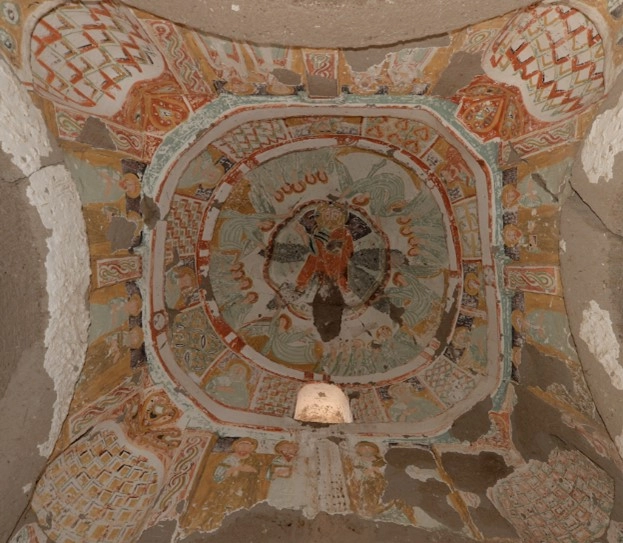
The church preserves a combination of figurative scenes, sacred symbols and decorative motifs.
The best-known composition is the Ascension in the central dome.
Other commonly identified subjects include:
- Daniel among the lions
- The Annunciation
- The Nativity
- The Adoration of the Magi
- The Flight into Egypt
- The Baptism of Christ
- Crosses and rosettes
- Interlaced patterns and flowers
- Griffin-like figures
Damage and paint loss can make some scenes easier to recognize than others.
How to Read the Frescoes
Begin With Architecture
Identify the central dome, cross arms and eastern apses before searching for individual scenes.
The architecture explains why one image appears overhead while another occupies a side vault.
Follow Gestures and Gaze
Raised hands, blessing gestures and the direction of faces guide attention toward the main action.
Angels and witnesses often point visually toward Christ.
Use Painted Objects
A river, cave, throne, lions, star or architectural structure can identify the setting.
These objects communicate symbolically rather than through modern realistic perspective.
Look for Inscriptions
Greek inscriptions can identify figures or scenes.
Damaged letters should be read cautiously.
Separate Damage From Original Simplicity
A blank section may have lost plaster or pigment.
It should not automatically be treated as an area that was never painted.
The Ascension in the Central Dome
The Ascension is the church's best-known painting.
Christ occupies the heavenly center, surrounded by angels or a mandorla-like sacred frame.
The Virgin Mary, apostles and other figures form the earthly group below according to the surviving arrangement.
Upward gazes and gestures connect the figures beneath with Christ above.
The dome turns the physical ceiling into a theological image of heaven and departure from the earthly world.
The composition is especially effective because visitors stand directly below the central event.
How to Examine the Ascension
Begin from the center of the church without blocking the route.
Identify the upper figure of Christ before examining the surrounding angels.
Follow the visual movement downward toward the Virgin Mary and apostles.
Notice how the circular or domed surface changes the proportions of the figures when viewed from different positions.
Do not use flash or strong lighting to reveal faded details.
Allow natural visual adjustment and use a moderate zoom where photography is permitted.
Daniel Among the Lions
The image of Daniel among the lions is one of the principal reasons the church is sometimes called Daniel Church.
Daniel is normally shown as a protected central figure surrounded by lions.
The scene comes from the biblical account in which Daniel survives the lions' den through divine protection.
His calm central position contrasts with the dangerous animals around him.
The composition communicates faith, endurance and rescue.
The presence of the scene does not prove that the original church dedication was formally to Daniel.
Daniel as a Symbol of Salvation
Early Christian art often used Daniel among the lions as an image of deliverance from death and danger.
The subject could also be understood as a symbolic parallel to Resurrection.
The lions represent real threat, while Daniel's survival demonstrates divine intervention.
His posture may resemble prayer rather than physical struggle.
This distinction matters because the scene emphasizes trust and salvation rather than heroic combat.
The Annunciation
The Annunciation shows the Archangel Gabriel announcing to Mary that she will give birth to Christ.
Gabriel approaches or gestures toward Mary.
Mary's posture expresses attention, acceptance or surprise.
Architectural details may establish an interior setting.
The scene begins the visual narrative of Christ's birth and childhood.
The Nativity
The Nativity centers on the birth of Christ.
Mary and the infant Christ form the theological center, while Joseph, angels, animals and attendants may appear around them.
Several moments can be combined within one composition.
The figures are arranged according to sacred importance rather than naturalistic scale or distance.
Damage may remove secondary figures while leaving the central mother-and-child relationship visible.
The Adoration of the Magi
The Adoration presents the Magi approaching Christ with gifts.
Their movement creates a narrative direction toward Mary and the child.
A star may guide or identify the scene.
The Magi represent recognition of Christ beyond the immediate local community.
The composition often follows or interacts closely with the Nativity in early narrative cycles.
The Flight Into Egypt
The Flight into Egypt represents Mary, Joseph and the child escaping Herod's threat.
Mary is often shown seated on an animal while Joseph guides or accompanies the journey.
The scene communicates danger, protection and movement.
Landscape or architectural elements can indicate travel, although the setting does not reproduce a realistic map.
The subject belongs to the childhood cycle and helps explain the strong emphasis on early episodes from Christ's life.
The Baptism of Christ
The Baptism normally shows Christ standing in the Jordan River while John the Baptist reaches toward him.
Angels may wait beside the river.
The Holy Spirit can appear above in the form of a dove or heavenly sign.
The scene marks the beginning of Christ's public ministry.
Its vertical river form and the relationship between Christ and John provide the strongest visual clues.
Why Childhood Scenes Matter
Early Cappadocian programs often devote considerable space to the childhood of Christ.
The Annunciation, Nativity, Adoration and Flight into Egypt create a sequence before the public ministry begins.
These scenes emphasize the identity of Christ, the role of Mary and divine protection.
Some details may reflect apocryphal Christian traditions in addition to canonical Gospel texts.
The cycle should be read as one connected theological narrative rather than a group of unrelated family scenes.
Crosses and Rosettes
Crosses appear as central sacred symbols and decorative organizers.
Rosettes create repeated circular forms across borders and surfaces.
The two motifs can frame narrative scenes or occupy independent fields.
Repeated crosses do not automatically indicate one iconoclastic phase.
Their date depends on technique, location and relationship with surrounding decoration.
Interlaced Patterns and Flowers
Interlaced designs create continuous visual movement.
Flowers and plant forms bring organic rhythm into the geometric system.
These motifs can frame arches, mark boundaries and connect separate surfaces.
Plant decoration may carry ideas of life, renewal and sacred abundance.
Not every flower or knot has one securely documented symbolic meaning.
Griffin-Like Figures
Griffin-like creatures combine features associated with powerful animals or birds.
Such hybrid forms appear across several eastern Mediterranean and Near Eastern artistic traditions.
At Ağaçaltı, they contribute to a decorative language that is not limited to direct biblical illustration.
Related Tours
Popular experiences for this destination
Green TourGreen Tour Cappadocia
Explore Derinkuyu underground city, the beautiful Ihlara Valley, and S…
Vip Mix Tour Cappadocia
Experience the ultimate Cappadocia highlights in comfort-historic vall…
Blue TourBlue Tour Cappadocia
Explore hidden valleys, ancient churches, and cultural gems on Cappado…
AdventureTrekking Tours Cappadocia
Hike Cappadocia’s spectacular valleys, fairy chimneys, and cave dwelli…
Red TourRed Tour Cappadocia
Discover Göreme Open-Air Museum, Avanos pottery workshops, and breatht…
AdventureJeep Safari Tour Cappadocia
Take an off-road jeep adventure across Cappadocia’s rugged landscapes,…
AdventureATV Tour Cappadocia
Ride powerful ATVs through Cappadocia’s unique valleys, fairy chimneys…
AdventureHorseback Riding Tour Cappadocia
Experience Cappadocia on horseback, riding through valleys, hidden tra…
Professional Photo Shoot Cappadocia
Capture your Cappadocia moments with a guided professional photo shoot…
Classic Car Tour Cappadocia
Step into nostalgia with a vintage classic car ride through Cappadocia…
Carpet Weaving Experience Cappadocia
Discover the art of Turkish carpet weaving, learn traditional techniqu…
Nostalgic Electric Car Tour Cappadocia
Ride eco-friendly nostalgic electric cars through Cappadocia’s valleys…
Their presence should not be used to claim one exact cultural origin without supporting evidence.
Similarity can reflect shared visual traditions, workshop knowledge or the long circulation of motifs.
Local, Byzantine and Eastern Artistic Traditions
Ağaçaltı is often discussed as part of a regional style shaped by several artistic influences.
Byzantine Christian subjects provide the main religious framework.
Local workshop practices affect proportion, line, scene arrangement and color.
Plant, geometric and hybrid-animal motifs connect the church with wider eastern decorative traditions.
This mixture should not be described as crude imitation.
It represents an active regional visual language adapted to the architecture and community of Ihlara Valley.
Color and Line
The interior is remembered for strong early color, red outlines and closely arranged scenes.
Dark contour lines define faces, clothing and movement.
Red borders can separate compositions or emphasize architectural boundaries.
Pale backgrounds help figures remain visible in a dim interior.
The colors seen today have been affected by age, moisture, surface deposits and restoration.
Color should be interpreted together with architecture, gesture and inscription.
Painting Technique and Surface Preparation
The volcanic rock required preparation before detailed painting.
Plaster or related layers created a smoother ground for outlines, pigments and inscriptions.
Different phases may use different surface preparation and painting methods.
The word fresco is commonly used for Cappadocian wall paintings, although the exact technique can vary across surfaces.
Later repairs, deposits and scratches can overlap the original paint.
Visitors should not attempt to clean or wet a surface to make details more visible.
Why the Paintings Survive Unevenly
Moisture, temperature change, dust, smoke, scratching and physical contact affect painted surfaces.
Plaster can detach from the rock and remove complete figures.
Areas near openings receive more air movement and environmental change.
Collapsed rock can destroy both architecture and painting at the same time.
A protected section may preserve color differently from an exposed wall.
Visitors see the combined result of original work, later use, natural deterioration and conservation.
Conservation and Responsible Visiting
- Do not touch frescoes, plaster or carved surfaces.
- Do not use flash.
- Follow current signs when photography is prohibited.
- Keep bags, coats and hair away from walls.
- Do not lean against apses or vault surfaces.
- Keep the entrance clear for other visitors.
- Do not cross barriers or enter unstable sections.
- Never use strong artificial lighting close to the paintings.
A brighter photograph is not more important than the survival of an early medieval painted surface.
How Long a Visit Takes
| Visit Style | Time Inside | Best For | Main Limitation |
|---|---|---|---|
| Brief Stop | 15 to 20 minutes | Ascension and a quick architectural overview | Limited time for the cross arms and decorative phases |
| Standard Visit | 20 to 40 minutes | Most first-time visitors | Group flow may reduce viewing time |
| Art-Focused Visit | 40 to 60 minutes | Fresco sequence, motifs and architecture | Compact space can become crowded |
Add the staircase descent, the return climb and any riverside walking separately.
Visitor Information
| Planning Point | Practical Guidance |
|---|---|
| Location | Near the main staircase below Ihlara village |
| Typical Church Visit | Approximately 20 to 40 minutes |
| Access | Reached after descending the main valley staircase |
| Tickets | Check current Ihlara Valley entrance and pass conditions |
| Photography | Follow current signs and never use flash |
| Walking Conditions | Long staircase, uneven rock and possible wet surfaces |
Final admission and access to individual churches may end before the listed valley closing time.
Seasonal schedules, restoration and weather can affect the route.
Accessibility and Physical Conditions
The main challenge is the staircase between the plateau entrance and valley floor.
Full wheelchair access to Ağaçaltı Church should not be assumed.
Visitors with limited mobility should confirm whether an alternative route or closer vehicle approach is currently available.
Low light and uneven thresholds can affect visitors with balance or visual concerns.
Strollers are not practical inside the church and can be difficult on the main staircase.
Older visitors should allow time for breaks during the return climb.
Visiting With Children
Children can visit with close adult supervision.
- Keep children beside an adult on the staircase.
- Do not allow climbing on carved walls or collapsed rock.
- Keep hands away from frescoes.
- Use quiet voices inside the church.
- Carry water and sun protection.
- Plan the return before children become tired.
The lions, Magi and Ascension can provide useful visual themes, but the protected interior is not a play area.
Best Time to Visit
Early Morning
Early arrival often provides a quieter interior and cooler conditions on the staircase.
Midday
Organized groups can make the church busy because it is close to the main entrance.
Allow others to enter and avoid standing in the doorway.
Late Afternoon
Late afternoon may be calmer, but enough time must remain for the staircase climb and final exit.
Do not begin a long river walk close to closing time.
Seasonal Planning
Spring
Cooler temperatures suit the staircase and river walk, but rain can make stone and soil slippery.
Summer
Descend earlier when possible. The return climb can feel hot even when the canyon floor is shaded.
Autumn
Cooler conditions often suit longer walking routes. Shorter daylight should be considered.
Winter
Snow and ice can remain on shaded steps after roads appear clear.
Do not descend when the staircase or church approach is unsafe.
Continuing Toward Kokar and Pürenli Seki
Ağaçaltı can be visited before continuing along the riverside path toward Kokar, Pürenli Seki and other southern Ihlara churches.
These monuments are not all located at the same height or directly beside the easiest trail.
Allow time for side approaches, interior visits and route finding.
Do not assume that every church is open simply because the valley trail is accessible.
A guided Cappadocia trekking tour can help with route selection and church identification.
Ağaçaltı or Belisırma?
| Feature | Ağaçaltı and Southern Entrance | Belisırma Area |
|---|---|---|
| Main Access | Long staircase from Ihlara village | Road access to the riverside village |
| Artistic Focus | Early architecture and narrative painting | Middle and Late Byzantine churches and donor inscriptions |
| Key Churches | Ağaçaltı, Kokar and Pürenli Seki | Kırkdamaltı, Direkli and nearby monuments |
| Best For | First introduction to the southern church group | Shorter riverside options and later medieval context |
The Belisırma churches guide explains the later group farther north.
Combining Ağaçaltı With Selime
Ağaçaltı and Selime Cathedral can be included on the same road itinerary.
This does not mean they are close together on the walking trail.
A common plan uses a selected Ihlara walk, then continues by vehicle toward Selime.
Allow enough time for the staircase, lunch, transport and final admission at Selime.
Do not schedule a detailed church visit, long hike and full Selime exploration within an unrealistic short period.
Green Tour and Ağaçaltı Church
A Cappadocia Green Tour commonly includes Ihlara Valley, but the exact walking section and church stops vary.
Some tours descend the main staircase and may pass close to Ağaçaltı.
Others use a different route or prioritize the riverside walk and lunch.
Ask the operator:
- Which valley entrance is used
- Whether Ağaçaltı Church is entered
- How long the group spends inside
- Whether entrance fees are included
- How much walking and stair climbing are required
- Whether Selime is included afterward
A listed Ihlara stop does not guarantee a detailed fresco visit.
Transport and Route Planning
The main entrance near Ihlara village is reached by road.
A rental car provides flexibility, but the driver must return to the same parking area unless a one-way route has been arranged.
A private driver is practical when the group exits at Belisırma or continues by road to Selime.
Share exact pickup points before descending because mobile reception can weaken in the canyon.
Use the guide to getting to and around Cappadocia when comparing a tour, rental car, taxi and private driver.
How to Read Early Ihlara Art
Begin with the narrative sequence rather than judging each figure according to naturalistic realism.
Early regional painters emphasized clear action, sacred hierarchy and recognizable symbols.
Figures may appear frontal, compressed or arranged in closely connected bands.
Scale can communicate importance rather than physical distance.
Architecture, color and gesture work together to create meaning inside a compact rock-cut space.
Common Ağaçaltı Planning Mistakes
- Counting only the church visit: The staircase adds significant time and effort.
- Applying one date to every surface: The church may preserve several decorative phases.
- Calling every cross iconoclastic: Crosses were used across several Byzantine periods.
- Treating Daniel Church as a confirmed original dedication: The name is connected with the prominent scene.
- Looking only at the Ascension: Childhood scenes and symbolic decoration are also important.
- Confusing Ağaçaltı with Belisırma churches: They belong to different sections and historical contexts.
- Using flash: Current conservation rules must be followed.
- Blocking the entrance: The church can become busy with groups.
- Starting a long walk too late: The return staircase and closing time must be considered.
Questions Travelers Ask About Ağaçaltı Church
Where is Ağaçaltı Church?
It is located near the bottom of the main staircase descending into Ihlara Valley from the Ihlara village entrance.
Why is it called Ağaçaltı?
The Turkish name means beneath the tree. The exact origin of the modern name should not be confused with a documented Byzantine dedication.
Is it also called Daniel Church?
Yes. Some sources use Daniel Church because of the prominent image of Daniel among the lions.
What does Pantonassa mean?
Pantonassa is a title associated with the Virgin Mary and can be translated as Queen or Sovereign of All.
How old is the church?
The principal architecture and figurative paintings are often associated with an early phase, possibly around the 7th century, while some decoration may belong to later periods.
Is the dating certain?
No. Researchers differ, and the church may contain more than one architectural or decorative phase.
What is the most famous fresco?
The Ascension scene in the central dome is the best-known painting.
Which other scenes survive?
Commonly identified subjects include Daniel among the lions, the Annunciation, Nativity, Adoration of the Magi, Flight into Egypt and Baptism.
How long should you spend inside?
Allow approximately 20 to 40 minutes, excluding the staircase and wider valley walk.
Is the church near Belisırma?
No. Ağaçaltı is near the southern Ihlara village entrance, while Belisırma lies farther north.
Is it included in every Green Tour?
No. The walking route and church stops vary between operators.
Can visitors take photographs?
Photography rules can change. Follow current signs and never use flash.
Is the route wheelchair accessible?
Full access should not be assumed because the main approach includes a long staircase and uneven surfaces.
Can children visit?
Yes, with close supervision on the stairs and inside the church.
Is a guide useful?
Yes. A guide can explain the dating debate, free-cross architecture, scene sequence and differences between the decorative phases.
An Early Painted Church at the Ihlara Entrance
Ağaçaltı Church provides one of the clearest introductions to the early religious art of Ihlara Valley.
Its free-cross plan creates a central domed space surrounded by barrel-vaulted arms and an eastern sanctuary with three apses.
The Ascension transforms the central dome into a heavenly focal point.
Daniel among the lions, the childhood scenes and the Baptism connect protection, incarnation and ministry within the wider painted program.
Crosses, rosettes, interlace, flowers and griffin-like creatures show that the church's visual language extends beyond narrative scenes.
For travelers who account for the staircase, allow their eyes time to adjust and examine more than the central dome, Ağaçaltı offers a valuable introduction to early Byzantine Cappadocia.
Use the Cappadocia trip planning guide and the Cappadocia safety and essentials guide when planning the wider Ihlara route.