St. John Church
St. Jean Church in Gülşehir: Two Levels and 1212 Frescoes
St. Jean Church, also known as Saint John Church and commonly associated with Karşı Kilise, is a two-storey rock-cut sanctuary near the entrance of Gülşehir in Nevşehir Province. Its lower and upper levels preserve contrasting architectural functions and decorative traditions within one connected monument.
The lower level contains a restrained red-painted program, burial spaces and practical rooms, while the upper church is covered with biblical frescoes. An inscription in the apse gives the date 1212, making the upper painted church an important example of later Byzantine art in Cappadocia.
Most visitors should allow approximately 45 to 75 minutes for both levels. Travelers studying the fresco sequence, inscriptions, ceiling medallions and lower service spaces may need closer to 90 minutes.
Opening hours, ticket prices, Museum Pass conditions, photography rules and access between the two floors can change. Check current official information before traveling and follow the instructions displayed at the church.
Why St. Jean Church Is Important
The monument allows visitors to compare two very different approaches to sacred space within one rock-cut complex.
The lower level uses red crosses, geometric lines and restrained non-figurative ornament. The upper level presents a much more extensive figurative program centered on Christ, biblical history, saints and sacred ancestors.
The dated inscription of 1212 gives the upper church an unusual chronological importance. Many Cappadocian churches are dated through style and architectural comparison, while St. Jean provides a written date connected with its painted program.
The two-storey arrangement also preserves evidence of worship, burial, storage, water management and daily community use.
St. Jean should therefore be understood as a complex monument rather than only as a room containing colorful frescoes.
How to Plan a First Visit
Begin with the exterior and identify how the two levels are arranged within the rock mass.
Visit the lower section before the upper church when the current visitor route permits. The contrast becomes clearer when the red symbolic decoration is seen first.
Allow your eyes time to adjust inside the upper church. Moving directly from bright daylight into a dim painted interior can hide smaller medallions and inscriptions during the first moments.
Wear shoes with reliable grip. Steps, thresholds and worn rock surfaces may be uneven.
Carry only a small bag. Large backpacks, loose straps and tripods are difficult to manage near painted walls and narrow transitions.
Do not rush the ceiling. Some of the most important figures are positioned above normal eye level and require a slow, organized viewing sequence.
St. Jean Church at a Glance
| Feature | Main Importance | What to Notice |
|---|---|---|
| Lower Level | Worship, burial and practical spaces | Red crosses, geometric decoration, tombs and service areas |
| Upper Level | Main painted church | Biblical scenes, saints, medallions and inscriptions |
| 1212 Inscription | Written date for the upper painted program | The distinction between fresco date and complete complex chronology |
| Warrior Saints | Protection and victory over evil | Saint George and Saint Theodore confronting creatures |
This table provides a visitor framework. It does not prove that every room, carving and painted surface was completed during one campaign.
Where Is St. Jean Church?
St. Jean Church is located near the entrance of Gülşehir in Nevşehir Province.
It is outside the compact sightseeing area around Göreme, Uçhisar, Ürgüp and Avanos, but it can be included in a northern Cappadocia route.
The monument is often associated with the name Karşı Kilise. Map applications and local signs may use St. Jean, Saint John or Karşı Church.
Use the exact church location rather than a general Gülşehir church marker when planning the final approach.
The site works best with Gülşehir, Açık Saray and other northern stops rather than as a hurried detour during a full Göreme museum day.
St. Jean Church or Karşı Kilise?
The names St. Jean Church, Saint John Church and Karşı Kilise are commonly used for the same monument.
St. Jean reflects the association with Saint John, usually understood in relation to John the Baptist and the Baptism scene.
Karşı Kilise is a Turkish identifying name and can be translated as the church opposite or across the way.
A modern place name does not necessarily preserve the original Byzantine dedication in its complete medieval form.
Visitors should use both names when searching maps or asking for local directions.
Historical Context
The upper paintings belong to the later Byzantine artistic history of Cappadocia.
The date 1212 falls within a period when Christian communities continued to maintain churches and commission paintings under changing political conditions in Central Anatolia.
The monument should not be placed inside a simple story in which Christian artistic life ended immediately after the Seljuk arrival.
Religious communities, local patrons and painters continued to work in different parts of Cappadocia during the 12th and 13th centuries.
The exact chronology of the lower carving, practical rooms, tombs and upper church may involve several phases.
For the wider background, see Christian history in Cappadocia.
Why the 1212 Date Matters
An inscription in the apse gives the date 1212.
This written date is generally connected with the upper church and its figurative painted program.
It provides a more secure chronological anchor than stylistic comparison alone.
The inscription does not automatically prove that the lower level, wine cellars, tombs, water channel and every carved passage were created in 1212.
Rock-cut monuments can preserve older spaces, later additions, repairs and repainting within one visible complex.
The strongest interpretation separates the dated upper decoration from the wider architectural history.
A Two-Storey Rock-Cut Monument
The vertically arranged levels are the defining feature of St. Jean Church.
The lower floor combines a small church with burial and practical spaces.
The upper level functions as the main painted sanctuary.
Part of the original rock between the levels has collapsed, affecting the relationship between the lower ceiling and upper floor.
This loss makes the present interior easier to misunderstand.
Visitors should imagine two connected but distinct levels rather than one tall chamber divided only for modern access.
How the Two Levels Relate
Vertical Organization
The complex uses the height of the rock to separate activities and decorative programs.
Practical functions, burials and restrained worship space occupy the lower level.
The extensive biblical cycle occupies the upper church.
Different Visual Languages
The lower floor communicates through crosses, red lines and geometric forms.
The upper level communicates through human figures, biblical events, inscriptions and medallions.
Changing Phases
The contrast may reflect different dates, patrons, workshops or religious needs.
It should not be reduced to an unsupported claim that one floor was iconoclastic and the other was created immediately afterward.
Movement Between Levels
Access involves rock-cut transitions and changes in floor level.
The current route may differ from the original medieval circulation because of collapse, restoration and visitor management.
The Lower Level
The lower floor contains a rock-cut church together with spaces connected with practical use and commemoration.
Documented features include:
- A simple worship area
- Wine-storage or production spaces
- Rock-cut tombs
- A water channel
- Rooms associated with attendants or members of the community
These spaces demonstrate that the complex supported more than formal worship.
Food and drink storage, water management, burial and daily service were part of the wider life of a religious community.
The Lower Church Plan
The lower church has a short-armed cross-shaped arrangement with an apse at its eastern end.
The cross arms organize the worship area around a central space.
The eastern apse marks the main liturgical focus.
Because part of the original ceiling has collapsed, the relationship between the lower church and upper floor is not fully preserved.
Damage should not be interpreted as the original design.
Look for surviving wall lines, carved transitions and the direction of the apse before attempting to understand the plan.
Recommended Tours for This Page
Popular experiences for this destination
 Blue Tour
Blue Tour Cappadocia
Explore hidden valleys, ancient churches, and cultural gems on Cappado…
Vip Mix Tour Cappadocia
Experience the ultimate Cappadocia highlights in comfort-historic vall…
 Green Tour
Green Tour Cappadocia
Explore Derinkuyu underground city, the beautiful Ihlara Valley, and S…

Cappadocia Rent A Car
Explore Cappadocia freely at your own pace with flexible car rental op…
 Balloon
Cappadocia Hot Air Balloon Tour
See Cappadocia from the air at sunrise on a professionally operated ho…
 Adventure
ATV Tour Cappadocia
Ride powerful ATVs through Cappadocia’s unique valleys, fairy chimneys…
 Red Tour
Red Tour Cappadocia
Discover Göreme Open-Air Museum, Avanos pottery workshops, and breatht…
 Adventure
Horseback Riding Tour Cappadocia
Experience Cappadocia on horseback, riding through valleys, hidden tra…
Turkish Night Show Cappadocia
Enjoy a traditional Turkish dinner with live music, folk dances, and w…
Professional Photo Shoot Cappadocia
Capture your Cappadocia moments with a guided professional photo shoot…

Airport Transfer Service Cappadocia
Travel comfortably and safely between Cappadocia’s airports and your h…

Classic Car Tour Cappadocia
Step into nostalgia with a vintage classic car ride through Cappadocia…
Red Crosses and Geometric Decoration
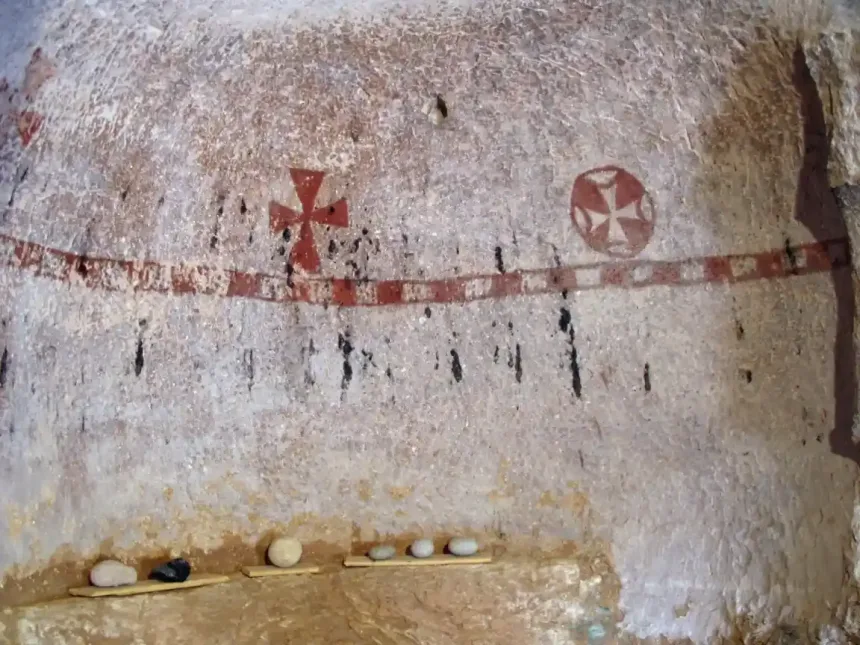
The lower decoration is dominated by red-painted crosses, lines and geometric forms.
These designs create a restrained visual environment compared with the richly painted upper church.
Crosses can appear independently, inside frames or as part of a larger decorative system.
Red lines may imitate architectural divisions, emphasize the apse or organize the wall surface.
Non-figurative decoration should not be dismissed as unfinished painting.
Symbolic programs could communicate Christian identity, protection and sacred order without a long narrative cycle.
Was the Lower Level Iconoclastic?
The restrained decoration is sometimes associated with an earlier symbolic tradition.
Crosses and non-figurative patterns were especially important during and around the Byzantine Iconoclastic periods.
However, decorative style alone should not be used to assign every lower surface to one exact iconoclastic date.
Some symbolic painting continued after figurative images returned to Byzantine church art.
The lower level is best described as preserving an earlier or more restrained decorative phase unless stronger church-specific evidence provides a precise date.
Wine Spaces and Agricultural Life
The lower complex includes spaces described as wine cellars or areas connected with wine storage.
Viticulture formed an important part of the rural economy of Cappadocia.
Religious communities could receive, produce, store or use wine for both daily and liturgical purposes.
A storage room should not automatically be called a complete winery unless pressing basins, collection channels and related features support that interpretation.
The presence of wine spaces does not reduce the sacred importance of the complex. Agricultural work and religious life were closely connected in medieval communities.
Rock-Cut Tombs
The lower level contains rock-cut tombs.
Burial close to a church connected the dead with prayer, worship and communal memory.
The tombs may have belonged to clergy, patrons, community members or other individuals associated with the monument.
Identity should not be invented when inscriptions or human remains do not provide secure evidence.
Visitors should not step into tombs, place objects inside them or use burial recesses as seats.
The Water Channel
A carved water channel demonstrates practical management within the complex.
Water could support cleaning, storage, food-related activity or the wider needs of the community.
The exact original function depends on the channel's direction, connected basins and relationship with other rooms.
A narrow carved groove should not automatically be identified as a ritual feature.
Later alterations may also have changed how water moved through the lower level.
Rooms for Attendants or Community Members
Several lower spaces are associated with people who supported the daily use of the complex.
Possible functions include rest, storage, supervision and practical work.
Shape alone cannot securely identify every room as a monk's cell or servant's chamber.
Later reuse may have changed entrances, floors and niches.
The safest interpretation considers how each room connects with the church, tombs, water channel and storage areas.
The Upper Church
The upper level served as the principal painted sanctuary.
Its walls and ceiling are covered with biblical figures, saints, medallions and narrative scenes.
The program brings together the life of Christ, Passion, Resurrection, warrior saints and sacred figures from the Old Testament.
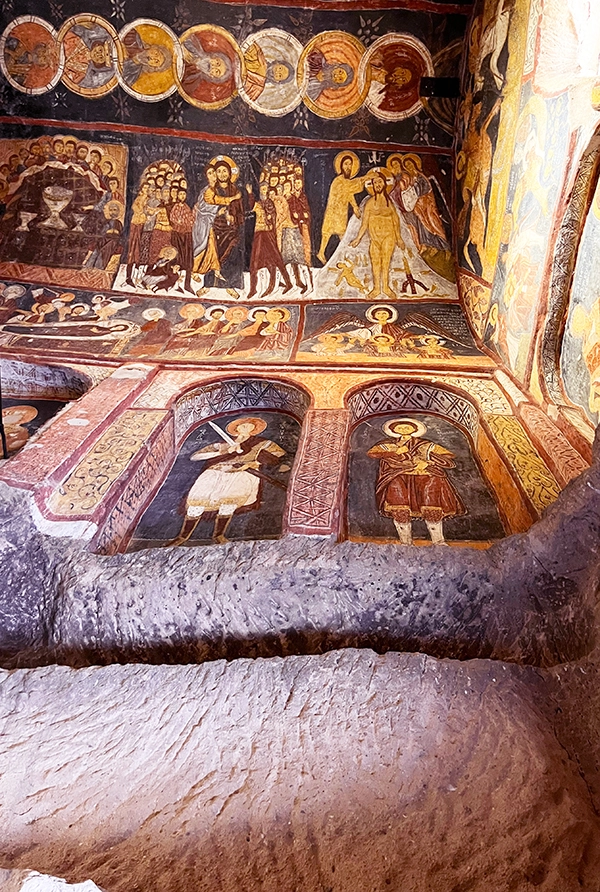
The paintings should not be read as unrelated panels.
The arrangement connects Christ's ministry and suffering with a longer sacred history represented by prophets, patriarchs and kings.
How to Read the Upper Church
Begin With the Apse
The apse provides the liturgical and chronological focus because it contains the dated inscription.
Identify its relationship with the main worship area before following the narrative scenes.
Move Through the Large Scenes
Begin with the Baptism, Last Supper, Betrayal, Crucifixion, Descent and Resurrection subjects.
Follow the movement from Christ's ministry toward the Passion and victory over death.
Look Up at the Medallions
The ceiling connects the New Testament scenes with figures including Abraham, Isaac, Jacob, Moses, David and Solomon.
These sacred ancestors provide historical and theological continuity.
Use Inscriptions
Greek inscriptions identify figures and scenes.
Damaged letters should be interpreted cautiously rather than silently reconstructed.
Main Frescoes on the Upper Level
Documented subjects include:
- The Baptism of Christ
- The Last Supper
- The Betrayal or Kiss of Judas
- The Crucifixion
- The Descent from the Cross
- The Resurrection
- Saint George confronting a dragon or serpent-like creature
- Saint Theodore confronting a dragon or serpent-like creature
- Medallions of biblical ancestors and rulers
The surviving program may include additional saints and supporting figures.
Surface loss and restoration can make some details easier to identify than others.
The Baptism of Christ
The Baptism is especially relevant to the identity of the church because Saint John the Baptist is the figure who baptizes Christ in the River Jordan.
Christ is normally shown standing in the water while John reaches toward him from the riverbank.
The Holy Spirit may appear above in the form of a dove.
Angels often wait at the side of the composition.
The scene marks the beginning of Christ's public ministry and presents John as the prophet who prepares the way.
How to Recognize the Baptism Scene
The river forms the central vertical or curved field around Christ.
John stands outside the water and reaches toward Christ's head.
Angels may hold cloths or stand in attendance.
A heavenly sign above Christ connects the earthly baptism with divine revelation.
Damage to the water or upper section can make the scene difficult to distinguish from another standing composition.
The Last Supper
The Last Supper presents Christ with the apostles around a shared table.
The scene connects fellowship, betrayal and the Christian understanding of the Eucharist.
Christ's position, the arrangement of the apostles and the table provide the main visual structure.
Judas may be distinguished through gesture or position, but a damaged figure should not be identified from one detail alone.
Food and vessels on the table contribute to the meaning of the meal without functioning as a realistic inventory.
The Betrayal or Kiss of Judas
The Betrayal presents the arrest of Christ after Judas identifies him with a kiss.
The central interaction between Christ and Judas is surrounded by soldiers and followers.
Crowded figures, weapons and opposing gestures create tension.
The scene follows the Last Supper within the Passion narrative.
Its composition should be read through the central kiss, Christ's calm posture and the movement of the arresting group.
The Crucifixion
The Crucifixion places Christ on the cross at the center of the composition.
The Virgin Mary, John and other witnesses may appear beside him.
The cross creates the principal vertical structure.
Gestures of grief and attention direct the viewer toward Christ.
The scene should be interpreted within the complete Passion and Resurrection sequence rather than as an isolated image of suffering.
The Descent From the Cross
The Descent from the Cross represents the removal of Christ's body after the Crucifixion.
Figures support the body, approach the cross or participate in mourning.
The composition changes the rigid vertical structure of the Crucifixion into a more physical and emotional scene.
Hands, ladders and the position of Christ's body help identify the subject.
Damage can remove supporting figures while leaving the central action visible.
The Resurrection
English-language descriptions may use Resurrection for a scene connected with Christ's victory over death.
In Byzantine painting, this is often represented through the Anastasis rather than Christ emerging from a sealed tomb.
Christ may be shown raising Adam and Eve while standing above broken gates and the defeated power of death.
The exact form visible at St. Jean should be identified from the surviving composition rather than assumed from the English title alone.
The scene completes the movement from betrayal and death toward salvation and victory.
Saint George and Saint Theodore
The upper church includes representations of the warrior saints George and Theodore.
Each confronts a dragon or serpent-like creature.
Mounted warrior saints were important protective figures in Byzantine Cappadocia.
Their victory symbolizes the triumph of faith and sacred order over evil, danger and chaos.
The paintings should not be treated as records of literal battles fought near Gülşehir.
How the Warrior Saint Scenes Work
The mounted position gives the saints visual authority.
Horses, weapons and the direction of movement lead attention toward the defeated creature.
Halos identify the riders as sacred figures rather than ordinary soldiers.
The dragon or serpent occupies a lower and vulnerable zone.
The composition communicates protection through movement, hierarchy and symbolic victory.
Ceiling Medallions
The ceiling contains medallions and representations associated with Abraham, Isaac, Jacob, Moses, Christ, David and Solomon.
Medallions create an ordered series of sacred figures above the narrative scenes.
The circular frames distinguish each figure while connecting them to one theological sequence.
Abraham, Isaac and Jacob represent patriarchal ancestry.
Moses represents law, prophecy and the covenant tradition.
David and Solomon connect royal and prophetic history with the Christian understanding of Christ.
Old and New Testament Continuity
The upper program brings together figures from the Old Testament and scenes from the life of Christ.
This arrangement presents Christian history as fulfillment rather than a separate story without earlier roots.
Patriarchs, prophets and kings prepare the theological framework for Christ's ministry, Passion and Resurrection.
The ceiling and walls should therefore be read together.
Looking only at the large New Testament scenes misses the longer sacred history represented above.
Saint John the Baptist
Saint John the Baptist is known in the Eastern Christian tradition as the Prodromos, meaning the Forerunner.
He preached repentance and prepared people for the ministry of Christ.
John baptized Christ in the River Jordan and directed his followers toward him.
He is commonly represented with disordered hair, an ascetic garment and a scroll.
His appearance communicates wilderness life, discipline and prophetic authority.
John's Preaching and Baptism
John called people to repentance and used baptism as a sign of moral and spiritual change.
His message addressed religious hypocrisy, exploitation and corruption.
People from different groups came to hear him and receive baptism.
In Christian interpretation, John's ministry prepares the public appearance of Christ.
The Baptism scene therefore connects the church's saintly identity with one of the central events in Christ's life.
John's Imprisonment and Death
The Gospel tradition describes John criticizing the marriage of Herod Antipas to Herodias.
He was imprisoned and later beheaded.
Later Christian tradition connects Herodias's daughter, often identified as Salome, with the request for John's execution.
The story establishes John as a prophet who accepts martyrdom rather than remaining silent about moral wrongdoing.
Recommended Tours for This Page
Popular experiences for this destination
Blue TourBlue Tour Cappadocia
Explore hidden valleys, ancient churches, and cultural gems on Cappado…
Vip Mix Tour Cappadocia
Experience the ultimate Cappadocia highlights in comfort-historic vall…
Green TourGreen Tour Cappadocia
Explore Derinkuyu underground city, the beautiful Ihlara Valley, and S…
Cappadocia Rent A Car
Explore Cappadocia freely at your own pace with flexible car rental op…
BalloonCappadocia Hot Air Balloon Tour
See Cappadocia from the air at sunrise on a professionally operated ho…
AdventureATV Tour Cappadocia
Ride powerful ATVs through Cappadocia’s unique valleys, fairy chimneys…
Red TourRed Tour Cappadocia
Discover Göreme Open-Air Museum, Avanos pottery workshops, and breatht…
AdventureHorseback Riding Tour Cappadocia
Experience Cappadocia on horseback, riding through valleys, hidden tra…
Turkish Night Show Cappadocia
Enjoy a traditional Turkish dinner with live music, folk dances, and w…
Professional Photo Shoot Cappadocia
Capture your Cappadocia moments with a guided professional photo shoot…
Airport Transfer Service Cappadocia
Travel comfortably and safely between Cappadocia’s airports and your h…
Classic Car Tour Cappadocia
Step into nostalgia with a vintage classic car ride through Cappadocia…
Details from later art and literature should not be confused automatically with the exact wording of the biblical accounts.
The Angel of the Desert
Because of his solitary and ascetic life, John is sometimes called the Angel of the Desert.
In some Byzantine paintings he is shown with wings.
The wings do not mean that John was believed to be an angel by nature.
They express his role as a divine messenger and his life of prayer, discipline and separation from worldly comfort.
A winged John should be distinguished from the Archangel Gabriel or Michael through inscription, clothing and the complete composition.
John the Baptist in Other Cappadocian Churches
Saint John appears throughout Cappadocian painting.
In a Baptism scene, he stands beside Christ in the Jordan.
In a Deisis, he approaches Christ in prayer and intercession.
As a solitary portrait, he may hold a scroll or appear with ascetic clothing.
Dark Church preserves John within its own later Byzantine fresco program.
Those images should not be presented as paintings inside St. Jean Church.
Lower and Upper Decorative Traditions Compared
| Feature | Lower Level | Upper Level |
|---|---|---|
| Visual Language | Red crosses, lines and geometric ornament | Figurative biblical painting and medallions |
| Main Functions | Worship, burial, storage and daily service | Principal painted sanctuary |
| Dating | Earlier or separate phase, exact date uncertain | Dated by inscription to 1212 |
| Visitor Focus | Symbolic decoration and complex use | Narrative sequence, inscriptions and sacred ancestors |
The contrast demonstrates how symbolic ornament and figurative storytelling could coexist within different phases of one rock-cut monument.
Architecture Carved Directly Into Rock
St. Jean Church was not constructed from separate stone blocks.
Rooms, apses, vaults, tombs and connecting spaces were created by removing material from the existing rock.
Rock-cut builders could imitate conventional Byzantine architecture without reproducing every structural requirement of masonry construction.
An arch or column carved inside solid rock may organize the interior visually even when it does not carry a freestanding stone wall above it.
The builders still needed to control wall thickness, floor height and the relationship between the two levels.
The Collapsed Floor and Ceiling
Part of the original separation between the lower and upper levels has collapsed.
This loss affects both architecture and interpretation.
The lower church no longer preserves its complete ceiling, while the upper church has lost part of its original floor relationship.
Visitors should not approach broken edges or cross barriers to understand the collapse more closely.
Structural monitoring may require temporary restrictions that are not obvious from a casual view.
How the Frescoes Were Made
The rock surface required preparation before detailed painting.
Plaster or related layers provided a smoother ground for outlines, color and inscriptions.
Painters organized the walls and ceiling according to architectural fields.
Large scenes, medallions, borders and individual saints could require different working methods.
The word fresco is widely used for Cappadocian wall paintings, although the exact application process may vary between surfaces and phases.
Color, Line and Visual Hierarchy
Color helps distinguish garments, figures and narrative fields.
Dark outlines define faces and movement.
Medallion borders separate sacred ancestors from the larger scenes below.
Scale and position communicate importance.
Christ and central sacred figures occupy dominant locations, while witnesses and secondary participants support the main event.
Color should not be interpreted alone. Inscription, gesture, architecture and biblical context provide stronger evidence.
Conservation History
The upper paintings have been affected by soot, graffiti, moisture and surface loss accumulated over many centuries.
Conservation work has helped recover colors and details that were previously difficult to see.
Cleaning does not recreate missing paint or make the surface new.
Conservators must distinguish original pigment from soot, later marks, repairs and unstable plaster.
The current appearance is the result of original painting, deterioration and careful intervention.
Why the Paintings Remain Fragile
Painted plaster depends on the stability of the rock beneath it.
Water entering cracks can weaken the bond between layers.
Temperature change can widen fractures.
Touching transfers oils and moisture to the surface.
Flash, strong artificial light, bags and tripods add unnecessary visitor pressure.
A restored fresco remains an original and vulnerable historic surface.
Photography and Responsible Visiting
- Do not use flash.
- Follow current signs when photography is prohibited.
- Do not touch frescoes, plaster, tombs or carved walls.
- Keep bags, coats and hair away from painted surfaces.
- Do not block the stairs or passage between levels.
- Do not use a tripod when it obstructs movement.
- Never move a barrier for a closer photograph.
- Keep voices low inside the upper church.
A brighter photograph is not more important than the survival of the painted program.
How to Examine the Upper Frescoes
- Allow your eyes time to adjust.
- Begin with the largest biblical scenes.
- Follow the Passion sequence in order.
- Look for names beside saints and principal figures.
- Examine the ceiling medallions after the wall scenes.
- Notice how gestures and gazes direct attention.
- Compare the upper color program with the lower red ornament.
- Stand where you do not block stairs or doorways.
Visitor Information
| Planning Point | Practical Guidance |
|---|---|
| Location | Near the entrance of Gülşehir in Nevşehir Province |
| Typical Visit | Approximately 45 to 75 minutes |
| Detailed Visit | Up to 90 minutes for both levels and fresco study |
| Opening Hours | Check the current official schedule and restoration notices |
| Admission | Confirm current ticket and Museum Pass conditions |
| Physical Conditions | Uneven rock, steps, narrow passages and dim interiors |
Final admission may occur before the listed closing time.
Seasonal schedules, public holidays, conservation work and official events can affect access.
Accessibility and Physical Conditions
The church contains changes in level, steps and narrow rock-cut spaces.
Full wheelchair access to both floors should not be assumed.
Visitors with limited mobility should confirm which sections are currently reachable.
Low light can affect visitors with visual or balance concerns.
Strollers are not practical between the two levels.
Older visitors should move slowly and use available hand support without touching painted walls.
Visiting With Children
Children can visit with close adult supervision.
- Keep children beside an adult on stairs.
- Do not allow entry into tombs or closed rooms.
- Keep hands away from frescoes and red-painted surfaces.
- Do not allow running near collapsed or uneven areas.
- Use quiet voices in the upper church.
- Explain that the site includes burial and sacred spaces.
The contrast between the two floors can be an effective way to explain how one monument changed over time.
Best Time to Visit
Early Morning
Early arrival often provides a quieter interior and more time to examine the upper medallions.
Midday
Midday light can create a strong contrast between the exterior and dim church.
Pause after entering rather than moving immediately toward the frescoes.
Late Afternoon
Late afternoon may be calmer, but final admission must be confirmed.
Do not leave the church until the final minutes when it is the main reason for the route.
Seasonal Planning
Spring
Mild weather suits a Gülşehir route, although rain can make exterior steps and rock surfaces slippery.
Summer
The rock-cut interior may feel cooler than the exterior.
Carry water when combining the church with Açık Saray or other outdoor monuments.
Autumn
Cooler conditions often suit a longer northern Cappadocia day.
Winter
Snow and ice can affect roads, entrances and exposed steps.
Check local road and site conditions before leaving central Cappadocia.
Combining St. Jean Church With Gülşehir
St. Jean works naturally with a focused Gülşehir route.
Açık Saray provides a contrasting landscape of carved facades, chambers and rock formations.
The town and nearby road stops can be included according to available daylight.
Do not combine too many distant sites only because they appear in the same northern direction.
Allow enough time to examine both levels rather than treating the church as a photograph stop.
Route Planning From Göreme
Travelers based in Göreme should treat Gülşehir as a separate regional outing.
The route can be completed by rental car, private driver or organized itinerary.
Review the guide to getting to and around Cappadocia when comparing transport options.
Agree on the waiting time when using a private driver or taxi.
Save the exact map point and current entrance before leaving the main road.
Rental Car, Taxi or Private Driver
Rental Car
A rental car provides flexibility for St. Jean, Gülşehir and Açık Saray.
Check parking and entrance signs on arrival rather than stopping at an informal roadside point.
Private Driver
A private driver is practical when the church is combined with several northern sites.
Agree on the complete route and realistic visit time in advance.
Taxi
Arrange the return or waiting time before entering.
A one-way drop-off without a confirmed pickup can create unnecessary delay.
St. Jean and Göreme Churches Compared
| Feature | St. Jean Church | Göreme Painted Churches |
|---|---|---|
| Main Character | Two levels with contrasting decoration | Several separate church complexes |
| Chronological Anchor | Upper fresco inscription dated 1212 | Dates often based on inscriptions, style and architecture |
| Practical Spaces | Wine areas, tombs, channel and community rooms | Varies between each complex |
| Best Visitor Focus | Comparison between lower and upper levels | Comparison between different churches |
The Göreme Open-Air Museum guide provides the strongest introduction to the main managed church route.
St. Jean adds a different perspective through its vertical organization and dated upper program.
Visiting With a Guide
A knowledgeable guide can explain the two floors, fresco sequence, ceiling medallions and the role of Saint John the Baptist.
A guide is especially useful for separating the 1212 upper program from the uncertain date of the lower level.
Ask whether enough time is allowed for both floors.
An itinerary that lists St. Jean among many distant stops may provide too little time for careful observation.
Detailed explanations should be given where the group does not block stairs or narrow passages.
Common St. Jean Church Planning Mistakes
- Calling the entire complex a 1212 construction: The inscription dates the upper painted program, not automatically every carved space.
- Skipping the lower floor: The contrast between the levels is central to the monument.
- Calling every practical room a wine cellar: Function should follow architectural evidence.
- Ignoring the ceiling medallions: They connect the Gospel scenes with earlier sacred history.
- Calling the lower level certainly iconoclastic: The exact date of the restrained decoration requires caution.
- Confusing John the Baptist with another Saint John: The Baptism and Forerunner context should be considered.
- Using flash: Current conservation rules must be followed.
- Touching restored frescoes: Conservation does not make the surface durable.
- Adding the church to an overloaded route: Both levels require time.
Questions Travelers Ask About St. Jean Church
Where is St. Jean Church?
It is located near the entrance of Gülşehir in Nevşehir Province.
Is St. Jean Church the same as Karşı Kilise?
The names are commonly used for the same two-level rock-cut monument.
Why is the church unusual?
It contains two vertically arranged levels with different functions and decorative programs.
What is on the lower level?
The lower section includes a simple church, red geometric decoration, tombs, a water channel and practical rooms.
What is on the upper level?
The upper church contains extensive biblical frescoes, saints, inscriptions and ceiling medallions.
What does the 1212 inscription date?
It is generally connected with the upper church and its painted decoration.
Does 1212 date the entire complex?
No. The lower carving and practical spaces may belong to different phases.
Which biblical scenes survive?
Documented subjects include the Baptism, Last Supper, Betrayal, Crucifixion, Descent from the Cross and Resurrection.
Which warrior saints appear?
Saint George and Saint Theodore are represented confronting dragon or serpent-like creatures.
Who appears in the ceiling medallions?
Figures associated with Abraham, Isaac, Jacob, Moses, Christ, David and Solomon are documented.
How long should you spend there?
Allow approximately 45 to 75 minutes, or up to 90 minutes for a detailed visit.
Can visitors take photographs?
Photography rules can change. Follow current signs and never use flash near frescoes.
Is the church wheelchair accessible?
Full access should not be assumed because the monument includes steps, narrow passages and two levels.
Can children visit?
Yes, with close supervision around stairs, tombs, frescoes and uneven surfaces.
Is a guide useful?
Yes. A guide can explain the chronology, architecture, fresco sequence and symbolic differences between the floors.
A Rare Two-Level Church in Cappadocia
St. Jean Church is important because its two levels preserve more than one chapter of religious and artistic history.
The lower floor combines worship, burial, practical rooms and restrained red decoration.
The upper church presents an extensive painted program dated by inscription to 1212.
Biblical narratives, warrior saints and ceiling medallions connect Christ's life with a longer sacred history.
The monument also demonstrates how a rock-cut complex could be expanded, reused, damaged and conserved across several periods.
For travelers who examine both floors rather than focusing only on the restored frescoes, St. Jean provides one of the clearest comparisons between symbolic ornament and later figurative painting in Cappadocia.
Use the Cappadocia trip planning guide and the Cappadocia safety and essentials guide when planning the Gülşehir route.