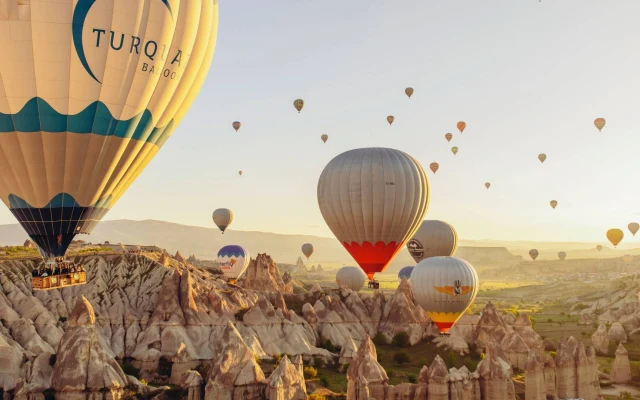
Uchisar Castle
Uçhisar Castle Cappadocia Visitor Guide
Uçhisar Castle is a natural volcanic rock mass that was gradually transformed into a multilevel settlement. Rooms, passages, storage spaces and shelters were carved into the formation during different periods. Rising above Uçhisar village, it provides one of the widest accessible panoramic views in central Cappadocia.
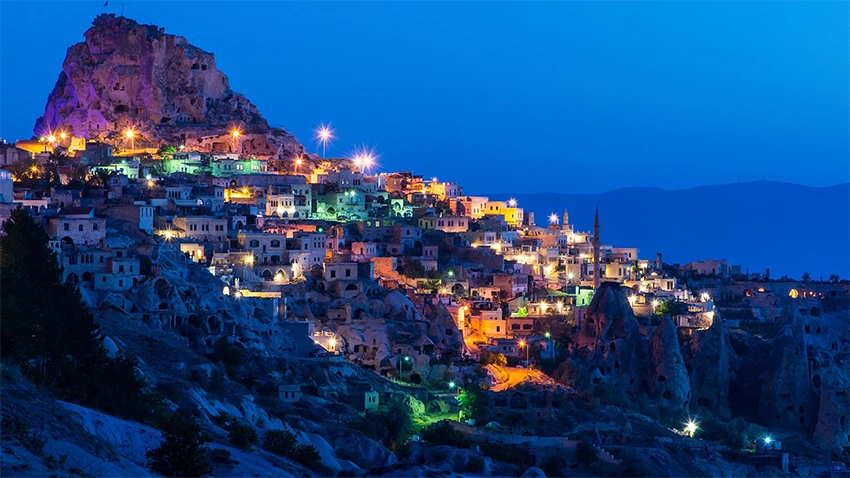
Despite its name, Uçhisar Castle is not a conventional fortress built from masonry walls. Nature created the main rock outcrop, while generations of residents hollowed out and adapted its interior.
Its elevated position supported observation, storage, shelter and settlement life. Today, the public route leads through selected rock-cut sections and repeated stairways before reaching the upper viewpoint.
A normal visit takes around 60 to 90 minutes, including the ascent, summit views, photographs and descent. Late afternoon is often the most comfortable period for the climb, but the upper platform can become crowded and windy near sunset.
Why Is Uçhisar Castle Famous?
Uçhisar Castle is known for three closely connected features:
- It dominates the skyline of Uçhisar and remains visible from many parts of central Cappadocia.
- Its carved rooms and openings show how communities adapted volcanic rock for practical use.
- Its summit gives visitors a broad view across villages, valleys, fairy chimneys and distant mountains.
The castle also makes Cappadocia's relationship between geology and settlement history easy to understand. The rock formation existed before human occupation, but its present appearance reflects centuries of carving, erosion, collapse, repair and reuse.
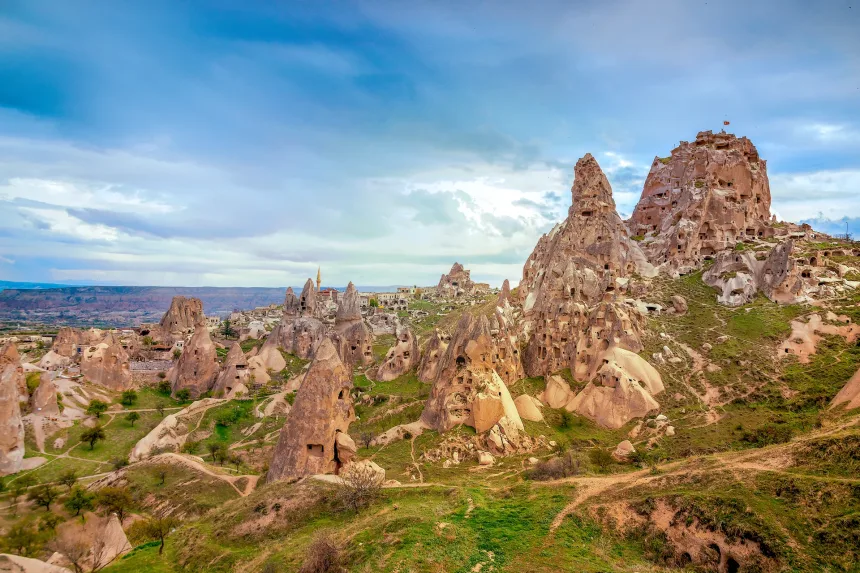
From below, the openings can appear random. A closer look reveals different levels, former rooms, narrow access points and connections with stone houses around the base. The formation and the old village should therefore be read as one settlement landscape rather than two separate attractions.
Is Uçhisar Castle the Highest Point in Cappadocia?
Uçhisar Castle is frequently described as the highest point in Cappadocia, but that statement needs geographical context.
It is one of the highest and most commanding public viewpoints within the central Cappadocia tourism area. Its summit rises clearly above Uçhisar village and opens toward the Göreme valleys, surrounding plateaus and distant volcanic mountains.
Cappadocia is a much wider region that contains mountain summits and high plateaus. Uçhisar Castle is therefore not the highest geographical point in the entire region.
A more accurate description is that it is one of the highest accessible panoramic viewpoints in central Cappadocia. This distinction avoids comparing a visitor attraction with mountains such as Erciyes and Hasan.
How Was Uçhisar Castle Formed?
The castle began as a natural mass of volcanic rock. Repeated eruptions deposited ash, pumice and other volcanic material across central Cappadocia. These deposits later consolidated into rock units that included tuff and ignimbrite.
Rainfall, concentrated surface runoff, temperature changes, gravity and wind gradually altered the plateau. Softer material was removed more quickly, while more resistant sections survived as ridges, cones and prominent isolated masses.
Uçhisar Castle should not be understood simply as one oversized fairy chimney. It is a complex eroded formation containing fractures, varied surfaces, rock layers and extensive carved sections.
The form seen today is not permanent. Water enters cracks, frost widens openings and gravity continues to weaken unsupported blocks. Human-made cavities can also change how weight is distributed inside the rock.
The guide to the formation of Cappadocia's fairy chimneys explains volcanic deposits, differential erosion and the development of the region's landforms in greater detail.
Was Uçhisar Castle Built by People?
The main exterior formation is natural, but much of its interior was modified by people.
Residents carved rooms, passages, niches, storage spaces and practical openings into the rock. Some chambers were enlarged over time, while others were connected with stone-built houses and working areas around the lower slopes.
This mixed building method is common in Cappadocia. A space may begin inside a carved rock chamber and continue into a masonry section constructed outside it. The result is neither entirely natural nor entirely built.
Erosion has exposed some rooms that were once enclosed. Openings visible high on the formation may therefore represent the remains of interior spaces rather than windows designed to face the open air.
The present visitor route covers only a small and maintained part of this larger network. Many spaces are closed because they are inaccessible, blocked, collapsed or structurally unsafe.
History of Uçhisar Castle
Uçhisar Castle does not have one simple construction date. It was not completed during a single building campaign, and its rooms were not all carved by one community.
The wider Cappadocia region was inhabited through antiquity, the Byzantine centuries, the Seljuk period and the Ottoman era. Spaces within and around the castle were reused and altered, which makes it difficult to assign every chamber to one precise period.
Later carving may have removed earlier evidence. Erosion and collapse have also changed the original relationship between rooms, passages and exterior buildings.
The position of the formation provided several practical advantages:
- A wide field of observation across routes, settlements and valleys
- Elevated spaces with approaches that were easier to observe
- Rock-cut rooms suitable for storage and temporary shelter
- Connections with houses, courtyards, stables and work areas below
- A prominent landmark that helped organize the surrounding settlement
The word hisar means fortress or citadel in Turkish. The name reflects the defensive character associated with the formation, but it does not mean that every room was military or that the entire rock was created in one historical period.
Descriptions that attribute the whole castle to a single civilization should be treated cautiously. Its importance comes from long-term use, adaptation and reuse rather than one confirmed founding date.
What Was Uçhisar Castle Used For?
The castle was not used only as a military lookout. Its carved spaces supported observation, storage, shelter, agricultural work and parts of everyday settlement life.
Related Tours
Popular experiences for this destination
Professional Photo Shoot Cappadocia
Capture your Cappadocia moments with a guided professional photo shoot…
 Adventure
Trekking Tours Cappadocia
Hike Cappadocia’s spectacular valleys, fairy chimneys, and cave dwelli…
 Red Tour
Red Tour Cappadocia
Discover Göreme Open-Air Museum, Avanos pottery workshops, and breatht…
 Adventure
Horseback Riding Tour Cappadocia
Experience Cappadocia on horseback, riding through valleys, hidden tra…

Classic Car Tour Cappadocia
Step into nostalgia with a vintage classic car ride through Cappadocia…
 Balloon
Balloon Watching Tour Cappadocia
Watch the magical sight of hundreds of hot air balloons rising at sunr…

Nostalgic Electric Car Tour Cappadocia
Ride eco-friendly nostalgic electric cars through Cappadocia’s valleys…
 Adventure
ATV Tour Cappadocia
Ride powerful ATVs through Cappadocia’s unique valleys, fairy chimneys…

Pottery Workshop Cappadocia
Learn the ancient art of pottery from Avanos masters, try shaping clay…
Vip Mix Tour Cappadocia
Experience the ultimate Cappadocia highlights in comfort-historic vall…
 Green Tour
Green Tour Cappadocia
Explore Derinkuyu underground city, the beautiful Ihlara Valley, and S…

Airport Transfer Service Cappadocia
Travel comfortably and safely between Cappadocia’s airports and your h…
Observation and Communication
The elevated position allowed activity across the surrounding landscape to be observed more easily. Routes approaching the settlement, neighboring ridges and parts of the valley system could be monitored from above.
Elevated points may also have supported visual communication during periods of insecurity, although the exact signaling arrangements and dates are not securely documented.
Shelter and Protection
Rock-cut chambers provided enclosed spaces that could be used when greater protection was needed. Narrow approaches and the height of the formation made movement easier to observe and control than in an open settlement.
This does not mean that the castle functioned as an underground city. Its spaces were arranged vertically within a surface rock mass and remained connected with the settlement around its base.
Food and Agricultural Storage
Rock chambers generally maintain more stable temperatures than exposed outdoor spaces. Rooms could be used for grain, dried food, grapes, wine and other agricultural products.
Storage was especially important in a region where vineyards, orchards and seasonal production shaped daily life. Cool rock-cut rooms could support both household use and longer-term preservation.
Living and Working Spaces
Some carved areas formed part of domestic or working environments. Lower chambers were integrated with houses, courtyards, stables and storerooms around the formation.
Look at the lower streets rather than focusing only on the summit. The transition between carved rock and cut-stone construction is easier to recognize around the base.
Pigeon Houses
Pigeon houses were carved into cliffs around Uçhisar and nearby Pigeon Valley. Their openings were designed to attract and shelter birds.
The manure collected from these houses was used as fertilizer in vineyards, orchards and agricultural fields. The pigeon houses therefore belonged to the working landscape rather than serving only as decoration.
Inside Uçhisar Castle
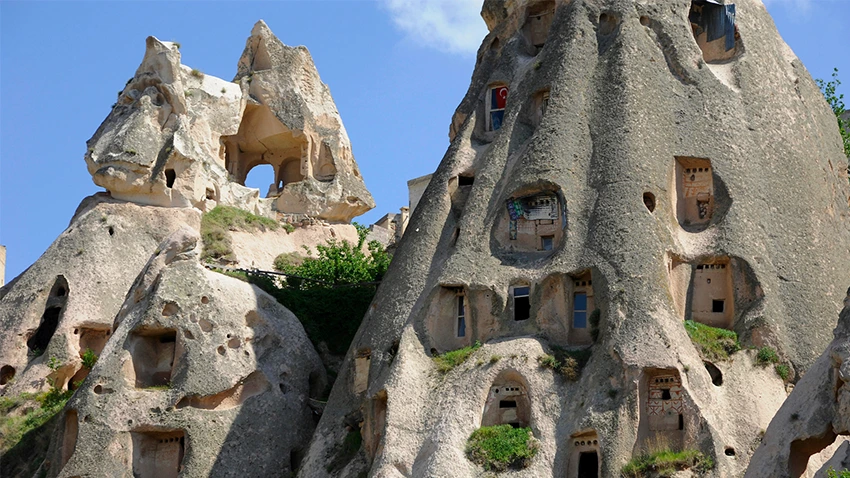
The accessible interior includes carved spaces, narrow passages, steps and openings at different levels. Some sections feel cooler and darker than the exposed stairs outside.
Do not expect a complete network of furnished historical rooms. Much of the original interior cannot be entered, and the visitor experience is centered on the climb and the relationship between the rock and the surrounding landscape.
Erosion has opened some former chambers to the outside. Other rooms have collapsed, while passages that once connected different levels may now be blocked.
The maintained route changes between carved stone steps, constructed staircases and open sections attached to the rock. Follow the current direction signs and do not enter unmarked cavities, even when they appear easy to reach.
Low light, narrow points and visitors moving in opposite directions can create short delays. Keep bags close to the body and avoid stopping in places where the route is too narrow for others to pass.
How Many Steps Are There at Uçhisar Castle?
Published step counts vary because people begin counting from different points and may include different stair sections.
Planning around one exact number is less useful than preparing for several hundred steps. The route includes repeated stairways, uneven surfaces and exposed upper sections.
Some parts of the climb pass through cooler rock-cut spaces. Higher sections receive more sunlight and wind, and the last part can feel tiring because the summit appears close before the final stairways are complete.
The ascent is manageable for many visitors who are comfortable with regular walking. It becomes more demanding during summer heat, strong wind or crowded periods.
Pause where the route widens rather than stopping on a narrow staircase. Carry water, but avoid large bags that make movement difficult inside tight sections.
What Can You See From the Summit?
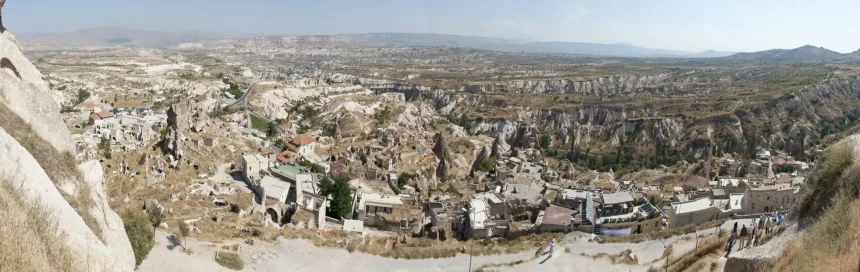
The summit provides a broad view across central Cappadocia. Visibility depends on cloud cover, atmospheric haze, season and the direction of the sunlight.
Depending on conditions, the panorama may include:
- Uçhisar village and its historic stone houses
- Pigeon Valley extending toward Göreme
- The ridges and formations around Love Valley
- The Göreme valley system and surrounding plateaus
- Rock formations near Çavuşin and the northern valleys
- Mount Erciyes on a clear distant horizon
- Hot-air balloons when wind and flight routes bring them into view
The viewpoint is especially useful for understanding how the central valleys connect. Locations that seem separate when reached by road become parts of one larger erosion system when seen from above.
Do not expect every named attraction to be clearly visible on every day. Heat haze, cloud, dust and backlighting can reduce long-distance detail.
Wind warning: The summit is much more exposed than the village streets. Secure hats, sunglasses, scarves, phones and lightweight camera equipment before reaching the highest platform.
A light outer layer is useful near sunset during spring and autumn. Wind can make the summit feel cold even when the lower streets remain comfortable.
Can You See Hot-Air Balloons From Uçhisar Castle?
Hot-air balloons are sometimes visible from Uçhisar, particularly from terraces and viewpoints facing the Göreme valleys.
Flight paths change with wind direction and operating conditions. Balloons do not follow one fixed route, and some mornings they remain far from the castle.
The public opening time creates another limitation. Balloon operations take place around sunrise, while summit access may begin after many flights have already landed.
This is a common planning mistake. The castle appears to be an ideal sunrise platform on a map, but nearby terraces and public observation areas may be more practical during balloon hours.
Travelers whose main goal is ground-based balloon photography can compare those options with a Cappadocia balloon watching tour.
The Cappadocia hot-air balloon guide explains flight approval, weather conditions, cancellation risks and the best way to schedule a balloon experience.
Sunrise or Sunset: Which Is Better?
Sunrise
Sunrise brings cooler temperatures, softer light and a chance of seeing balloons over parts of the valley system.
The summit may not be open early enough for the flight period. Check the current access time rather than assuming that the entrance operates before dawn.
Even when the castle is closed, streets, terraces and observation points around Uçhisar can provide wide early-morning views toward Göreme.
Photographers should choose a legal public position before the light changes. Driving between several viewpoints during the short balloon period often wastes more time than it saves.
Late Afternoon
Late afternoon is usually the most practical time for climbing. Temperatures begin to fall, side light reveals the carved openings and the rock surface becomes easier to photograph.
This period is popular. Arriving before the main sunset rush gives more time to climb slowly and find space at the summit.
The warmest light may fall on the exterior of the castle rather than on the landscape seen from the top. Decide whether the priority is the panorama or a photograph of the illuminated rock formation.
Sunset
Sunset can produce cream, gold, orange and reddish tones across the castle and surrounding ridges. Reach the entrance early enough to complete the climb before the strongest light.
The upper platform becomes crowded during busy travel periods. Narrow final stairways may also slow the descent when many visitors leave at the same time.
Some of the strongest sunset views are available from the village streets and terraces below. From these positions, the castle itself becomes the subject instead of the viewpoint.
Closing procedures vary with season and local decisions. Do not assume that visitors may remain at the summit after dark.
Best Time of Year to Visit Uçhisar Castle
Spring
April and May generally provide comfortable climbing temperatures. Rain can make exposed stairs, metal sections and polished stone slippery.
Weather changes quickly in spring. A calm village street does not guarantee calm conditions at the summit, so carry a light layer.
Summer
June, July and August can be hot, particularly around midday. Visit earlier or later in the day, carry drinking water and use sun protection.
Shade becomes limited on the upper route. Heat reflected from the rock and stairways can make the climb feel more demanding than the distance suggests.
Avoid beginning the ascent when already tired from a long valley hike. The repeated steps and exposed final section require more energy than a short viewpoint stop.
Autumn
September and October often bring clear views, comfortable daytime conditions and warm afternoon light.
Evenings become cooler as the season progresses. The summit can feel windy long before the streets below become cold.
Winter
Snow changes the appearance of Uçhisar and can make the carved openings stand out clearly against the pale landscape.
Ice may make the summit route unsafe. Shaded stairs can remain frozen after village roads have cleared, and access may be restricted during strong wind or severe weather.
Do not treat a temporary closure as an inconvenience to work around. Rock surfaces and exposed stairways can become dangerous very quickly in winter conditions.
How Long Do You Need at Uçhisar Castle?
Allow approximately 60 to 90 minutes for the castle itself. This normally covers the ascent, summit views, photographs and descent.
Allow additional time when:
- The entrance or upper stairways are crowded
- You prefer to climb slowly and take regular breaks
- You want to photograph changing late-afternoon light
- You plan to walk through the old streets below the castle
- You are combining the visit with Pigeon Valley
- You need time for cafés, terraces or shopping in Uçhisar
A rushed visit can be completed more quickly, but reaching the highest platform is not the only reason to come. The lower streets reveal the scale of the rock, its connections with houses and the way settlement life developed around it.
Travelers combining the castle with a full Pigeon Valley walk should treat the valley as a separate activity. The complete route requires additional daylight, water and return planning.
Related Tours
Popular experiences for this destination
Professional Photo Shoot Cappadocia
Capture your Cappadocia moments with a guided professional photo shoot…
AdventureTrekking Tours Cappadocia
Hike Cappadocia’s spectacular valleys, fairy chimneys, and cave dwelli…
Red TourRed Tour Cappadocia
Discover Göreme Open-Air Museum, Avanos pottery workshops, and breatht…
AdventureHorseback Riding Tour Cappadocia
Experience Cappadocia on horseback, riding through valleys, hidden tra…
Classic Car Tour Cappadocia
Step into nostalgia with a vintage classic car ride through Cappadocia…
BalloonBalloon Watching Tour Cappadocia
Watch the magical sight of hundreds of hot air balloons rising at sunr…
Nostalgic Electric Car Tour Cappadocia
Ride eco-friendly nostalgic electric cars through Cappadocia’s valleys…
AdventureATV Tour Cappadocia
Ride powerful ATVs through Cappadocia’s unique valleys, fairy chimneys…
Pottery Workshop Cappadocia
Learn the ancient art of pottery from Avanos masters, try shaping clay…
Vip Mix Tour Cappadocia
Experience the ultimate Cappadocia highlights in comfort-historic vall…
Green TourGreen Tour Cappadocia
Explore Derinkuyu underground city, the beautiful Ihlara Valley, and S…
Airport Transfer Service Cappadocia
Travel comfortably and safely between Cappadocia’s airports and your h…
Is Uçhisar Castle Difficult to Climb?
The climb does not require technical hiking skills, but it includes repeated stairs, uneven surfaces, confined sections and exposed viewpoints.
The summit route may be unsuitable for:
- Wheelchair users
- Visitors who cannot manage repeated stairways
- People with serious knee, balance, heart or breathing problems
- Travelers who are very uncomfortable with heights
- Very young children without continuous adult supervision
The descent can place more pressure on the knees than the ascent. Move slowly, use handrails where available and allow faster visitors to pass only where the route is wide enough.
Strong wind can make the final platform uncomfortable for people with balance concerns. Avoid leaning over barriers or stepping backward while taking photographs.
Travelers who cannot reach the summit can still appreciate the castle from village streets, restaurants and terraces. Several lower viewpoints provide a clearer understanding of the formation's full height than the summit itself.
Safety and Conservation
Uçhisar Castle is a historic rock-cut formation affected by weathering, fractures, rain, frost and gravity. Its surfaces should not be treated like modern concrete or engineered masonry.
- Remain on the designated public route.
- Do not enter closed rooms, chambers or unmarked passages.
- Do not climb onto ledges, barriers or fragile rock surfaces.
- Keep children close on exposed stairs and platforms.
- Wear shoes with reliable grip.
- Avoid the summit during thunderstorms, ice or very strong wind.
- Respect temporary closures and staff instructions.
- Do not carve, scratch or remove material from the rock.
- Keep phones, hats and camera accessories secure at the summit.
Fractures and geological discontinuities can create rockfall and block-slide risks in surface settlements such as Uçhisar. Openings carved too close together or weakened over time may also affect stability.
Temporary nets, barriers and closed spaces are protective measures. They allow visitors to use a maintained route without exposing unstable sections to further pressure.
Do not follow other visitors into a closed area simply because an opening appears passable. Conditions inside the rock cannot be judged reliably from the entrance.
The broader Cappadocia essentials and safety guide covers weather, walking conditions and practical precautions for regional travel.
Uçhisar Castle and Pigeon Valley
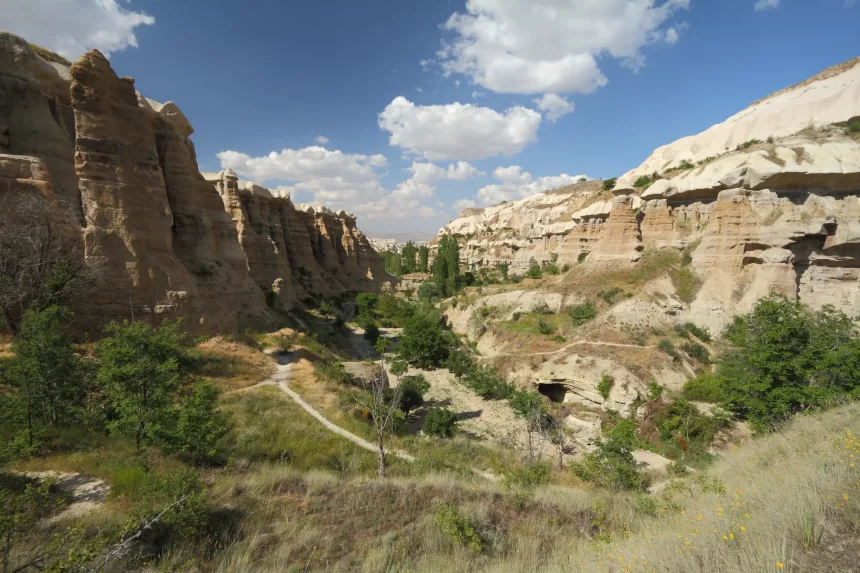
Pigeon Valley, known in Turkish as Güvercinlik Valley, extends between Uçhisar and Göreme. Its cliffs contain many pigeon houses carved into the rock.
The valley can be explored before or after the castle, but the full walk requires considerably more time than a short panoramic stop.
Trail conditions change after rain, snow, erosion and maintenance work. Paths may divide around orchards and rock formations, so download an offline route before entering.
Do not assume that every path beginning below Uçhisar leads directly to central Göreme. Some tracks end at agricultural land, climb toward a different road or become unclear inside the valley.
Carry sufficient water and begin with enough daylight for the full route. The walking surface includes dust, loose stone, slopes and uneven sections.
A practical plan is to visit the castle first, then decide whether time, weather and energy still support the valley walk. Starting both late in the afternoon can create a rushed finish or leave travelers without a convenient return option.
A guided Cappadocia trekking tour is useful when visitors want route support and interpretation of the pigeon houses, geology and agricultural landscape.
How to Get to Uçhisar Castle
From Göreme
Uçhisar is a short road journey west of Göreme. Travelers commonly arrive by taxi, rental car, local minibus, private transfer or organized tour.
Walking between the settlements by road is not the same as hiking through Pigeon Valley. Traffic, gradients, weather and the lack of continuous pedestrian space should be considered.
The valley route is more scenic but takes longer and ends at a different level from some roads and viewpoints. Confirm where the trail exits before using it as transportation to a timed visit.
From Nevşehir
Uçhisar lies east of Nevşehir on the route toward central Cappadocia. Local transport services operate between settlements, but schedules and stopping points may change.
Ask where to leave the vehicle for the castle rather than assuming every service continues into the old streets near the entrance.
By Rental Car
Drivers can reach Uçhisar from the main regional roads. Parking close to the castle may be limited during busy periods, and several old village streets are narrow.
Parking lower in the village and walking uphill can be easier than trying to reach the closest possible point. This approach also provides useful exterior views of the castle.
Do not block narrow roads or hotel entrances while waiting for a parking space. Local traffic and tour vehicles need room to turn.
Use the guide to getting to and around Cappadocia when comparing local minibuses, taxis, tours and rental cars.
Opening Hours and Entrance Fee
Opening hours and admission charges may change according to season, weather, maintenance work and local administrative decisions.
Old travel articles containing fixed prices should not be treated as current information. Check the information displayed at the entrance or a recent official local announcement before visiting.
Access may close temporarily because of:
- Snow or ice on the visitor route
- Strong wind or thunderstorms
- Maintenance and repair work
- Rock stability inspections
- Special events or local restrictions
Do not assume that a museum pass, student discount or previously published admission price remains valid. Uçhisar Castle may use a locally managed ticket arrangement rather than the same system as national museums.
Sunrise visitors should pay particular attention to opening times. Balloon flights may end before the summit route begins admitting visitors.
Near closing time, staff may begin clearing the upper route before the entrance itself closes. Arrive with enough time for both the ascent and descent rather than planning only around the final admission minute.
Facilities Around the Castle
The streets around the lower entrance contain cafés, restaurants, small shops and terraces overlooking the village and surrounding valleys.
Facilities become more limited after beginning the summit route. Use the restroom, carry drinking water and organize personal belongings before entering.
Large backpacks can be uncomfortable on narrow and crowded stairways. Carry only essential items when possible and keep both hands available on steeper sections.
The lower village deserves time of its own. Historic streets provide close views of cut-stone houses, carved rooms and the base of the formation that cannot be appreciated from above.
Travelers who do not climb can still use cafés and terraces as alternative viewpoints. Ask about steps and road access when mobility is limited, because some village lanes are steep.
Photography Tips
- Photograph the castle from below: Include stone houses or people to show the scale of the rock mass.
- Use late-afternoon side light: It reveals carved openings, fractures and surface texture.
- Choose the subject before sunset: The summit gives a panorama, while the village below gives the best view of the illuminated castle exterior.
- Protect bright areas: Pale rock and open sky can become overexposed.
- Use a wide lens at the summit: The surrounding landscape extends across a broad field of view.
- Keep equipment secure: Wind is often much stronger at the upper viewpoint.
- Avoid blocking the stairs: Move to a wider platform before stopping for photographs.
- Check drone rules: Protected zones, aviation requirements and local security restrictions may apply.
Do not assume that seeing an aerial photograph online means recreational drone use is automatically permitted. Confirm current rules before carrying or launching a drone near the castle.
For exterior photographs, move through the village and compare different elevations. A position directly below emphasizes height, while a more distant terrace shows how the formation rises above the settlement.
At the summit, avoid stepping backward while composing a photograph. Crowds, wind and uneven surfaces make this a common safety risk.
Places to Visit Near Uçhisar Castle
Pigeon Valley
Pigeon Valley links the Uçhisar and Göreme landscapes through a route lined with pigeon houses, orchards and eroded cliffs.
A short panorama stop is easy to combine with the castle. The full walk needs separate timing, footwear and return planning.
Göreme
Göreme provides cave hotels, restaurants, sunrise viewpoints and access to several central Cappadocia valleys.
Uçhisar is generally quieter in the evening, while Göreme places more restaurants and tour services within a compact center.
Göreme Open-Air Museum
The Göreme Open-Air Museum contains rock-cut churches, monastic spaces and major examples of Byzantine painting.
Combining the museum and Uçhisar Castle creates a useful contrast between religious interiors and a high settlement viewpoint. Visit the museum earlier in the day when possible, then climb the castle after the heat begins to decrease.
Love Valley
Love Valley is known for tall pillar-shaped formations and separate upper panorama and lower walking routes.
Confirm which section is included in a tour. The viewpoint and the valley floor are not the same stop.
Rose and Red Valleys
The Rose and Red Valleys contain walking routes, rock-cut churches and colored slopes that become more visible in late-afternoon light.
Do not schedule a long valley hike and the castle summit for the same sunset period. Choose one primary viewpoint and allow enough time to reach it safely.
Uçhisar Castle and nearby Pigeon Valley can be included in a private Cappadocia Mix Tour. A private route is useful when travelers want a slower climb, a short valley walk or timing adjusted around late-afternoon light.
Exact stops, entrance fees, lunch arrangements and time at each location should be confirmed before booking.
Frequently Asked Questions About Uçhisar Castle
Is Uçhisar Castle worth visiting?
Yes. It combines a rock-cut settlement with one of the widest accessible views in central Cappadocia. It is especially useful for first-time visitors who want to understand how the main valleys and villages connect.
Is Uçhisar Castle a real castle?
It is not a conventional fortress constructed entirely from stone walls. It is a natural rock formation whose interior was carved and used for observation, shelter, storage and settlement life.
How many steps are there at Uçhisar Castle?
Counts vary according to the starting point and sections included. Prepare for several hundred steps rather than relying on one fixed total.
How long does it take to visit Uçhisar Castle?
Allow approximately 60 to 90 minutes for the ascent, summit views, photographs and descent. Crowds and weather can increase the time required.
Can you see hot-air balloons from Uçhisar Castle?
Balloons may be visible when the wind carries them toward nearby valleys. Their route changes daily, and summit access may begin after the flights have ended.
Is Uçhisar Castle accessible for wheelchair users?
The summit route contains steep and uneven stairways and is not wheelchair accessible. The castle can still be viewed from more accessible streets and terraces around the village.
Is Pigeon Valley close to Uçhisar Castle?
Yes. Pigeon Valley begins in the Uçhisar area and extends toward Göreme. The full walking route should be planned separately from the castle visit.
What is the best time to visit Uçhisar Castle?
Late afternoon usually provides comfortable climbing conditions and stronger surface texture. Sunrise is cooler, but the summit may not open early enough for balloon flights.
Is the summit windy?
Yes. The summit is exposed, and wind can be much stronger than in the streets below. Secure loose belongings and carry a light layer near sunset.
Can visitors explore all the tunnels inside the castle?
No. Only a limited maintained route is open. Many rooms and passages are blocked, collapsed, inaccessible or unsafe.
Can you fly a drone around Uçhisar Castle?
Drone use may be restricted by aviation rules, protected-area regulations and local security decisions. Confirm current permission requirements before attempting a flight.
How to Include Uçhisar Castle in Your Cappadocia Itinerary
Uçhisar Castle provides more than a high viewpoint. It shows how communities transformed a natural volcanic formation into a layered environment for observation, storage, shelter, agriculture and daily life.
The summit places the central region into perspective. Valleys that seem disconnected by road become parts of one continuous landscape, with villages, vineyards, carved cliffs and fairy chimneys extending toward the horizon.
The castle is most rewarding when the visit also includes the lower village. Stone houses, terraces, carved rooms and the entrance to Pigeon Valley explain how the formation remained connected with everyday settlement life.
For a balanced plan, visit the Göreme Open-Air Museum earlier in the day and reserve Uçhisar Castle for the late afternoon. Travelers planning a full valley walk should place it on a separate morning or begin early enough to finish before sunset.
Include the castle in a wider Cappadocia trip plan, but leave enough time for old Uçhisar and Pigeon Valley instead of treating the site as a quick summit photograph.