El Nazar Church
El Nazar Church in Göreme
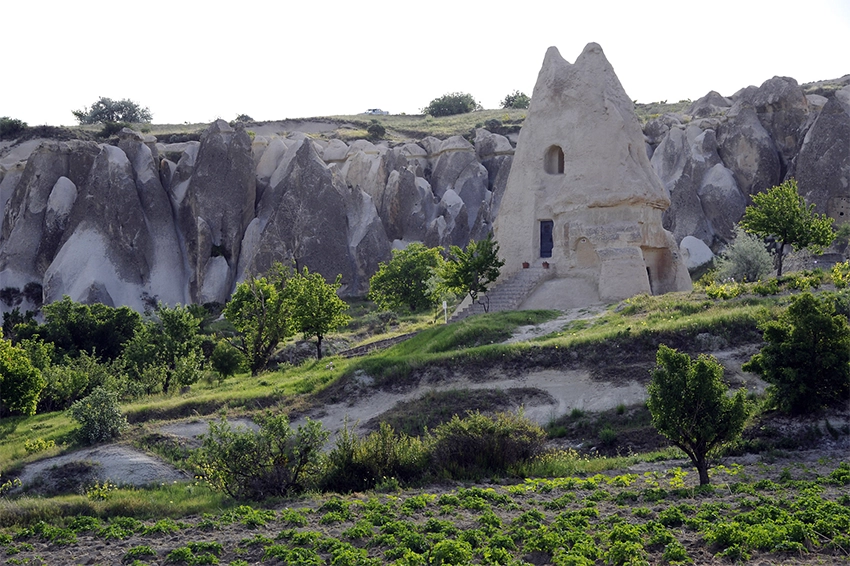
El Nazar Church is a small 10th-century Byzantine sanctuary carved into a freestanding volcanic cone near Göreme. Its unusual exterior, compact cross-plan interior and surviving frescoes make it one of the most distinctive rock-cut churches outside the main Göreme Open-Air Museum route.
The church belongs to the wider cultural landscape of Cappadocia, where volcanic formations were adapted into churches, chapels, homes, burial spaces and monastic complexes during the Byzantine period.
Most visitors should allow approximately 30 to 60 minutes for the church, its exterior and the immediate landscape. The complete outing may take longer because the approach route, ticket process and current access conditions can vary.
El Nazar is outside the enclosed museum circuit and should be planned as a separate stop. Do not assume that museum admission, the Museum Pass or an old access arrangement automatically applies.
How to Plan a First Visit
Confirm the current opening and access conditions before leaving Göreme. El Nazar has been affected by erosion, and conservation needs can change the visitor route without long advance notice.
Use the exact El Nazar Church map point rather than a general church marker. Several rock-cut monuments and informal paths exist around the Göreme landscape.
Wear shoes with reliable grip. The final approach may include dust, loose volcanic soil, mud, worn rock or uneven ground.
Carry only a small bag and the equipment needed for a short visit. Large backpacks, tripods and loose straps are difficult to manage inside a compact painted church.
Allow your eyes time to adjust after entering. Bright sunlight outside can make the frescoes appear less detailed during the first moments.
Use the church as a focused addition to a Göreme day rather than building an entire half-day around one compact interior.
El Nazar Church at a Glance
| Feature | Practical Meaning | What to Notice |
|---|---|---|
| Date | Generally associated with the 10th century | Post-iconoclastic figurative painting |
| Setting | Freestanding volcanic cone outside the museum enclosure | The relationship between natural form and carved architecture |
| Plan | Compact cross-plan sanctuary with an eastern apse | How the carved arms and vaults organize the fresco cycle |
| Visit Time | Approximately 30 to 60 minutes | Exterior, architecture, frescoes and route conditions |
The date and plan provide a visitor framework. Repairs, erosion and lost sections can make the original arrangement harder to read today.
Why El Nazar Church Is Different
Many Cappadocian churches were cut into large cliff faces or valley walls. El Nazar was carved inside a freestanding cone, allowing the natural formation to become the exterior shell of the sanctuary.
The relationship between geology and architecture is especially clear from outside. The cone appears almost complete until its entrance and damaged openings reveal the carved interior.
The church was not built inside an empty natural cave. Builders removed rock to create a planned worship space with a central area, cross arms, vaults and an eastern sanctuary.
Its compact form also makes natural damage more consequential. Loss from one side of the cone can affect both the exterior profile and the painted interior.
Visitors should examine the formation from a safe distance before entering. The exterior explains why conservation of the church depends on both architectural and geological stability.
What Does the Name El Nazar Mean?
El Nazar is often translated in tourism material as Evil Eye Church.
The exact historical reason for the name remains uncertain.
It should not automatically be presented as the original Byzantine dedication or as proof that the church was connected with an evil-eye ritual.
Rock-cut churches can acquire modern names from local stories, nearby landscape features, a surviving image or the need to distinguish one monument from another.
Without a secure dedicatory inscription or historical record, the original medieval title should remain uncertain.
History of El Nazar Church
El Nazar Church and its principal painted decoration are generally dated to the 10th century.
This places the monument within the post-iconoclastic development of Byzantine religious art in the Göreme Valley.
After the end of Byzantine Iconoclasm in 843, churches across Cappadocia were increasingly decorated with figurative paintings of Christ, the Virgin Mary, apostles, saints and biblical events.
El Nazar formed part of this wider artistic and religious environment.
The church should not be described as an isolated refuge created only for protection. Its plan and painting program identify it primarily as a place of Christian worship.
It may have belonged to a small religious or settlement network around Göreme, but the precise community, patrons and original dedication should not be invented when documentation is incomplete.
The guide to Christian history in Cappadocia explains the wider development of rock-cut churches, monastic communities and Byzantine painting.
Post-Iconoclastic Byzantine Art
The 10th-century dating is important because El Nazar belongs to a period when figurative religious painting had become central again in Byzantine church interiors.
Related Tours
Popular experiences for this destination
 Red Tour
Red Tour Cappadocia
Discover Göreme Open-Air Museum, Avanos pottery workshops, and breatht…
 Adventure
Trekking Tours Cappadocia
Hike Cappadocia’s spectacular valleys, fairy chimneys, and cave dwelli…
 Adventure
ATV Tour Cappadocia
Ride powerful ATVs through Cappadocia’s unique valleys, fairy chimneys…
 Adventure
Horseback Riding Tour Cappadocia
Experience Cappadocia on horseback, riding through valleys, hidden tra…
Pottery Workshop Cappadocia
Learn the ancient art of pottery from Avanos masters, try shaping clay…
Vip Mix Tour Cappadocia
Experience the ultimate Cappadocia highlights in comfort-historic vall…
Professional Photo Shoot Cappadocia
Capture your Cappadocia moments with a guided professional photo shoot…

Classic Car Tour Cappadocia
Step into nostalgia with a vintage classic car ride through Cappadocia…
 Blue Tour
Blue Tour Cappadocia
Explore hidden valleys, ancient churches, and cultural gems on Cappado…
Turkish Night Show Cappadocia
Enjoy a traditional Turkish dinner with live music, folk dances, and w…

Airport Transfer Service Cappadocia
Travel comfortably and safely between Cappadocia’s airports and your h…
Cappadocia Turkish Bath
Relax with a traditional hammam ritual including steam, scrubbing, and…
Crosses and geometric decoration remained important, but painters could also develop extensive cycles from the life of Christ.
Images were arranged according to architecture and worship rather than placed as independent illustrations.
The apse, vaults, cross arms and entrance zones provided different visual settings for Christological scenes, saints and supporting figures.
El Nazar should therefore be read as a complete painted sanctuary even though only part of the original program survives.
Architecture Inside the Rock Cone
The church was shaped by removing material from inside the volcanic cone rather than constructing walls from separate stone blocks.
Its plan is generally described as cross-shaped, with the apse positioned at the end of the central eastern space.
Vaulted arms extend from the central worship area and create separate surfaces for the painted program.
The architectural forms imitate elements found in constructed Byzantine churches, although they were carved from one rock mass.
Columns, arches or vault transitions inside a rock-cut church do not always carry loads in the same way as freestanding masonry structures.
They still organize movement, visual hierarchy and the relationship between worshippers and the sanctuary.
How the Cross Plan Works
Central Worship Area
The central space provides the main point from which the different arms and painted surfaces can be viewed.
Standing near the center helps reveal how one scene relates to another across the compact interior.
Eastern Apse
The apse marks the principal sanctuary focus.
Images placed in or near the apse would have carried a stronger liturgical relationship than scenes on the surrounding narrative surfaces.
Cross Arms and Vaults
The arms extend the main space in several directions and provide curved surfaces for biblical scenes and saintly figures.
Damage can make the original symmetry appear less clear today.
Entrance and Light
The entrance and damaged openings admit natural light into the interior.
The direction and intensity of this light affect which paintings are easiest to see at different moments.
Natural openings also expose the interior to dust, moisture and temperature change.
Carving a Church Into Volcanic Tuff
Cappadocian tuff can be cut more easily than hard building stone, but creating a church still required planning and skilled labor.
Builders needed to control the thickness of the cone while forming an interior large enough for worship.
Removing too much material could weaken the exterior shell or create cracks between adjoining spaces.
The rock also provided the surface on which plaster and paint layers were applied.
Architecture and painting were therefore connected from the beginning. The shape of the walls and vaults determined the available fresco fields.
El Nazar Church Frescoes
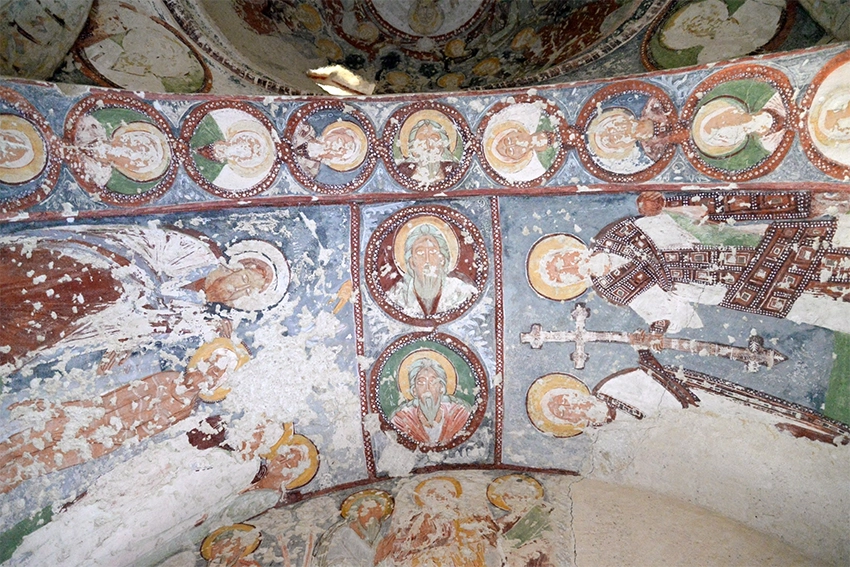
The interior preserves scenes connected with the life of Christ, together with portraits of saints and apostles.
Recognizable subjects commonly associated with the surviving program include:
- The Annunciation
- The Nativity
- The Baptism of Christ
- The Entry into Jerusalem
- The Crucifixion
- The Anastasis
- The Ascension
- Individual saints and apostles
The paintings use earthy reds, ochres, pale blues and darker outlines.
Some compositions remain legible, while others have been affected by moisture, lost plaster, scratching, erosion and structural damage.
A blank area should not automatically be interpreted as an originally undecorated wall. The painting layer may have disappeared.
How to Read the Fresco Cycle
Begin with the architecture rather than searching immediately for one famous scene.
Identify the apse, central area, cross arms and entrance direction.
Look for Christ through his cross-inscribed halo, central placement and the abbreviation IC XC.
Follow gestures and the direction of gaze. Apostles, angels and witnesses often guide attention toward the principal action.
Use painted beds, buildings, tombs, water and city walls to identify the setting.
Read surviving inscriptions together with the image. A few damaged letters should not be expanded into a complete name without supporting evidence.
The Annunciation
The Annunciation represents the Archangel Gabriel announcing to Mary that she will give birth to Christ.
The two principal figures are usually arranged in a direct visual relationship.
Gabriel approaches or gestures toward Mary, while Mary receives the message through posture and hand movement.
Architectural details can indicate an interior or sacred setting.
The scene begins the visual movement toward the Nativity and the childhood of Christ.
The Nativity
The Nativity centers on the birth of Christ.
Mary, the infant Christ, Joseph, angels, animals and attendants can appear within a composition that combines several moments of the story.
Byzantine Nativity scenes do not follow modern naturalistic perspective.
Figures and events may be arranged according to theological importance rather than ordinary physical distance.
Damage can remove secondary figures while leaving the central relationship between Mary and Christ recognizable.
The Baptism of Christ
The Baptism normally shows Christ standing in the Jordan River while John the Baptist reaches toward him.
Angels may wait on the riverbank, and a symbolic representation of the Holy Spirit can appear above.
Water is often shown through curved or vertical painted bands rather than modern landscape realism.
The scene marks the beginning of Christ's public ministry and connects earthly action with divine revelation.
The Crucifixion
The Crucifixion presents Christ on the cross, often with the Virgin Mary, John and other witnesses.
The cross creates the central vertical structure of the composition.
Gestures of grief and attention direct the viewer toward Christ.
The scene should be read within the larger Passion and Resurrection cycle rather than as an isolated image of suffering.
Lost paint can remove inscriptions or figures that originally clarified the full composition.
The Anastasis
The Anastasis presents Christ's victory over death.
Christ reaches toward Adam and Eve while standing above broken gates, locks or defeated forces of the underworld.
The event is sometimes called the Harrowing of Hell in English-language guides.
Adam and Eve represent humanity released from the power of death.
The scene provides a theological transition between the Crucifixion and the wider meaning of Resurrection.
The Ascension
The Ascension represents Christ's departure from the earthly world and the continuation of the Christian community.
Christ normally appears in an upper position, while the Virgin Mary, apostles and angels form the group below.
Upward gazes and gestures connect the earthly and heavenly zones.
The curved surface of a vault or upper wall can strengthen the vertical movement of the scene.
The Ascension often completes or concludes a Christological narrative cycle.
Saints and Apostles
Individual saints and apostles support the larger narrative program.
They may appear in medallions, standing portraits or groups around major scenes.
Inscriptions, clothing, facial type and attributes help identify them.
A damaged figure should not be named from one feature alone.
Their placement within the church can reflect liturgical importance, local devotion or the structure of the painting program.
Color and Painted Style
Earthy reds and ochres create strong outlines and borders against lighter backgrounds.
Pale blue and green tones help distinguish garments, architectural details and scene divisions.
Color contributes to visual organization, but it should not be interpreted alone.
Position, gesture, inscription and the biblical context provide stronger evidence for identifying a figure.
Surface deposits and pigment loss can change how the original colors appear today.
Painting Layers and Surface Preparation
The rock surface was prepared before the figurative paintings were completed.
Plaster or related preparation layers created a more suitable ground for color, outlines and inscriptions.
Different sections may preserve different levels of preparation and paint survival.
Later repairs, smoke or touching can overlap the original painting.
The word fresco is commonly used for Cappadocian wall paintings, but the precise application method may vary between churches and working phases.
Why the Frescoes Are Fragile
The painted surfaces depend on the stability of both the rock cone and the plaster layers.
Water entering cracks can weaken plaster and carry minerals across the paintings.
Temperature change and frost can widen fractures in exposed rock.
Dust, smoke, touching and photography equipment can add avoidable damage.
Natural erosion is unavoidable, but visitor behavior can reduce additional pressure.
El Nazar has been identified within heritage reporting as a monument requiring priority conservation attention because of erosion risk.
Related Tours
Popular experiences for this destination
Red TourRed Tour Cappadocia
Discover Göreme Open-Air Museum, Avanos pottery workshops, and breatht…
AdventureTrekking Tours Cappadocia
Hike Cappadocia’s spectacular valleys, fairy chimneys, and cave dwelli…
AdventureATV Tour Cappadocia
Ride powerful ATVs through Cappadocia’s unique valleys, fairy chimneys…
AdventureHorseback Riding Tour Cappadocia
Experience Cappadocia on horseback, riding through valleys, hidden tra…
Pottery Workshop Cappadocia
Learn the ancient art of pottery from Avanos masters, try shaping clay…
Vip Mix Tour Cappadocia
Experience the ultimate Cappadocia highlights in comfort-historic vall…
Professional Photo Shoot Cappadocia
Capture your Cappadocia moments with a guided professional photo shoot…
Classic Car Tour Cappadocia
Step into nostalgia with a vintage classic car ride through Cappadocia…
Blue TourBlue Tour Cappadocia
Explore hidden valleys, ancient churches, and cultural gems on Cappado…
Turkish Night Show Cappadocia
Enjoy a traditional Turkish dinner with live music, folk dances, and w…
Airport Transfer Service Cappadocia
Travel comfortably and safely between Cappadocia’s airports and your h…
Cappadocia Turkish Bath
Relax with a traditional hammam ritual including steam, scrubbing, and…
Conservation and UNESCO Context
El Nazar belongs to the UNESCO-listed Göreme National Park and the Rock Sites of Cappadocia.
The World Heritage landscape is valued for the relationship between volcanic landforms, rock-cut settlements and Byzantine painted sanctuaries.
The designation does not guarantee that every monument remains continuously open.
Conservation can require temporary closure, restricted access, protective barriers or changes to the visitor route.
These restrictions protect both the painted interior and the unstable rock formation surrounding it.
Where Is El Nazar Church?
El Nazar Church stands outside the enclosed grounds of Göreme Open-Air Museum, within the surrounding valley landscape near Göreme.
It is reached by a local road or walking path rather than through the museum's principal visitor entrance.
Map applications can show different approach lines, some of which may follow informal paths or outdated access points.
Use the exact church location, confirm the final approach locally and obey current signs.
The route may be dusty in dry weather, muddy after rain or icy during winter.
Walking From Göreme
Walking from central Göreme can be practical for visitors comfortable with rural paths and uneven ground.
Save the return direction before leaving the town streets.
Carry water and sun protection because shade and facilities may be limited.
Do not continue through cultivated land, closed gates or an unmarked shortcut simply because a map line appears direct.
Begin early enough to complete the return during daylight.
Arriving by Taxi or Private Driver
A taxi or private driver is useful when the church is combined with Göreme Open-Air Museum, Tokalı Church or another heritage stop.
Agree on the waiting time and exact pickup point before entering.
A one-way taxi without a return arrangement can create unnecessary waiting outside the main town center.
Road and parking access near the final approach can change, so the driver may need to use a current authorized stopping point.
Is El Nazar Included in the Museum Ticket?
El Nazar Church is a separate monument outside the enclosed museum grounds.
Do not assume that the Göreme Open-Air Museum ticket or Museum Pass automatically covers admission.
Current management can change the entrance arrangement, opening schedule or temporary access status.
Check official or local information shortly before visiting instead of relying on an old ticket photograph.
How Long an El Nazar Visit Takes
| Visit Style | Approximate Time | Best For | Main Limitation |
|---|---|---|---|
| Quick Stop | 20 to 30 minutes | Exterior and a brief interior view | Little time to follow the fresco cycle |
| Standard Visit | 30 to 60 minutes | Most first-time visitors | Access and route conditions may extend the outing |
| Art-Focused Visit | 60 to 75 minutes | Architecture, fresco scenes and photography | Compact space and visitor flow can limit observation |
The time needed for walking, parking and finding the current entrance should be added separately.
The church works best as a focused additional stop rather than a stand-alone half-day attraction.
Photography and Responsible Visiting
- Do not use flash.
- Follow current signs when photography is prohibited.
- Do not touch frescoes, plaster or carved rock.
- Keep bags, coats and hair away from painted surfaces.
- Do not use a tripod when it blocks movement.
- Do not wet or clean an inscription to improve visibility.
- Never move a barrier for a clearer photograph.
- Keep voices low inside the sanctuary.
A brighter photograph is not more important than the survival of a 10th-century painted surface.
Allow your eyes to adjust and use a moderate camera zoom when photography is permitted.
Accessibility and Physical Conditions
The final approach may include uneven natural ground, loose soil and short slopes.
Full wheelchair access should not be assumed.
Strollers are not practical on rough paths or inside the compact sanctuary.
Visitors with limited mobility, balance concerns or visual difficulties should confirm the current approach before setting out.
Low interior light can make changes in floor level difficult to see.
Older visitors should pause after entering before moving deeper inside.
Visiting With Children
Older children may enjoy the freestanding rock cone and painted interior, but close adult supervision is essential.
- Keep children beside an adult on uneven paths.
- Do not allow climbing on the cone or church walls.
- Keep hands away from frescoes and plaster.
- Do not enter closed or unsupported spaces.
- Carry water and sun protection.
- Return before darkness when walking.
A fragile rock-cut sanctuary is not a play area. Running and shouting can endanger visitors and disturb the monument.
Seasonal Planning
Spring
Cool weather can suit the walk, but rain may leave mud and slippery rock on the final approach.
Summer
Visit earlier or later in the day. The route can be exposed, with limited shade.
Autumn
Cooler air often provides comfortable walking conditions. Shorter daylight should be considered when combining several sites.
Winter
Snow and ice can make the approach unsafe even when the roads around Göreme are clear.
Do not continue when the route is icy, closed or difficult to identify.
Nearby Churches and Heritage Sites
Göreme Open-Air Museum
The Göreme Open-Air Museum guide explains the main managed church route, ticket planning and current visitor conditions.
Tokalı Church
Tokalı Church preserves a much larger fresco program and connected architectural complex near the museum entrance.
Dark Church
Dark Church is known for its well-preserved later Byzantine frescoes, including the Deisis and Anastasis.
Saklı Church
Saklı Church is another historic sanctuary in the wider Göreme landscape. Its current access should be confirmed separately.
Meryem Ana Church
The Church of the Virgin Mary near the Kılıçlar Valley area provides another comparison between a small valley sanctuary, damaged frescoes and changing access conditions.
Suggested Visit Combinations
El Nazar and Göreme Open-Air Museum
Use the museum for a structured introduction to Cappadocian church architecture, then add El Nazar only when current access and energy allow.
El Nazar and Tokalı Church
This comparison shows how a compact freestanding-cone church differs from a larger multi-section painted complex.
Short Göreme Heritage Route
Combine El Nazar with central Göreme and one nearby church rather than attempting every valley monument in the same period.
Art-Focused Route
Compare El Nazar's 10th-century cycle with Tokalı Church and later interiors such as Dark Church.
A guide can help separate differences in date, plan, preservation and painting style.
Visiting With a Guide
A knowledgeable guide can explain the cross plan, identify damaged scenes and connect the church with the post-iconoclastic development of Byzantine art.
Ask whether access has been confirmed before building the route around El Nazar.
A private Cappadocia Mix Tour can provide more flexibility for churches outside the standard museum circuit.
Göreme Open-Air Museum is commonly included in the Cappadocia Red Tour, but El Nazar should not be assumed to be part of every standard itinerary.
Common El Nazar Planning Mistakes
- Assuming the church is inside the museum: El Nazar is outside the enclosed Göreme Open-Air Museum grounds.
- Using an old access route: Erosion and conservation can change the final approach.
- Presenting Evil Eye Church as the original dedication: The historical origin of the modern name is uncertain.
- Treating the church only as a hidden refuge: It was primarily a place of worship.
- Looking only at the exterior cone: The cross plan and fresco cycle explain its full importance.
- Using flash: Current conservation rules must be followed.
- Touching damaged paintings: Fragile plaster and pigment can be lost through repeated contact.
- Walking in unsuitable shoes: Mud, loose tuff and worn rock require grip.
- Leaving the return until darkness: Informal paths become difficult to identify quickly.
Questions Travelers Ask About El Nazar Church
Is El Nazar Church inside Göreme Open-Air Museum?
No. El Nazar Church is a separate monument outside the enclosed museum grounds.
How old is El Nazar Church?
The church and its principal painted program are generally dated to the 10th century.
Why is it called El Nazar?
The name is often translated as Evil Eye Church, but its exact historical origin and original Byzantine dedication are uncertain.
How long does a visit take?
Allow approximately 30 to 60 minutes, plus the time required for walking, parking and confirming the entrance.
Can you walk from Göreme?
Yes, when the current route is open and the visitor is comfortable with uneven rural paths.
Is El Nazar always open?
No. Access can change because of conservation, erosion, safety or local management decisions.
Is it included in the Museum Pass?
Do not assume automatic inclusion. Confirm the current admission arrangement before visiting.
Which frescoes survive?
The painted program includes scenes connected with the life of Christ, including the Annunciation, Nativity, Baptism, Crucifixion, Anastasis and Ascension, together with saints and apostles.
Is the church wheelchair accessible?
Full accessibility should not be assumed because the approach may include uneven ground and the interior is compact.
Can children visit?
Yes, with close supervision on the route and inside the church.
Can visitors take photographs?
Photography rules can change. Follow current signs and never use flash.
Is a guide useful?
Yes. A guide can explain the architecture, fresco sequence and relationship between El Nazar and the wider Göreme church landscape.
A Compact Painted Sanctuary in Göreme
El Nazar Church is important because geology, architecture and painting remain visibly connected within one freestanding volcanic cone.
Its cross-plan interior demonstrates how Byzantine builders transformed a natural formation into an organized place of worship.
The surviving frescoes preserve a narrative moving through Christ's birth, ministry, suffering, victory over death and Ascension.
Erosion and paint loss make some parts difficult to interpret, but they also demonstrate why conservation and visitor restraint matter.
For travelers who confirm current access and take time to examine both the exterior cone and interior program, El Nazar provides a focused introduction to 10th-century Byzantine art outside the main museum enclosure.
Use the Cappadocia trip planning guide and the Cappadocia safety and essentials guide when combining El Nazar with walking, museum visits and other Göreme churches.