Elmali, Yilanli & Carikli Churches
Elmalı, Yılanlı and Çarıklı Churches in Göreme
Elmalı, Yılanlı and Çarıklı are three separate rock-cut churches inside the Göreme Open-Air Museum. Each preserves a different part of the Byzantine heritage of Cappadocia, from narrative scenes from the life of Christ to portraits of saints, donor traditions and local names that developed around individual paintings.
The churches are compact, but they should not be treated as interchangeable stops. Elmalı and Çarıklı belong to the group of column-supported churches with extensive biblical painting programs. Yılanlı has a simpler barrel-vaulted plan and is better known for individual saints and the dragon-fighting composition.
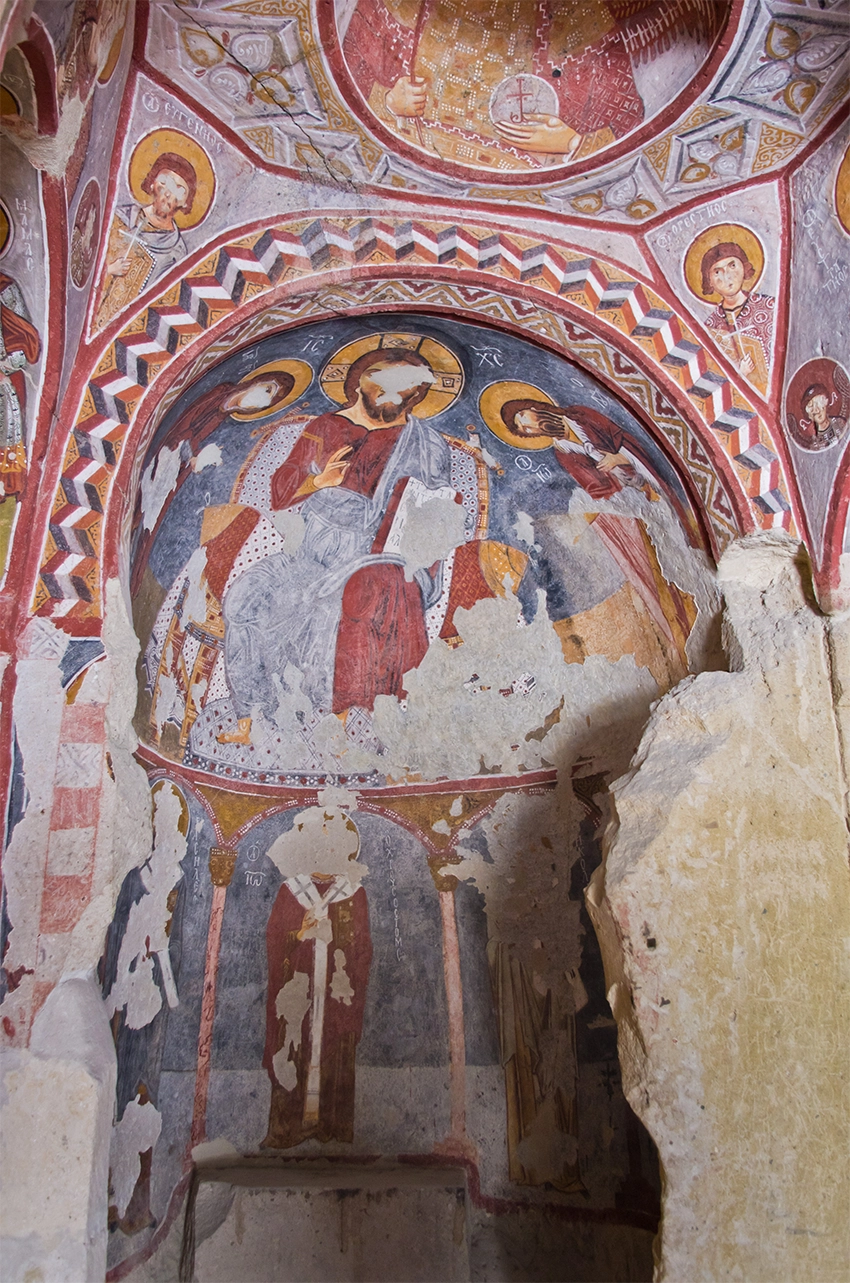
Most visitors need approximately 45 to 75 minutes to examine all three without rushing. The complete museum requires more time, especially when Tokalı Church and Dark Church are also priorities.
Opening hours, admission rules, visitor flow and photography restrictions can change. Current signs and museum staff instructions should take priority over old travel articles.
How to Plan a First Visit
Begin with the architecture before searching for individual frescoes. Identify the central space, apses, vaults, supports and entrance direction. This makes the narrative order easier to follow.
Allow your eyes time to adjust when entering a darker interior. Moving directly from strong sunlight can hide details that become visible after a short pause.
Use doorways only for entering and leaving. The churches are small, and one group standing at the entrance can block both circulation and the best viewing angle.
Wear shoes with reliable grip. The museum route includes stone steps, uneven rock and polished surfaces.
Keep bags and clothing away from frescoes. Painted surfaces may continue onto columns, arches and areas that do not look like conventional walls.
Visit early when possible. Lower crowd levels make it easier to compare scenes, inscriptions and architectural plans.
The Three Churches at a Glance
| Church | Approximate Date | Architectural Character | Main Visual Focus |
|---|---|---|---|
| Elmalı Church | 11th century | Column-supported cross-in-square plan with domed sections and three apses | Extensive cycle from the life, Passion and Resurrection of Christ |
| Yılanlı Church | 11th century | Simple barrel-vaulted interior with a small narthex and burial spaces | Warrior saints, Constantine and Helena, and Saint Onuphrius |
| Çarıklı Church | 11th century or later Middle Byzantine phase | Compact column-supported cross-plan with domed and vaulted sections | New Testament cycle, Ascension and footprint-shaped marks |
The dates are general art-historical ranges. Individual construction, painting and later-use phases may not belong to one exact year.
Why These Churches Should Be Compared
Elmalı, Dark Church and Çarıklı are often discussed as a related group of column-supported churches in Göreme.
Their plans and painting programs share important characteristics, but they are not copies of one another.
Different artists, working phases, surface conditions and later damage affect the appearance of each interior.
Yılanlı provides a useful contrast. Its simpler architecture and concentration on selected saintly figures create a different type of visit from the extensive narrative cycles in Elmalı and Çarıklı.
Comparing all three helps visitors understand that Cappadocian church art developed through several architectural and visual approaches rather than one fixed regional template.
Elmalı Church
Architecture and Date
Elmalı Church, commonly translated as Apple Church, is generally dated to the 11th century.
Its compact cross-in-square plan includes four rock-cut supports, a central domed area, surrounding domed or vaulted compartments and three apses.
The design imitates the organization of a constructed Byzantine church even though the interior was carved directly from volcanic rock.
The central dome and cross arms create a hierarchy between the principal worship space, sanctuary and surrounding compartments.
The rock-cut supports divide the interior while preserving visual connections between the central bay and the apses.
How the Elmalı Plan Works
The central bay provides the main spatial focus.
Four supports organize movement and create smaller viewing zones around the interior.
The principal apse marks the sanctuary, while the side apses complete the eastern arrangement.
Domed and vaulted surfaces provide separate areas for biblical scenes, saints and decorative bands.
Visitors should look upward as well as toward the walls. Important scenes and figures can appear across vaults, domes and transition zones.
Elmalı Church Frescoes
The interior contains saints, bishops and scenes from the life of Christ.
Important subjects include:
- The Nativity
- The Adoration of the Magi
- The Baptism
- The Raising of Lazarus
- The Transfiguration
- The Entry into Jerusalem
- The Last Supper
- The Crucifixion
- The Anastasis
- The Ascension
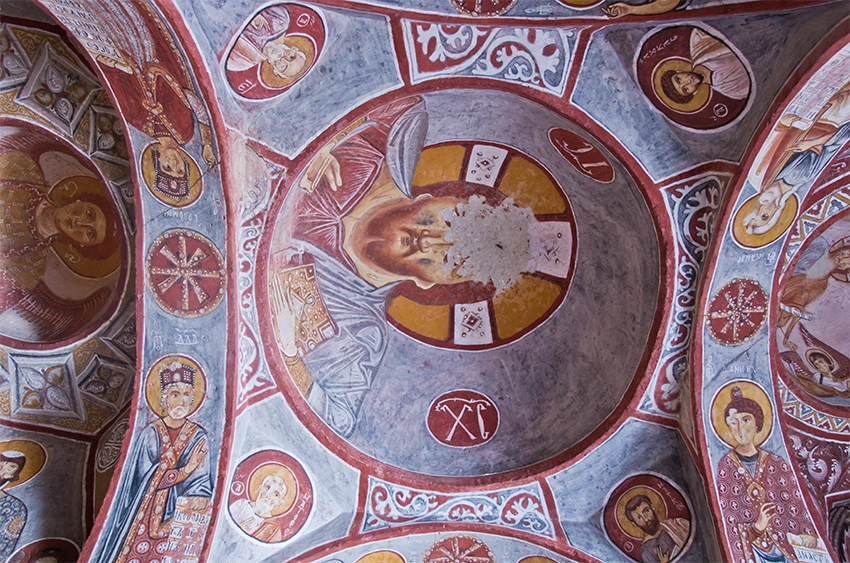
The sequence should be read as a connected account rather than a checklist of famous scenes.
Related Tours
Popular experiences for this destination
 Red Tour
Red Tour Cappadocia
Discover Göreme Open-Air Museum, Avanos pottery workshops, and breatht…
 Adventure
Trekking Tours Cappadocia
Hike Cappadocia’s spectacular valleys, fairy chimneys, and cave dwelli…
 Adventure
ATV Tour Cappadocia
Ride powerful ATVs through Cappadocia’s unique valleys, fairy chimneys…
 Adventure
Horseback Riding Tour Cappadocia
Experience Cappadocia on horseback, riding through valleys, hidden tra…
Pottery Workshop Cappadocia
Learn the ancient art of pottery from Avanos masters, try shaping clay…
Vip Mix Tour Cappadocia
Experience the ultimate Cappadocia highlights in comfort-historic vall…
 Blue Tour
Blue Tour Cappadocia
Explore hidden valleys, ancient churches, and cultural gems on Cappado…
 Green Tour
Green Tour Cappadocia
Explore Derinkuyu underground city, the beautiful Ihlara Valley, and S…
Professional Photo Shoot Cappadocia
Capture your Cappadocia moments with a guided professional photo shoot…
Cappadocia Turkish Bath
Relax with a traditional hammam ritual including steam, scrubbing, and…

Cappadocia Rent A Car
Explore Cappadocia freely at your own pace with flexible car rental op…
 Balloon
Cappadocia Hot Air Balloon Tour
See Cappadocia from the air at sunrise on a professionally operated ho…
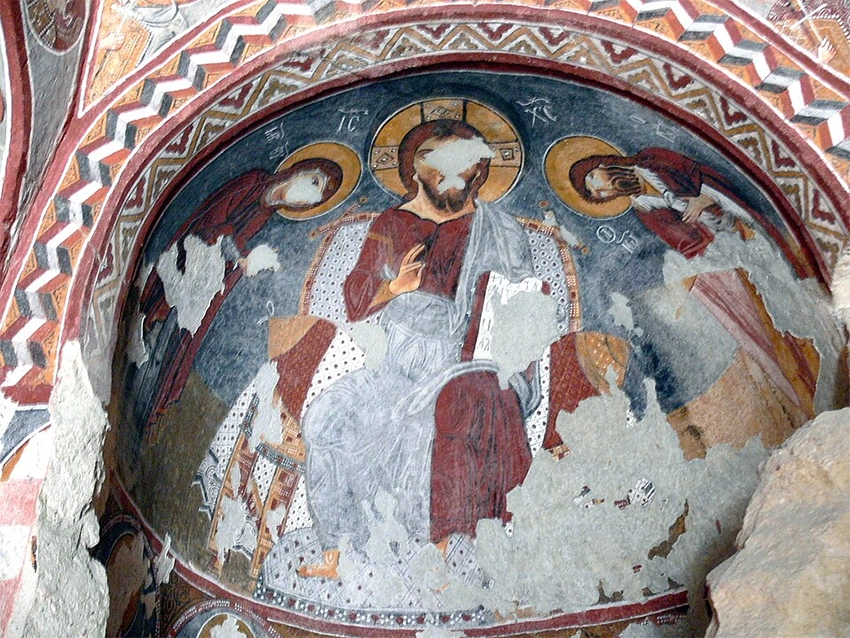
Childhood, ministry, Passion and Resurrection subjects occupy different architectural surfaces according to the visual program.
Christ can usually be recognized through his cross-inscribed halo, position and the abbreviation IC XC.
Apostles, the Virgin Mary, angels and witnesses guide the viewer through gestures and direction of gaze.
The Last Supper and the Fish
The Last Supper includes a fish on the table.
The fish can be connected with Christian symbolism and the Greek word ichthys.
This detail should still be read within the complete meal scene. Food, table arrangement, apostles and Christ's position all contribute to the composition.
One symbolic object should not replace the wider theological meaning of the Last Supper.
Earlier Red-Painted Decoration
Earlier red-painted decoration remains visible beneath parts of the later fresco layer.
This indicates that the church was decorated in more than one phase.
The earlier layer may include crosses, geometric forms and simple linear ornament.
Later painters did not necessarily remove every earlier mark before applying a more elaborate program.
Where layers overlap, visitors can see that the church's visual history developed through reuse and repainting.
Why Is It Called Apple Church?
The origin of the modern name remains uncertain.
One explanation connects it with an apple tree that once grew nearby.
Another links the name with a reddish round object held by an archangel in one of the paintings.
Neither explanation should be presented as the confirmed original dedication.
The modern name helps identify the church, but it does not establish the historical patron, saint or first liturgical title.
What to Notice in Elmalı Church
- The relationship between the central dome and four supports
- The three-apse sanctuary arrangement
- The transition between earlier red decoration and later frescoes
- The organization of childhood, ministry and Passion scenes
- The use of gestures to connect figures
- The fish on the Last Supper table
Yılanlı Church
Architecture and Date
Yılanlı Church is generally dated to the 11th century.
It is also associated with Saint Onuphrius because of the distinctive hermit portrait inside.
The church has a simple barrel-vaulted interior rather than the multi-domed, column-supported organization of Elmalı and Çarıklı.
A small rectangular narthex contains or adjoins burial spaces.
The absence of a central dome and columns creates a direct interior with fewer architectural divisions.
This simpler plan concentrates attention on the individual saintly figures and selected compositions along the walls and vault.
Why Is It Called Snake Church?
The name is connected with the painting of Saint George and Saint Theodore fighting a dragon or serpent.
The long body beneath the mounted saints appears snake-like, which contributed to the modern local name.
The scene belongs to a wider Byzantine tradition in which military saints defeat evil represented through a dragon.
The painting should not be interpreted as evidence that the church was dedicated to snakes.
Do Not Confuse It With Yılanlı Church in Ihlara
Göreme Yılanlı Church should not be confused with Ihlara Valley's church of the same modern name.
The famous Ihlara painting showing sinners punished by snake-like creatures belongs to the Ihlara church.
Göreme Yılanlı receives its name from the warrior saints and dragon composition.
Using the full location name prevents confusion when reading guides, booking tours or asking a guide about specific frescoes.
Saint George and Saint Theodore
Saint George and Saint Theodore appear as mounted military saints confronting the dragon.
Their horses, weapons and direction of movement create a strong visual contrast with the defeated creature below.
The saints represent divine protection and the victory of faith over evil.
The scene should be viewed through the complete composition rather than only the snake-like body.
Look at the position of the horses, the saints' halos and the direction of their spears.
Constantine and Helena With the True Cross
Emperor Constantine and Saint Helena are shown with the True Cross.
The composition connects imperial authority, Christian memory and the veneration of the Cross.
Constantine and Helena appear together in Byzantine art because of traditions linking Helena with the discovery of the True Cross and Constantine with the Christian Roman Empire.
The cross between them provides the central visual and religious focus.
Saint Onuphrius
The portrait of Saint Onuphrius is one of the church's most distinctive images.
He is shown as a desert hermit with long hair and a covering of leaves.
The unusual appearance represents an ascetic life separated from ordinary clothing, comfort and society.
Saint Onuphrius belongs to the wider tradition of desert monasticism and extreme religious discipline.
The figure should not be described simply as a strange local character. His appearance communicates a specific model of holiness and withdrawal.
Other Saints
Other figures associated with the church include Saint Thomas and Saint Basil.
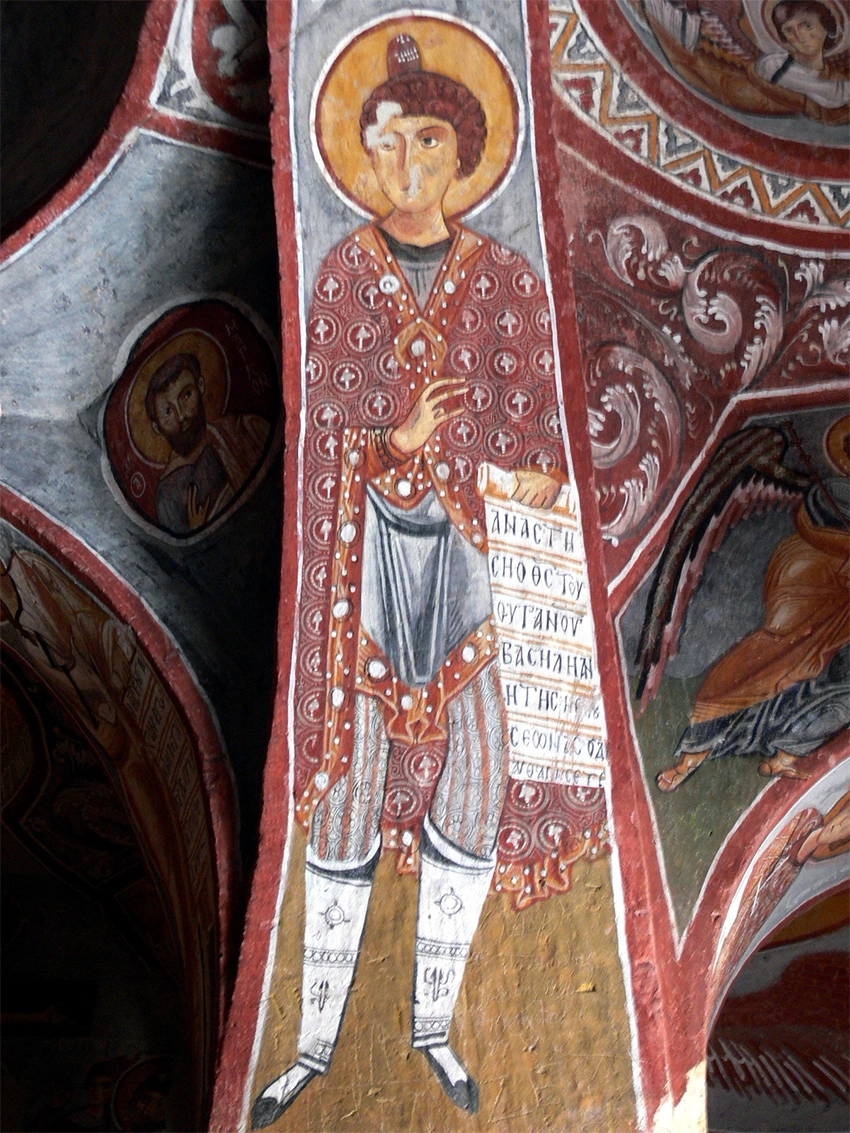
Individual saints can be identified through inscriptions, clothing, facial type and attributes.
Damage or paint loss may make one feature difficult to see, so identification should rely on the complete surviving image.
The presence of several saints does not mean they all lived in Cappadocia or used this church personally.
Burials and Commemoration
The narthex and associated burial spaces connect the church with commemoration as well as worship.
Burial close to a sacred interior could express religious hope, family memory and association with holy figures.
Visitors should not step into graves, move stones or place objects inside burial recesses.
What to Notice in Yılanlı Church
- The simple barrel-vaulted plan
- The absence of a central dome and columns
- Saint George and Saint Theodore above the dragon
- Constantine and Helena holding the True Cross
- The long-haired figure of Saint Onuphrius
- The relationship between the narthex and burial spaces
Çarıklı Church
Architecture and Date
Çarıklı Church, translated as Sandals Church, is generally dated to the 11th century or a later Middle Byzantine phase.
Its compact cross-plan interior combines a central domed area with supporting elements, adjoining vaulted sections and apses.
The architecture belongs to the column-supported group represented in Göreme by Elmalı, Dark Church and Çarıklı.
Its interior is smaller than a constructed urban church, but the plan reproduces a sophisticated Byzantine spatial hierarchy inside volcanic rock.
The painted program is closely integrated with domes, vaults, arches and sanctuary surfaces.
How Çarıklı Compares With Elmalı
Both churches contain extensive New Testament cycles and column-supported architectural organization.
Elmalı is especially useful for observing several decoration phases and the relationship between earlier red painting and later frescoes.
Çarıklı is particularly associated with its Ascension scene and the footprint-shaped marks that gave the church its modern name.
The two interiors should be compared through plan, scene placement, figure scale and preservation rather than treated as duplicate churches.
Çarıklı Church Frescoes
The paintings follow major episodes from the New Testament.
Scenes include:
- The Nativity
- The Adoration of the Magi
- The Baptism
- The Raising of Lazarus
- The Transfiguration
- The Entry into Jerusalem
- The Last Supper
- The Crucifixion
- The Anastasis
- The Ascension
The program follows Christ from birth and ministry through suffering, death, victory over death and Ascension.
The scenes should be read according to their architectural position rather than as a modern illustrated book arranged at eye level.
Related Tours
Popular experiences for this destination
Red TourRed Tour Cappadocia
Discover Göreme Open-Air Museum, Avanos pottery workshops, and breatht…
AdventureTrekking Tours Cappadocia
Hike Cappadocia’s spectacular valleys, fairy chimneys, and cave dwelli…
AdventureATV Tour Cappadocia
Ride powerful ATVs through Cappadocia’s unique valleys, fairy chimneys…
AdventureHorseback Riding Tour Cappadocia
Experience Cappadocia on horseback, riding through valleys, hidden tra…
Pottery Workshop Cappadocia
Learn the ancient art of pottery from Avanos masters, try shaping clay…
Vip Mix Tour Cappadocia
Experience the ultimate Cappadocia highlights in comfort-historic vall…
Blue TourBlue Tour Cappadocia
Explore hidden valleys, ancient churches, and cultural gems on Cappado…
Green TourGreen Tour Cappadocia
Explore Derinkuyu underground city, the beautiful Ihlara Valley, and S…
Professional Photo Shoot Cappadocia
Capture your Cappadocia moments with a guided professional photo shoot…
Cappadocia Turkish Bath
Relax with a traditional hammam ritual including steam, scrubbing, and…
Cappadocia Rent A Car
Explore Cappadocia freely at your own pace with flexible car rental op…
BalloonCappadocia Hot Air Balloon Tour
See Cappadocia from the air at sunrise on a professionally operated ho…
Domes and upper surfaces can emphasize divine authority, while walls and vaults carry narrative events and supporting figures.
The Ascension Scene
The Ascension represents Christ's departure from the earthly world and the continuation of the Christian community.
Christ normally occupies a prominent upper position, while the Virgin Mary, apostles and angels form the earthly group below.
Gestures and upward gazes guide attention toward the central heavenly figure.
The composition connects physical architecture with vertical theological movement.
The Footprint-Shaped Marks
Two footprint-shaped marks appear below the Ascension scene.
These marks gave the church its modern name, Çarıklı, which refers to sandals or footwear.
Local stories sometimes identify them as the physical footprints of Christ.
They are better understood within the church's devotional and visual tradition rather than documented bodily impressions.
The exact date and intended function of the marks should be presented cautiously.
Visitors should view them without touching, tracing or placing their own feet over the shapes.
What to Notice in Çarıklı Church
- The relationship between the central domed area and adjoining sections
- The New Testament sequence across several surfaces
- The Ascension composition
- The upward gaze and gestures of the figures
- The footprint-shaped marks below the scene
- The similarities and differences between Çarıklı, Elmalı and Dark Church
How the Painting Styles Compare
| Feature | Elmalı | Yılanlı | Çarıklı |
|---|---|---|---|
| Primary Structure | Column-supported and multi-domed | Simple barrel-vaulted interior | Column-supported cross-plan |
| Painting Emphasis | Long Christological narrative | Selected saints and symbolic compositions | New Testament cycle and Ascension |
| Distinctive Detail | Earlier red decoration beneath later frescoes | Saint Onuphrius and warrior saints | Footprint-shaped marks |
| Best Comparison | Dark Church and Çarıklı | Other saint-focused chapels | Elmalı and Dark Church |
Elmalı and Çarıklı use broader narrative programs within column-supported plans.
Yılanlı creates a more concentrated experience through individual figures and selected religious themes.
Preservation also affects modern impressions. A less complete scene does not prove that the original painting was less important or less skilled.
How to Read the Biblical Scenes
Identify the Central Figure
Christ is often marked by a cross-inscribed halo and the abbreviation IC XC.
The Virgin Mary, apostles and saints may be identified through inscriptions, clothing and their position within a familiar event.
Follow Gestures and Gaze
Hands and eyes direct attention across the composition.
A blessing gesture, prostration or group looking toward one figure helps identify the principal action.
Notice Painted Architecture
Beds, tables, tombs, buildings and city walls establish the setting of a biblical scene.
These painted forms are visual symbols rather than realistic plans of Cappadocian towns.
Separate Damage From Original Design
Blank rock may indicate lost plaster or pigment.
Smoke, scratching, humidity and structural loss can interrupt a narrative that was originally more complete.
Greek Inscriptions and Abbreviations
Greek inscriptions can identify figures, scenes, prayers and biblical words.
Common abbreviations include IC XC for Jesus Christ and MP XY for the Mother of Christ.
Names may appear beside saints or within narrative scenes.
Damaged letters should be interpreted cautiously. One surviving stroke is not enough to support a complete identification.
Visitors should never touch, wet or trace an inscription to improve visibility.
Conservation and Photography
Rock-cut wall paintings are vulnerable to moisture, dust, temperature change, scratching and repeated human contact.
- Do not use flash.
- Follow current signs when photography is prohibited.
- Do not touch frescoes, columns or carved surfaces.
- Keep bags, coats and hair away from walls.
- Do not block entrances with phones or cameras.
- Keep voices low inside the churches.
- Do not use tripods when they obstruct the route.
- Never move a barrier for a clearer view.
Photography rules may differ between churches and can change according to conservation needs.
A brighter photograph is not more important than the survival of the painting.
Visitor Information
| Planning Point | Practical Guidance |
|---|---|
| Location | Inside Göreme Open-Air Museum near central Göreme |
| Combined Visit Time | Approximately 45 to 75 minutes for all three churches |
| Admission | Covered by current museum entrance conditions unless official rules state otherwise |
| Photography | Follow current signs and never use flash |
| Walking Conditions | Stone steps, uneven rock, narrow entrances and low-light interiors |
| Best Time | Early morning or a quieter period before final admission |
Final admission may occur before the museum's listed closing time.
Restoration, visitor-flow decisions and official events can change access to individual interiors.
Accessibility and Family Planning
The museum route and church entrances include stone steps, uneven rock and compact interiors.
Full wheelchair access to all three churches should not be assumed.
Visitors with limited mobility should ask about the current accessible route before entering the museum.
Low light and polished steps can affect visitors with balance or visual concerns.
Children should remain close to an adult around stairs, graves, columns and painted surfaces.
Strollers are not practical inside the compact rock-cut interiors.
Best Time to Visit
Early Morning
Early arrival normally provides the calmest interiors and the best opportunity to compare frescoes without waiting at small entrances.
Midday
Midday can be busy during popular travel periods.
Groups may move through the churches in close sequence, reducing the time available in the best viewing positions.
Late Afternoon
Late afternoon may be quieter, but current final admission times must be checked.
Do not leave all three churches until the final minutes of the museum visit.
Visiting With a Guide
A knowledgeable guide can explain the different plans, identify principal scenes and prevent confusion between Göreme Yılanlı and Ihlara Yılanlı.
Ask whether the route includes enough time for all three churches rather than only their names on the itinerary.
Detailed explanations should be given outside narrow doorways or in a position that does not block other visitors.
Göreme Open-Air Museum is commonly included in the Cappadocia Red Tour.
A private Cappadocia Mix Tour can provide more control over museum time and the balance between churches and panoramic stops.
Combining the Churches With the Museum Route
The three churches should be included within a wider museum plan rather than visited as a disconnected group.
Allow at least two hours for a normal museum visit and more when Tokalı and Dark Church are priorities.
The Göreme Open-Air Museum guide explains the wider route, ticket planning and relationship between the main complexes.
Visitors staying in Göreme can reach the museum without a regional sightseeing transfer, although the uphill route and summer heat should be considered.
The guide to Christian history in Cappadocia provides context for monastic life, rock-cut architecture, iconoclasm and Byzantine painting.
Common Planning Mistakes
- Treating the churches as identical: Their plans and painting programs are different.
- Confusing the two Yılanlı churches: The snake-punishment scene belongs to Ihlara, not Göreme.
- Calling the Elmalı name certain: The apple-tree and archangel-object explanations remain interpretations.
- Treating the Çarıklı marks as proven footprints: They belong to devotional tradition, not documented physical evidence.
- Ignoring earlier decoration: Elmalı preserves evidence of more than one painting phase.
- Looking only at famous scenes: Architecture and narrative order provide the main context.
- Using flash: Current conservation rules must be followed.
- Blocking the doorway: Small entrances must remain open for visitor movement.
- Leaving the churches until closing: Final admission and access may end earlier.
Questions Travelers Ask About Elmalı, Yılanlı and Çarıklı
Are all three churches inside Göreme Open-Air Museum?
Yes. Elmalı, Yılanlı and Çarıklı are located along the visitor route inside Göreme Open-Air Museum.
How long do you need for the three churches?
Allow approximately 45 to 75 minutes when architecture and frescoes are a priority.
Which church has the largest narrative cycle?
Elmalı and Çarıklı both preserve extensive New Testament programs. Elmalı is especially useful for observing the relationship between earlier red decoration and later frescoes.
Why is Elmalı called Apple Church?
The name may refer to an apple tree once located nearby or a round object held by an archangel. Neither explanation is confirmed as the original dedication.
Why is Yılanlı called Snake Church?
The name is connected with Saint George and Saint Theodore fighting a dragon or serpent.
Does Göreme Yılanlı contain the snake-punishment fresco?
No. That composition belongs to Yılanlı Church in Ihlara Valley.
Who is Saint Onuphrius?
He is a desert hermit represented with long hair and a covering of leaves, symbolizing extreme ascetic life.
Which church contains the footprint-shaped marks?
Çarıklı Church contains two footprint-shaped marks below the Ascension scene.
Are they the physical footprints of Christ?
They are associated with local devotional tradition, but they should not be presented as documented bodily footprints.
Can visitors take photographs?
Photography rules can change between interiors. Follow current signs and never use flash.
Are the churches wheelchair accessible?
Full access should not be assumed because the route includes stone steps, uneven surfaces and narrow entrances.
Can children visit?
Yes, with close supervision around steps, graves, barriers and painted surfaces.
Is a guide useful?
Yes. A guide can explain architectural differences, identify scenes and separate established history from local naming traditions.
Three Different Views of Byzantine Göreme
Elmalı, Yılanlı and Çarıklı demonstrate that the painted churches of Göreme cannot be understood through one architectural plan or one type of fresco program.
Elmalı combines a column-supported interior with an extensive narrative and evidence of more than one decoration phase.
Yılanlı uses a simpler barrel-vaulted space to present warrior saints, Constantine and Helena, Saint Onuphrius and other individual figures.
Çarıklı returns to a column-supported cross-plan and a wide New Testament cycle, while the Ascension and footprint-shaped marks give the church its distinctive modern identity.
Together, the three churches provide a practical comparison of narrative painting, saintly portraiture, architectural organization and local devotional memory.
Use the Cappadocia trip planning guide and the Cappadocia safety and essentials guide when planning the wider museum visit.