Barbara Church
Saint Barbara Church in Göreme Open-Air Museum
Saint Barbara Church, also known as Barbara Church or Azize Barbara Kilisesi, is an 11th-century rock-cut sanctuary inside the Göreme Open-Air Museum. The church is known for its compact Byzantine architecture, red ochre lines, crosses, geometric forms and unusual symbolic images.
Its visual character differs from the extensive narrative cycles in Tokalı Church and the richly painted interior of Dark Church. Saint Barbara Church combines sacred figures with a restrained but highly recognizable symbolic language.
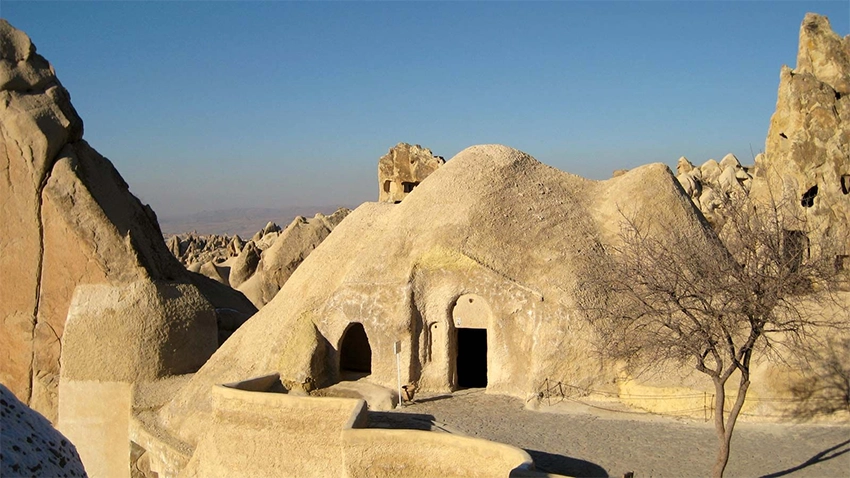
Most visitors should allow approximately 20 to 40 minutes for the church itself. The complete museum visit requires considerably more time, especially when several painted interiors are included.
Opening hours, ticket conditions, visitor-flow rules and photography restrictions can change. Check current official information and follow the signs displayed inside the museum.
Why Saint Barbara Church Is Important
Saint Barbara Church demonstrates that Byzantine religious decoration in Cappadocia did not depend only on large biblical narratives.
Crosses, geometric borders, linear architectural imitation, mounted saints and symbolic creatures could also communicate protection, authority, faith and the defeat of evil.
The church is especially useful for comparing figurative painting with red ochre decoration. Christ and warrior saints are recognizable human figures, while other designs remain abstract or uncertain in meaning.
Its architecture also provides an important comparison with the Elmalı, Yılanlı and Çarıklı Churches. Saint Barbara belongs to a compact column-supported plan rather than a simple single-nave chapel.
The church should be read as one integrated space. Architecture, symbolic lines and sacred figures were arranged in relation to the dome, apses, supports and movement of worshippers.
How to Plan a First Visit
Visit when you still have enough concentration to examine small motifs. The church can be passed quickly on the museum route, but its most distinctive details require slower observation.
Allow your eyes time to adjust after entering. Red lines and darker figures may become easier to see after a short pause away from direct sunlight.
Keep doorways clear. The interior is compact, and one group stopping at the entrance can obstruct both circulation and the view.
Wear shoes with reliable grip. The museum route includes stone steps, sloping paths and uneven volcanic rock.
Carry only a small bag. Loose straps, tripods and large backpacks can strike carved or painted surfaces.
Do not enter closed spaces or move barriers. Current restrictions may respond to conservation concerns that are not obvious to visitors.
Saint Barbara Church at a Glance
| Feature | Main Importance | What to Notice |
|---|---|---|
| Date | Generally associated with the 11th century | Post-iconoclastic Byzantine religious art |
| Architecture | Compact cross-domed arrangement with two supports and three apses | Central space, sanctuary and carved architectural divisions |
| Decoration | Red ochre lines, crosses, geometric motifs and sacred figures | The relationship between symbolic and figurative imagery |
| Best-Known Images | Christ enthroned and mounted warrior saints | Visual hierarchy, movement and protection |
The table provides a visitor framework rather than a complete catalogue of every surviving mark.
Date and Historical Context
Saint Barbara Church is generally dated to the 11th century.
It belongs to the post-iconoclastic development of Byzantine art in the Göreme Valley.
After the end of Byzantine Iconoclasm in 843, many Cappadocian churches were decorated with figures of Christ, the Virgin Mary, apostles, saints and biblical events.
Symbolic decoration did not disappear. Crosses, geometric forms, red lines and non-narrative motifs continued to be used alongside sacred figures.
Saint Barbara Church preserves this combination especially clearly.
The church should not be described as an iconoclastic monument merely because much of its decoration is geometric or linear. Its 11th-century dating and figurative images place it within a later artistic context.
Saint Barbara Church and UNESCO
The church forms part of Göreme National Park and the Rock Sites of Cappadocia, inscribed on the UNESCO World Heritage List in 1985.
UNESCO documentation identifies Saint Barbara Church among the important 11th-century sanctuaries of the Göreme Valley.
The wider World Heritage property includes rock-cut churches, chapels, cells, settlements, valleys and underground structures.
The designation protects a cultural landscape rather than one isolated church.
World Heritage status does not mean that every room remains permanently open or that visitor rules never change.
Conservation can require photography restrictions, barriers, controlled movement or temporary closure.
Rock-Cut Architecture
The entire church was created by removing material from Cappadocia's volcanic tuff.
Columns, arches, apses, vaults and domed surfaces were shaped from one rock mass rather than assembled from separate masonry blocks.
The plan is generally described as a compact cross-domed arrangement related to the architecture of Çarıklı Church.
The surviving interior includes:
- One principal central apse
- Two smaller side apses
- A central domed section
- Cross arms or adjoining vaulted compartments
- Two rock-cut supports organizing the interior
These carved elements imitate forms used in constructed Byzantine churches.
Related Tours
Popular experiences for this destination
 Red Tour
Red Tour Cappadocia
Discover Göreme Open-Air Museum, Avanos pottery workshops, and breatht…
 Adventure
ATV Tour Cappadocia
Ride powerful ATVs through Cappadocia’s unique valleys, fairy chimneys…
 Adventure
Horseback Riding Tour Cappadocia
Experience Cappadocia on horseback, riding through valleys, hidden tra…
 Adventure
Trekking Tours Cappadocia
Hike Cappadocia’s spectacular valleys, fairy chimneys, and cave dwelli…
Pottery Workshop Cappadocia
Learn the ancient art of pottery from Avanos masters, try shaping clay…
 Blue Tour
Blue Tour Cappadocia
Explore hidden valleys, ancient churches, and cultural gems on Cappado…
Vip Mix Tour Cappadocia
Experience the ultimate Cappadocia highlights in comfort-historic vall…
 Green Tour
Green Tour Cappadocia
Explore Derinkuyu underground city, the beautiful Ihlara Valley, and S…

Cappadocia Rent A Car
Explore Cappadocia freely at your own pace with flexible car rental op…
 Balloon
Cappadocia Hot Air Balloon Tour
See Cappadocia from the air at sunrise on a professionally operated ho…
Turkish Night Show Cappadocia
Enjoy a traditional Turkish dinner with live music, folk dances, and w…
Professional Photo Shoot Cappadocia
Capture your Cappadocia moments with a guided professional photo shoot…
Inside solid rock, a support or arch does not always carry weight in exactly the same way as a freestanding masonry element. It still creates visual hierarchy, movement and separation between spaces.
How the Interior Plan Works
Central Domed Space
The central area forms the principal spatial focus.
The dome and surrounding compartments direct attention upward and toward the sanctuary.
Standing near the center helps visitors understand how the painted surfaces relate to the architectural plan.
Two Rock-Cut Supports
The two supports divide the compact interior and create changing sightlines toward the apses.
They also provide additional surfaces for painted or linear decoration.
Visitors should not lean against them because fragile color or surface preparation may remain outside the most obvious images.
Main and Side Apses
The central apse marks the principal sanctuary focus.
The two side apses belong to the wider liturgical organization of the eastern section.
Images placed near the sanctuary carry a different relationship to worship than figures shown in surrounding compartments.
Vaults and Cross Arms
Vaulted sections create separate fields for sacred figures and symbolic decoration.
The curved surfaces also affect how red lines and geometric forms are perceived from the center of the church.
Painted Imitation of Masonry
Red lines were painted across parts of the interior to imitate carefully cut stone blocks and architectural joints.
This technique gave the carved rock a more ordered, constructed appearance.
The lines should not be interpreted only as decoration. They help organize walls, vaults and transitions between architectural zones.
Painted imitation could connect a rock-cut interior with the visual language of masonry churches without requiring dressed stone.
Some lines form borders, while others create rectangular fields or follow arches and curved surfaces.
Paint loss can interrupt the pattern, making the original system appear less regular today.
Frescoes and Red Ochre Decoration
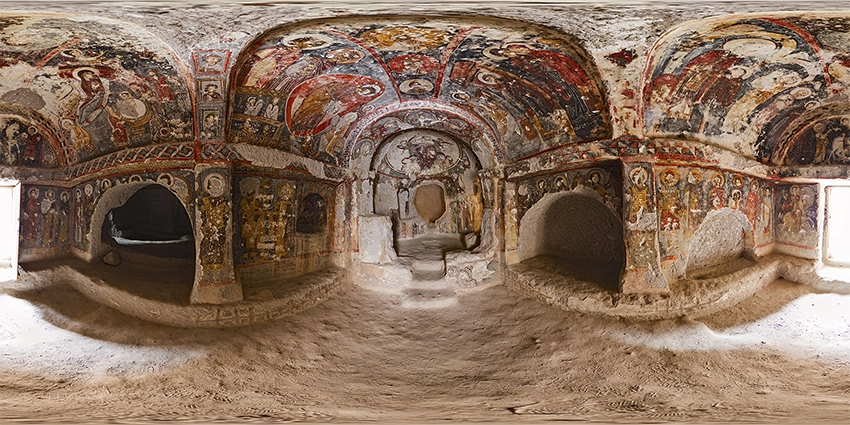
Saint Barbara Church combines figurative paintings with red ochre symbols and linear designs.
Geometric forms, crosses, stylized creatures and sacred figures appear across the compact interior.
The decoration differs from the continuous New Testament cycles found in larger churches.
Visitors should still avoid dividing the imagery into important figures and meaningless patterns. Abstract forms could frame, protect, separate or emphasize sacred areas.
The exact meaning of every motif is not known.
A careful interpretation distinguishes clearly recognizable Christian symbols from forms whose purpose remains uncertain.
How to Read the Decoration
Begin With Architectural Position
Images placed in the dome, upper vaults or sanctuary have a different visual importance from motifs near the entrance or lower walls.
Position helps explain hierarchy but does not prove the identity of a damaged figure.
Separate Figurative and Symbolic Forms
Christ, mounted saints and other human figures can be identified through halos, clothing, inscriptions and attributes.
Geometric forms and animal-like motifs may require comparison with other churches and should not be assigned one certain meaning from resemblance alone.
Follow Repeated Crosses
Crosses can appear independently, inside larger designs or beside symbolic creatures.
Their repetition creates a protective and religious visual field throughout the interior.
Notice Painted Boundaries
Red borders separate surfaces and create the appearance of architectural order.
They can also direct attention toward the sanctuary or frame a sacred figure.
Christ Enthroned
A representation of Christ enthroned occupies an elevated part of the church.
The image is surrounded by red geometric decoration following the curved rock surface.
Christ's upper position reflects visual hierarchy in Byzantine church art.
Major sacred figures were commonly placed in domes, upper vaults and sanctuary zones.
Saints and supporting figures could appear on lower walls or adjoining surfaces.
The elevated placement should be read together with gesture, halo, clothing and any surviving inscription.
Meaning of the Throne
The throne communicates authority, judgement and divine rule.
Christ is not represented as an ordinary seated figure.
His position transforms the upper architectural zone into a visual statement of sacred authority.
The surrounding geometric decoration reinforces rather than distracts from the central image.
What to Notice
- The position of Christ above the main viewing level
- The relationship between the figure and the curved surface
- The throne and seated posture
- The use of red borders around the image
- The contrast between the sacred figure and abstract decoration
Saint George and Saint Theodore
One of the church's most recognizable compositions shows Saint George and Saint Theodore on horseback.
The warrior saints confront a dragon and a serpent-like creature.
Mounted saints were associated with protection, faith and the defeat of evil.
Their horses, weapons and opposing creatures create movement despite the restrained color palette.
Similar equestrian saints appear in other Cappadocian churches, but their arrangement, inscriptions and accompanying figures can differ.
How the Composition Creates Movement
The direction of the horses and weapons leads the viewer toward the defeated creatures.
The saints' elevated mounted position establishes authority.
The dragon and serpent-like forms occupy the vulnerable lower zone.
Halos identify the riders as sacred figures rather than ordinary soldiers.
The complete composition communicates victory through position and direction as well as through the represented action.
Protection and the Defeat of Evil
The warrior saints should not be interpreted as a record of a literal local battle.
The dragon-fighting image belongs to a Christian symbolic tradition in which evil is made visible as a defeated creature.
The subject also reflects the protective role assigned to military saints in Byzantine devotion.
The Locust-Like Symbol
Another unusual design resembles a large locust, grasshopper or insect-like creature positioned near crosses.
It has often been interpreted as evil, danger or destruction restrained by the protective power of the cross.
This explanation remains uncertain.
The figure should therefore be described as a locust-like or insect-like motif rather than identified as one specific creature with one proven meaning.
Visual resemblance alone cannot establish whether the painter intended a locust, another animal or a symbolic hybrid.
The surrounding crosses remain important because they place the motif within a Christian visual context.
Why Caution Matters
Unusual images often attract dramatic explanations.
A memorable story can become repeated until it sounds like documented fact.
The responsible approach separates what is visibly present from what scholars or guides have proposed.
The motif's shape and location are certain. Its exact symbolic meaning is not.
Crosses and Geometric Signs
Crosses appear in several forms across the church.
They may stand alone, terminate linear designs or occupy the center of geometric arrangements.
Geometric signs can include intersecting lines, borders, circles and repeated angular forms.
These patterns structure the interior and connect separate surfaces visually.
The decoration demonstrates that Byzantine religious meaning could be communicated without a continuous narrative cycle.
Simple color does not mean simple thought. The placement and repetition of crosses create a deliberate sacred environment.
Who Was Saint Barbara?
According to Christian hagiographic tradition, Saint Barbara was an early Christian martyr associated with the 3rd century.
Her feast day is observed on December 4 in several Christian traditions.
Later devotional accounts describe her as the daughter of a wealthy pagan named Dioscorus.
Her father is said to have confined her in a tower to separate her from the outside world.
Barbara nevertheless became a Christian in secret.
These stories belong to hagiography, a religious literary tradition centered on the lives, suffering and virtues of saints.
The Three Windows and the Trinity
One part of the later legend says that Barbara's father ordered a private bathhouse with two windows.
During his absence, Barbara had a third window added as a sign of the Holy Trinity.
The three-window story became one of the most recognizable elements of her devotional biography.
It should not be treated as an independently documented historical event.
The story's religious purpose is clear: Barbara uses architecture to express her Christian faith.
Martyrdom and Lightning
According to the legend, Barbara's father attempted to kill her after she admitted her Christian faith.
The story describes a miraculous escape, later betrayal, arrest and torture.
Barbara was eventually condemned to death by beheading, with her father carrying out the sentence.
Later accounts say that he was struck by lightning on his journey home.
This ending explains why Barbara became associated with protection from lightning, fire, explosions and sudden death.
The story belongs to devotional tradition and should not be presented as verified biography.
Saint Barbara's Later Patronage
Saint Barbara became a patron saint of people whose work involved sudden danger, fire or explosives.
Later traditions associated her with miners, artillery workers, military engineers and similar occupations.
Related Tours
Popular experiences for this destination
Red TourRed Tour Cappadocia
Discover Göreme Open-Air Museum, Avanos pottery workshops, and breatht…
AdventureATV Tour Cappadocia
Ride powerful ATVs through Cappadocia’s unique valleys, fairy chimneys…
AdventureHorseback Riding Tour Cappadocia
Experience Cappadocia on horseback, riding through valleys, hidden tra…
AdventureTrekking Tours Cappadocia
Hike Cappadocia’s spectacular valleys, fairy chimneys, and cave dwelli…
Pottery Workshop Cappadocia
Learn the ancient art of pottery from Avanos masters, try shaping clay…
Blue TourBlue Tour Cappadocia
Explore hidden valleys, ancient churches, and cultural gems on Cappado…
Vip Mix Tour Cappadocia
Experience the ultimate Cappadocia highlights in comfort-historic vall…
Green TourGreen Tour Cappadocia
Explore Derinkuyu underground city, the beautiful Ihlara Valley, and S…
Cappadocia Rent A Car
Explore Cappadocia freely at your own pace with flexible car rental op…
BalloonCappadocia Hot Air Balloon Tour
See Cappadocia from the air at sunrise on a professionally operated ho…
Turkish Night Show Cappadocia
Enjoy a traditional Turkish dinner with live music, folk dances, and w…
Professional Photo Shoot Cappadocia
Capture your Cappadocia moments with a guided professional photo shoot…
These associations developed from the lightning and martyrdom legend.
They are not evidence that the Göreme church was built for miners, soldiers or explosive workers.
The identity of a saint and the historical function of a church must be interpreted separately.
Saint Barbara in New Tokalı Church
A separate representation of Saint Barbara appears in the New Church of Tokalı.
That image confirms the wider importance of Saint Barbara within Cappadocian religious painting.
It must not be confused with the paintings inside Saint Barbara Church.
Tokalı has its own architectural history and fresco program.
The presence of Barbara in more than one church demonstrates regional devotion, not one shared interior or identical date.
Church Dedication and Painted Program
The church's modern dedication to Saint Barbara and the surviving paintings should not automatically be treated as the same type of evidence.
A church may be named for a saint even when the best-known surviving paintings represent Christ, warrior saints or symbolic creatures.
Later names can also preserve local tradition rather than an original dedicatory inscription.
The precise medieval process by which the church received its name should remain uncertain when written evidence is incomplete.
This caution allows the legend of Saint Barbara and the art inside the monument to be explained without merging them into one unsupported story.
Why the Decoration Is Unusual
The interior includes:
- Christ enthroned in an elevated position
- Mounted warrior saints confronting creatures
- Crosses and geometric signs
- A locust-like or insect-like symbolic figure
- Red lines imitating constructed stonework
- A combination of sacred portraiture and abstract visual organization
This mixture allows visitors to see how religious meaning could be communicated through several visual methods at once.
The church is not unfinished simply because it lacks the same type of long narrative cycle seen in Tokalı.
Its decoration responds to its own architecture, scale and devotional purpose.
Color and Painting Technique
Red ochre provides the dominant visual language in much of the church.
The pigment was used for borders, masonry imitation, crosses, geometric forms and selected details.
Figurative images include additional tones, but the overall impression remains restrained compared with richer narrative interiors.
The rock surface may have received different levels of preparation before painting.
Some designs appear closely connected with the natural stone, while more developed figures may rely on prepared surfaces and layered color.
The exact technique can vary across the interior and should not be reduced to one method for every mark.
Why the Paintings Survive Unevenly
Moisture, dust, temperature change, smoke, scratching and physical contact affect wall paintings.
Rock movement or loss of plaster can remove complete parts of a figure or geometric design.
Areas near openings may experience stronger air movement and environmental change.
Darkened or damaged sections should not automatically be interpreted as unfinished decoration.
Later use and restoration can also change the appearance of the surface.
Visitors see the combined result of original painting, natural deterioration and conservation.
Conservation and Visitor Behavior
Saint Barbara Church is protected within the UNESCO-listed Göreme landscape.
Its paintings and carved surfaces remain vulnerable to moisture, erosion, touching and heavy visitor traffic.
- Do not touch frescoes, columns or painted rock.
- Do not use flash.
- Follow current signs when photography is prohibited.
- Keep bags, coats and hair away from walls.
- Do not lean against supports or apses.
- Do not block the entrance for photographs.
- Keep voices low inside the sanctuary.
- Never move a barrier for a closer view.
A brighter photograph is not more important than the survival of an 11th-century painted surface.
Visitor Information
| Planning Point | Practical Guidance |
|---|---|
| Location | Inside Göreme Open-Air Museum near central Göreme |
| Typical Time | Approximately 20 to 40 minutes for the church itself |
| Admission | Managed under current museum ticket and pass conditions |
| Opening Hours | Check the current museum schedule and restoration notices |
| Photography | Follow current signs and never use flash |
| Walking Conditions | Stone steps, sloping paths and uneven volcanic surfaces |
Final admission may occur before the listed museum closing time.
Official events, restoration and visitor management can affect access to individual churches.
Accessibility and Physical Conditions
The museum route includes stone steps, slopes and uneven rock.
Full wheelchair access to Saint Barbara Church should not be assumed.
Visitors with limited mobility should ask about the current accessible route at the museum entrance.
The compact interior can feel crowded when several groups arrive together.
Low light may affect visitors with balance or visual concerns.
Strollers are not practical inside the small rock-cut sanctuary.
Visiting With Children
Children can visit with close adult supervision.
- Keep children beside an adult on steps and slopes.
- Do not allow touching of painted walls or supports.
- Do not let children climb barriers or carved surfaces.
- Keep entrances clear for other visitors.
- Explain before entering that the church is a protected monument.
The symbolic animals and mounted saints can hold a child's attention, but the images should be explained without presenting uncertain interpretations as fact.
Best Time to Visit
Early Morning
Early arrival often provides the calmest interior and the best opportunity to examine smaller red motifs.
Midday
Midday can be crowded during popular travel periods.
Groups may move through the church in close sequence, reducing the time available for observation.
Late Afternoon
Late afternoon may be quieter, but final admission times must be confirmed.
Do not leave Saint Barbara Church until the last minutes when it is a priority.
Visiting With a Guide
A knowledgeable guide can explain the cross-domed plan, identify mounted saints and separate established Christian symbols from uncertain motifs.
Ask the guide to explain whether a claim comes from an inscription, a recognized iconographic tradition or later local interpretation.
Detailed explanations should be given in a position that does not block the entrance.
Göreme Open-Air Museum is commonly included in the Cappadocia Red Tour.
A private Cappadocia Mix Tour can provide more control over museum time and the balance between churches and panoramic stops.
Combining Saint Barbara Church With the Museum Route
Saint Barbara Church should be viewed as part of the wider Göreme church landscape.
The Göreme Open-Air Museum guide explains the main route, ticket planning and the relationship between principal complexes.
Allow at least two hours for a normal museum visit and more when Tokalı Church and Dark Church are priorities.
Compare Saint Barbara with Elmalı or Çarıklı to understand differences between symbolic red decoration and extensive New Testament cycles.
Compare it with Yılanlı Church to examine how warrior saints and unusual local names appear in different architectural settings.
The guide to Christian history in Cappadocia provides the wider context of monastic life, iconoclasm and Byzantine painting.
Continue Exploring Göreme's Churches
Tokalı Church
Tokalı Church preserves a large multi-section complex and one of Cappadocia's most extensive biblical painting programs.
Dark Church
Dark Church is known for its later Byzantine frescoes, strong color preservation, Deisis and Anastasis.
Elmalı, Yılanlı and Çarıklı
The Elmalı, Yılanlı and Çarıklı Churches provide useful comparisons of narrative painting, saintly portraiture and column-supported architecture.
El Nazar Church
El Nazar Church offers a 10th-century fresco cycle inside a freestanding volcanic cone outside the main museum enclosure.
Common Saint Barbara Church Planning Mistakes
- Calling the church iconoclastic: It is generally dated to the 11th-century post-iconoclastic period.
- Treating every red form as decoration without meaning: Crosses and boundaries organize the sacred interior.
- Assigning one certain meaning to the locust-like image: Its exact interpretation remains uncertain.
- Assuming the saint's legend proves the church's function: Later patronage does not identify the original community.
- Confusing the Tokalı image with this church: Saint Barbara appears in more than one monument.
- Looking only at the mounted saints: Architecture and red masonry imitation are equally important.
- Using flash: Current conservation rules must be followed.
- Blocking the entrance: The compact interior requires controlled movement.
- Depending on old ticket information: Museum conditions can change.
Questions Travelers Ask About Saint Barbara Church
Where is Saint Barbara Church?
It is located inside Göreme Open-Air Museum near central Göreme.
How old is Saint Barbara Church?
The church is generally dated to the 11th century.
What makes the church unusual?
Its interior combines Christ, mounted warrior saints, crosses, geometric motifs, a locust-like figure and red lines imitating masonry.
Is it an iconoclastic church?
No. Its 11th-century dating and figurative paintings place it within the post-iconoclastic period.
Who are the mounted saints?
They are identified as Saint George and Saint Theodore confronting a dragon and serpent-like creature.
What is the insect-like image?
It resembles a locust or grasshopper and has been interpreted symbolically, but its exact meaning remains uncertain.
Who was Saint Barbara?
Christian hagiographic tradition describes her as an early martyr whose later legend connected her with protection from lightning, explosions and sudden death.
Did Saint Barbara live in Cappadocia?
The church's dedication does not prove that the saint lived in Göreme or used this sanctuary.
How long should you spend inside?
Allow approximately 20 to 40 minutes when the architecture and symbols are a priority.
Can visitors take photographs?
Photography rules can change. Follow current signs and never use flash.
Is the church wheelchair accessible?
Full access should not be assumed because the museum route includes stone steps, slopes and uneven surfaces.
Can children visit?
Yes, with close supervision around steps, barriers and painted surfaces.
Is a guide useful?
Yes. A guide can explain the architecture, saintly figures and the difference between recognized symbols and uncertain interpretations.
A Symbolic Church of Byzantine Cappadocia
Saint Barbara Church is memorable because a compact carved interior contains several different forms of Byzantine visual communication.
Christ enthroned establishes sacred authority in the upper zone.
Saint George and Saint Theodore represent protection and the defeat of evil through a dynamic mounted composition.
Crosses, geometric forms and red masonry imitation organize the surrounding surfaces.
The locust-like motif demonstrates why unusual images should be described carefully when their exact meaning is uncertain.
The legend of Saint Barbara provides devotional context, but it should remain separate from unsupported claims about the church's original function.
Use the Cappadocia trip planning guide and the Cappadocia safety and essentials guide when planning the wider museum visit.