Tokali Church
Tokalı Church: Architecture, Frescoes and Biblical Scenes
Tokalı Church, also known as the Church of the Buckle, stands near the entrance area of the Göreme Open-Air Museum. It is one of the most important rock-cut churches in Cappadocia for understanding Byzantine architecture, religious storytelling and mural painting.
Tokalı is not a single chamber. It developed as a connected complex of chapels, burial spaces and worship areas. Its walls and vaults preserve an extensive visual sequence covering the childhood, ministry, miracles, Passion and Resurrection of Christ.
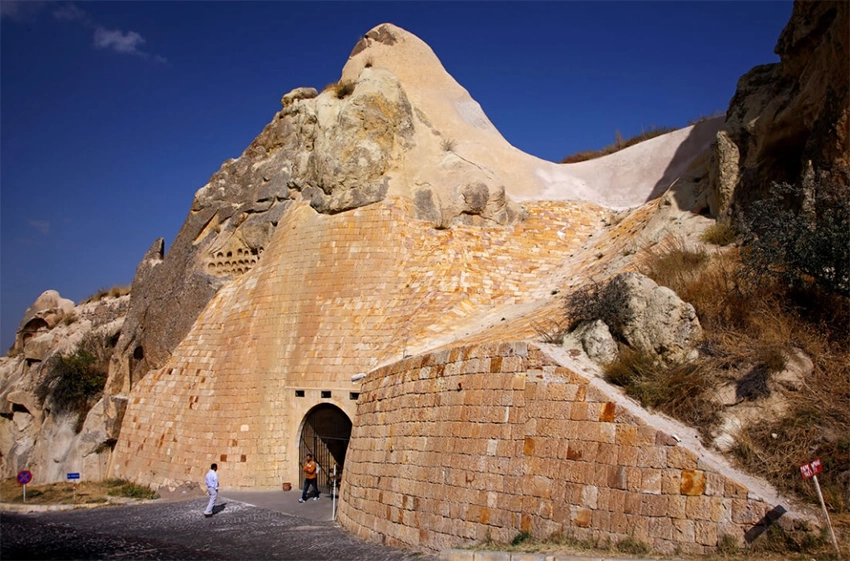
Most visitors need approximately 30 to 60 minutes inside the complex, depending on crowd levels, current access and how carefully they examine the paintings.
The strongest visit begins with the architecture. Identifying the Old Church, New Church, Lower Church and side chapel makes the fresco program easier to follow.
Opening hours, ticket arrangements and photography rules can change. Check the current official information and follow the instructions displayed at the church.
Why Tokalı Church Is Important
Tokalı Church belongs to the wider Göreme National Park and the Rock Sites of Cappadocia, which entered the UNESCO World Heritage List in 1985.
The complex is associated primarily with the 10th-century development of the Göreme Valley's rock-cut church architecture and painting.
Its importance comes from the relationship between architecture and narrative. The paintings are not separate decorative panels added without order. They form a structured visual account that moves across walls, vaults and architectural divisions.
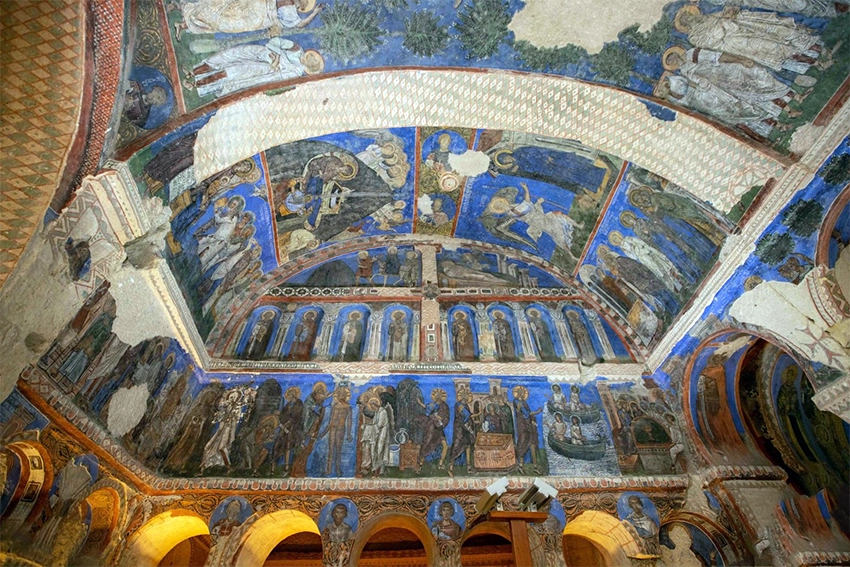
The New Church is especially recognizable for its deep blue backgrounds, strongly outlined figures and large biblical compositions.
The Old Church preserves a denser narrative sequence arranged in horizontal bands. Comparing the two sections helps visitors understand how scale, architecture and viewing distance changed the presentation of sacred stories.
Tokalı is also valuable because its connected spaces reveal several phases of construction, burial and decoration rather than one completed design created at a single moment.
How to Plan a First Visit
Visit Tokalı before or after the main Göreme Open-Air Museum circuit according to the current entrance arrangement. Do not assume that its position outside or near the principal gate means the ticket conditions are separate or permanently unchanged.
Allow your eyes time to adjust before studying the frescoes. Entering directly from bright sunlight can make the interior appear darker and less detailed than it really is.
Move slowly and use the larger spaces for observation. Narrow connecting areas and doorways should remain clear for other visitors.
Wear shoes with secure grip. The route can include uneven rock floors, worn steps, low-light areas and narrow transitions.
Carry only compact photography equipment. Tripods, large bags and long straps are difficult to manage in a crowded rock-cut interior.
Visitors primarily interested in the painted scenes should arrive early when possible. A quieter interior makes it easier to follow the sequence without being moved forward by another group.
Tokalı Church at a Glance
| Feature | Main Importance | What to Notice |
|---|---|---|
| Old Church | Dense narrative cycle in horizontal bands | How one scene leads into the next across the barrel vault |
| New Church | Large compositions and deep blue backgrounds | Miracles, figures, inscriptions and architectural framing |
| Lower Church | Earlier development and burial context | The relationship between worship and commemoration |
| Side Chapel | Additional liturgical and commemorative space | Its connection with the larger complex |
The table provides a visitor framework rather than a complete archaeological chronology. Dating and phase relationships require careful study of architecture, painting and later alterations.
The Four-Part Rock-Cut Complex
Tokalı Church is generally described as a complex of four connected sections:
- Old Church: A single-nave, barrel-vaulted space that now also provides access toward the New Church.
- New Church: The larger and more elaborately painted section, containing extensive scenes from the life and miracles of Christ.
- Lower Church: A lower rock-cut section associated with the earlier development of the complex and containing burial spaces.
- Side Chapel: A smaller adjoining chapel, sometimes described by the Byzantine architectural term parekklesion.
The complex was created by cutting architecture directly into volcanic tuff. Arches, vaults, apses, columns and interior divisions were formed by removing rock rather than building walls from separate masonry blocks.
This method allowed builders to imitate familiar architectural forms inside a natural rock mass.
Carved columns and arches could organize the interior visually even when they did not carry loads in the same way as freestanding masonry construction.
The connected sections also show that rock-cut architecture could be expanded. A new space could be opened beside, below or beyond an earlier chapel when the community's needs changed.
The Old Church
Single-Nave Plan
The Old Church is a single-nave space covered by a barrel vault.
Its long interior creates a clear direction from entrance to sanctuary while also providing an extended surface for painted narrative bands.
The compact plan requires the viewer to stand relatively close to the scenes. This contributes to the dense and continuous feeling of the program.
Narrative Bands
The Old Church contains a long visual sequence arranged in horizontal registers across the vault.
The paintings follow episodes from the childhood of Christ, his ministry and miracles, and the events leading toward the Passion.
The viewer should not examine only one surviving image. The historical value of the Old Church comes from the way several scenes work together as a sequence.
Architectural boundaries and painted bands help separate one episode from another while preserving the direction of the larger story.
How to Follow the Old Church Cycle
Begin near the entrance and identify the direction in which the narrative develops.
Look for repeated figures, especially Christ, the Virgin Mary and the apostles. Their position and gestures help connect scenes even when inscriptions or painted surfaces are incomplete.
Do not expect a modern left-to-right reading order on every surface. The sequence responds to the shape of the vault and the liturgical orientation of the church.
The New Church
A Larger Painted Interior
The New Church is larger and visually more open than the Old Church.
Related Tours
Popular experiences for this destination
 Adventure
ATV Tour Cappadocia
Ride powerful ATVs through Cappadocia’s unique valleys, fairy chimneys…
 Red Tour
Red Tour Cappadocia
Discover Göreme Open-Air Museum, Avanos pottery workshops, and breatht…
 Adventure
Horseback Riding Tour Cappadocia
Experience Cappadocia on horseback, riding through valleys, hidden tra…
 Adventure
Trekking Tours Cappadocia
Hike Cappadocia’s spectacular valleys, fairy chimneys, and cave dwelli…
Pottery Workshop Cappadocia
Learn the ancient art of pottery from Avanos masters, try shaping clay…
 Green Tour
Green Tour Cappadocia
Explore Derinkuyu underground city, the beautiful Ihlara Valley, and S…
 Blue Tour
Blue Tour Cappadocia
Explore hidden valleys, ancient churches, and cultural gems on Cappado…
Vip Mix Tour Cappadocia
Experience the ultimate Cappadocia highlights in comfort-historic vall…

Cappadocia Rent A Car
Explore Cappadocia freely at your own pace with flexible car rental op…
 Balloon
Cappadocia Hot Air Balloon Tour
See Cappadocia from the air at sunrise on a professionally operated ho…
Turkish Night Show Cappadocia
Enjoy a traditional Turkish dinner with live music, folk dances, and w…
Professional Photo Shoot Cappadocia
Capture your Cappadocia moments with a guided professional photo shoot…
Its architecture provides broader surfaces for large compositions and a different relationship between figures and viewers.
The paintings include Christ, the Virgin Mary, apostles, saints, witnesses and participants in biblical events.
The expanded scale allows gestures, clothing, architecture and groups of figures to be presented with greater visual separation.
Deep Blue Backgrounds
The deep blue backgrounds are among the most recognizable features of the New Church.
Blue gives visual unity to several compositions and increases the contrast between figures, halos, inscriptions and architectural details.
The surviving color should be viewed as part of the complete painting program rather than as a decorative effect separated from the scenes.
Paint loss, moisture, dust and later damage can affect the intensity of the color in different sections.
Architecture and Painted Space
Painted buildings, beds, tombs and landscape elements help identify biblical settings inside the scenes.
These painted settings do not reproduce Cappadocian buildings literally. They create a visual language that allows the viewer to recognize a house, city, sanctuary or burial place.
The real rock-cut architecture and the painted architecture work together. Vaults, arches and apses provide boundaries for the sacred narrative.
The Lower Church and Burial Context
The Lower Church belongs to the earlier development of the complex and contains burial spaces.
Burial areas connect the church with commemoration, family memory and the desire to be buried near a sacred place.
The presence of graves does not mean the section functioned only as a cemetery. Worship and commemoration could operate together.
Later construction above or beside an earlier space can change circulation and make the first architectural arrangement difficult to reconstruct.
Visitors should not enter closed burial recesses, step into graves or place objects inside them.
The Side Chapel or Parekklesion
The smaller adjoining chapel is sometimes described as a parekklesion.
This term refers to a subsidiary chapel connected with a larger church or religious complex.
A side chapel could support additional worship, burial, commemoration or services connected with a smaller group.
Its meaning should be interpreted through its position, decoration and relationship with the main church rather than from the modern label alone.
Access to a side section may change for conservation or visitor-flow reasons.
The Fresco Program as a Continuous Narrative
The Old and New Church paintings should not be viewed as a random collection of famous biblical images.
The sequence moves through major stages in the life of Christ, including childhood, ministry, miracles, suffering, death and renewed life.
Scenes of healing and resurrection prepare the theological context for the Passion and Resurrection.
The architecture controls where the viewer encounters each event. A scene placed on a vault, wall or apse carries a different visual relationship to the worship space.
Some parts of the program survive more clearly than others. Missing plaster and paint should not be mistaken for an originally empty area.
Childhood and Ministry Scenes
Scenes from the childhood and public ministry of Christ establish the beginning of the narrative.
Figures may be identified through halos, inscriptions, clothing, gestures and their position within a familiar biblical event.
The Virgin Mary, apostles, religious authorities and witnesses appear according to the needs of each composition.
Painted architecture can indicate an interior, city or sacred location even when perspective does not follow modern visual conventions.
Visitors should focus on the relationship between figures rather than judging the paintings by modern realism.
Miracle Scenes in Tokalı Church
Miracle scenes demonstrate healing, divine authority, faith and restoration.
They also create narrative rhythm. A composition with several witnesses may be followed by a more intimate event centered on Christ and one individual.
Hand gestures are especially important. Christ may bless, command, touch or raise a person, while witnesses express grief, surprise or prayer.
Two of the clearest resurrection miracles discussed in the New Church are the Resurrection of Jairus' Daughter and the Raising of Lazarus.
Resurrection of Jairus' Daughter
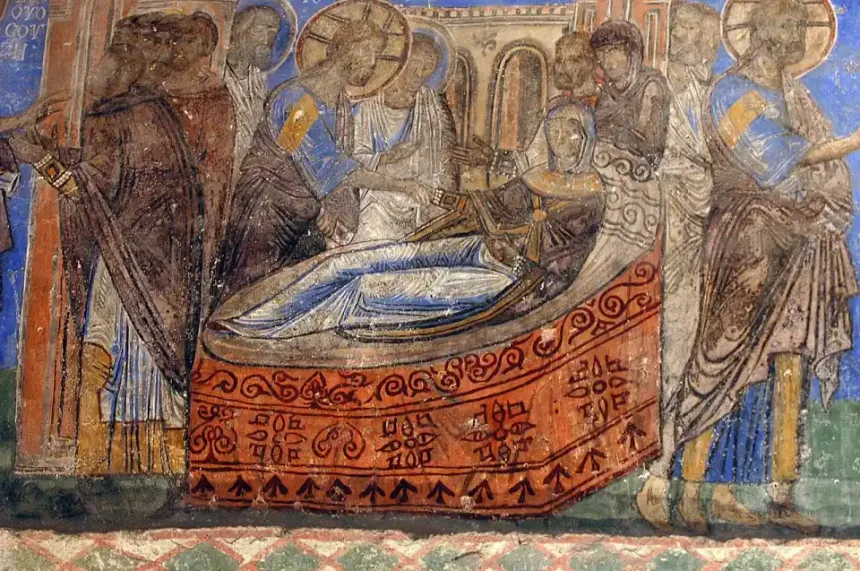
One important miracle scene in the New Church depicts the Resurrection of Jairus' Daughter.
The event appears in the Gospels of Mark, Matthew and Luke.
Jairus, a leader or patron of the synagogue, approaches Jesus and asks him to save his daughter.
In the accounts of Mark and Luke, the girl is dying when Jairus makes his request. In Matthew, she is already dead.
While Jesus travels toward the house, a woman suffering from prolonged bleeding touches his cloak and is healed. The two miracles are therefore connected within the Gospel narrative.
When Jesus reaches the house, he takes the girl by the hand and restores her to life.
The Gospel of Mark preserves the Aramaic words:
Talitha Koum, meaning, Little girl, I say to you, get up.
How the Scene Is Composed
In the Tokalı composition, Christ approaches the bed and takes the young girl by the hand.
The scene focuses attention on the physical connection between Christ and the child.
The bed identifies the domestic setting and separates the miracle from the public tomb setting used in the Lazarus scene.
Nearby figures provide witness and emotional context, but the central action remains the gesture of raising the girl.
What to Notice
- The position of Christ beside the bed
- The physical contact between Christ and the girl
- The direction in which surrounding figures look
- The use of the bed to define an interior setting
- The contrast between stillness and renewed movement
The scene should be read as part of the wider miracle cycle rather than as an isolated image of a child.
The Raising of Lazarus
Another major resurrection miracle in the New Church is the Raising of Lazarus.
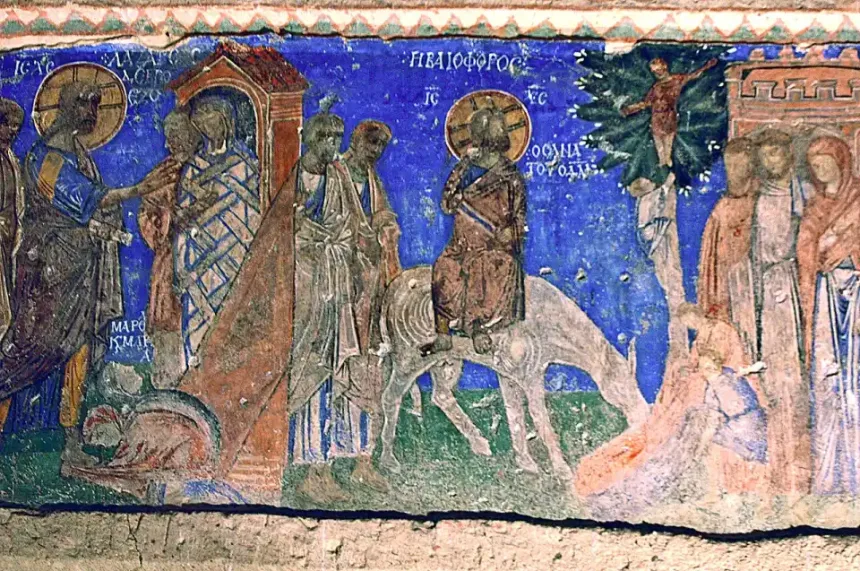
The composition presents the moment when Christ commands Lazarus to leave his tomb.
Christ stands on the left and is followed by two apostles.
His right hand extends in a gesture of blessing and command. In his left hand he holds a scroll associated with teaching and divine authority.
Martha and Mary appear at the feet of Christ in proskynesis, a gesture of bowing or prostration.
Martha turns her head toward Lazarus, connecting the figures on the two sides of the composition.
On the right, Lazarus stands within or beside the tomb, wrapped in white grave cloth.
A nearby figure holds the stone slab that had covered the burial place.
Public Miracle and Witnesses
The Lazarus scene is more public than the scene of Jairus' daughter.
Apostles, family members and other figures frame the command and the opening of the tomb.
The composition uses distance and opposing groups to create a visual line between Christ and Lazarus.
The viewer can follow this line through Christ's extended hand, the kneeling sisters and the figure emerging from burial.
Burial Cloth and Tomb
The white grave cloth identifies Lazarus as someone who has left the tomb but remains visibly connected with death and burial.
The stone slab and tomb architecture establish the setting and distinguish the scene from healing miracles that occur in houses or public streets.
These objects also help a viewer recognize the biblical event when parts of an inscription are difficult to read.
Greek Inscriptions in the Lazarus Fresco
The inscriptions identify the principal figures and preserve Christ's command to Lazarus:
- IC XC: An abbreviated form of Iesous Christos, meaning Jesus Christ.
- ΛΑΖΑΡΕ / ΔΕΥΡΟ / ΕΞΩ: Lazarus, come out.
- ΜΑΡΘΑ / Κ ΜΑΡΙΑ: Martha and Mary.
The inscriptions were not merely decorative.
They helped viewers identify figures, recognize the event and connect the painted action with words from the biblical account.
Abbreviations such as IC XC were familiar visual identifiers in Byzantine Christian art.
Damage, paint loss and viewing distance can make individual letters difficult to see today.
Visitors should use their eyes or a moderate camera zoom rather than moving close to the wall.
Jairus' Daughter and Lazarus Compared
| Feature | Jairus' Daughter | Lazarus |
|---|---|---|
| Setting | Domestic interior beside a bed | Public burial setting beside a tomb |
| Central Action | Christ takes the girl by the hand | Christ commands Lazarus to come out |
| Visual Emphasis | Intimate contact and awakening | Authority, witnesses and emergence from burial |
| Main Objects | Bed and domestic architecture | Tomb, grave cloth and stone slab |
Both scenes focus on restoration from death, but their compositions communicate the event differently.
Related Tours
Popular experiences for this destination
AdventureATV Tour Cappadocia
Ride powerful ATVs through Cappadocia’s unique valleys, fairy chimneys…
Red TourRed Tour Cappadocia
Discover Göreme Open-Air Museum, Avanos pottery workshops, and breatht…
AdventureHorseback Riding Tour Cappadocia
Experience Cappadocia on horseback, riding through valleys, hidden tra…
AdventureTrekking Tours Cappadocia
Hike Cappadocia’s spectacular valleys, fairy chimneys, and cave dwelli…
Pottery Workshop Cappadocia
Learn the ancient art of pottery from Avanos masters, try shaping clay…
Green TourGreen Tour Cappadocia
Explore Derinkuyu underground city, the beautiful Ihlara Valley, and S…
Blue TourBlue Tour Cappadocia
Explore hidden valleys, ancient churches, and cultural gems on Cappado…
Vip Mix Tour Cappadocia
Experience the ultimate Cappadocia highlights in comfort-historic vall…
Cappadocia Rent A Car
Explore Cappadocia freely at your own pace with flexible car rental op…
BalloonCappadocia Hot Air Balloon Tour
See Cappadocia from the air at sunrise on a professionally operated ho…
Turkish Night Show Cappadocia
Enjoy a traditional Turkish dinner with live music, folk dances, and w…
Professional Photo Shoot Cappadocia
Capture your Cappadocia moments with a guided professional photo shoot…
Together, they contribute to the wider theological narrative leading toward Christ's own Passion and Resurrection.
Passion, Resurrection and Ascension
The miracle cycles prepare the viewer for the events of the Passion and Resurrection.
Scenes connected with suffering, death, victory over death and Ascension complete the larger narrative movement of the church.
The Descent into Hell, also known as the Anastasis in Byzantine art, presents Christ's victory over death and his liberation of the righteous.
The Ascension shifts attention from earthly action toward divine authority and the continuation of the Christian community.
These scenes should be followed within the complete architectural program rather than searched for only as separate famous images.
How to Identify Christ and Other Figures
Halos
Christ is commonly shown with a cross-inscribed halo.
Other holy figures may have plain halos, but the form, position and inscription should be considered together.
IC XC
The abbreviation IC XC identifies Jesus Christ through the first and final letters of the Greek words.
It can appear near Christ's head and helps identify him even when the surrounding scene is damaged.
Clothing and Position
Clothing colors, scrolls, books and placement within the group can help distinguish apostles, saints and other participants.
These features should not be interpreted alone because paint loss can remove an important identifying detail.
Inscriptions
Greek inscriptions may name a person, scene or spoken command.
An incomplete inscription should be read cautiously. A few surviving letters do not always support a complete identification.
How Gestures Communicate Meaning
Byzantine paintings use hands, posture and gaze to communicate action and emotion.
Christ's extended hand can express command, blessing or healing.
Prostration can express prayer, grief, reverence or appeal.
A figure turning toward another part of the scene can connect two groups that appear visually separated.
Witnesses often guide the viewer's attention through their gaze.
Look at the complete body before assigning one meaning to a hand gesture. Position, surrounding figures and the biblical context all matter.
How Architecture Organizes the Frescoes
Vaults, arches, apses and walls divide the painted program into meaningful zones.
A scene placed above the viewer has a different visual emphasis from one positioned near eye level.
The apse and sanctuary belong to the liturgical focus of the church and should not be read as ordinary wall space.
Architectural transitions can mark a change between childhood scenes, miracles, Passion events or saintly figures.
The Old Church uses its long vault for a dense sequence, while the New Church provides broader surfaces for larger compositions.
This difference is central to understanding why the two painted programs feel distinct even when they belong to one connected complex.
Painting Technique and Surface Preparation
The paintings were applied to prepared rock surfaces rather than directly to untreated volcanic stone in every area.
Plaster and painting layers created a suitable ground for figures, inscriptions and color.
Different working phases may be visible where surfaces, outlines or color application change.
The word fresco is widely used for Cappadocian wall paintings, but the exact painting method and sequence can vary across a church and between monuments.
Visitors should avoid presenting every surface as the product of one painter or one uninterrupted campaign.
Why the Paintings Survive Unevenly
Moisture, dust, temperature change, smoke, scratching and physical contact affect wall paintings.
Rock movement and loss of plaster can remove complete parts of a scene.
Areas protected from strong light or direct air movement may retain color differently from exposed surfaces.
Later use can add soot, marks or damage that overlap the original painting.
A blank patch may represent lost decoration rather than an area that was never painted.
Tokalı Church and UNESCO Protection
Tokalı Church is protected within the UNESCO-listed Göreme National Park and the Rock Sites of Cappadocia.
The World Heritage property includes a wider cultural landscape of churches, settlements, valleys and underground structures.
The designation does not mean that every interior remains permanently open or unchanged.
Conservation may require temporary restrictions, controlled photography, visitor-flow changes or closure of a section.
Following these rules is part of protecting the paintings rather than an obstacle to the visit.
Photography and Conservation Rules
- Do not use flash.
- Follow current signs when photography is restricted completely.
- Do not touch painted or plastered surfaces.
- Keep bags and clothing away from the walls.
- Do not lean against carved columns or burial areas.
- Do not block doorways with a phone or camera.
- Do not use tripods when they are prohibited or obstruct movement.
- Keep voices low inside the church.
A brighter photograph is not more important than the survival of the painted surface.
Long exposure, increased camera sensitivity and careful observation are better than flash when current rules allow photography.
Visitors should never move a barrier to obtain a cleaner angle.
Visitor Information
| Planning Point | Practical Guidance |
|---|---|
| Location | Near the entrance area of Göreme Open-Air Museum and close to central Göreme |
| Visit Duration | Approximately 30 to 60 minutes for careful viewing |
| Opening Hours | Check the current official schedule and restoration notices |
| Tickets | Confirm current inclusion and Museum Pass conditions |
| Photography | Follow current signs and never use flash |
| Walking Conditions | Uneven floors, worn steps, low light and narrow transitions |
Schedules may change according to season, restoration work, official events and special museum programs.
Final admission may occur before the listed closing time. Leave enough time to see the complex without rushing.
Accessibility and Physical Conditions
Tokalı is not a completely level or uniformly accessible interior.
Uneven rock floors, steps, narrow transitions and low light can affect visitors with limited mobility or balance concerns.
Visitors who use a wheelchair should check current accessibility information before arriving. The full historic route may not be suitable.
Children should remain close to an adult around steps, burial spaces and fragile surfaces.
Strollers are not practical inside narrow rock-cut sections.
Allow older visitors time for their eyes to adjust before moving through darker areas.
Best Time to Visit
Early Morning
Early arrival often provides a quieter viewing experience and makes the narrative cycle easier to follow.
Midday
Midday can be crowded during busy travel periods. Groups may move through narrow sections in quick sequence.
Late Afternoon
Late visits may be calmer, but current closing and final admission times must be confirmed.
Do not leave Tokalı until the final minutes when it is an important part of the museum visit.
Visiting With a Guide
A knowledgeable guide can explain the relationship between the four sections, identify scenes and connect Greek inscriptions with the painted action.
The guide should provide detailed explanations in areas where the group does not block a doorway or another visitor's view.
Ask whether Tokalı Church is included in the planned route and how much time is allowed inside.
A tour that lists Göreme Open-Air Museum may still move quickly through individual churches.
Travelers can compare the Cappadocia Red Tour or request a more flexible route through the private Cappadocia Mix Tour.
Combining Tokalı With Göreme Open-Air Museum
Tokalı should be treated as part of the wider painted-church experience rather than a separate quick stop.
The Göreme Open-Air Museum guide explains the main route, ticket planning and the relationship between the churches.
Allow at least two hours for the wider museum area, with additional time when Tokalı and the Dark Church are priorities.
Do not attempt to memorize every scene in one visit. Compare architecture, color and narrative structure across a limited group of churches.
Continue Exploring Göreme's Painted Churches
Dark Church
The Dark Church preserves a richly painted interior whose limited natural light contributed to the survival of its colors.
Elmalı, Yılanlı and Çarıklı Churches
The Elmalı, Yılanlı and Çarıklı Churches allow visitors to compare different plans, painting programs and biblical scenes within the museum.
El Nazar Church
El Nazar Church provides another important 10th-century painted interior near Göreme, subject to current access conditions.
Christian History in Cappadocia
The guide to Christian history in Cappadocia explains the wider development of rock-cut architecture, monastic life, iconoclasm and Byzantine painting.
Common Tokalı Church Planning Mistakes
- Treating Tokalı as one chamber: The complex contains four connected sections with different functions and painting programs.
- Looking only at the blue background: Color is important, but the narrative order and architecture provide the main context.
- Searching only for famous scenes: Jairus and Lazarus belong to a larger sequence of childhood, ministry, Passion and Resurrection.
- Ignoring the Old Church: Its dense narrative bands are essential for understanding the complex.
- Reading every blank area as intentional: Plaster and paint loss can remove parts of the original program.
- Using flash: Current conservation rules must be followed.
- Blocking the doorway: Explanations and photographs should not stop visitor movement.
- Depending on an old ticket rule: Entrance and Museum Pass conditions can change.
- Rushing directly from sunlight: Allow the eyes time to adjust before examining the frescoes.
Questions Travelers Ask About Tokalı Church
Where is Tokalı Church?
Tokalı Church stands near the entrance area of Göreme Open-Air Museum, close to central Göreme.
Why is it called the Church of the Buckle?
Tokalı is commonly translated as Church of the Buckle. The modern name identifies the monument, but the exact historical reason for the name should not be used to invent an unsupported legend.
How long should you spend inside?
Allow approximately 30 to 60 minutes when the frescoes and architecture are a priority.
How many sections does Tokalı have?
The complex is generally described as four connected sections: the Old Church, New Church, Lower Church and a side chapel or parekklesion.
What is special about the New Church?
It contains large biblical compositions, deep blue backgrounds, Greek inscriptions and an extensive narrative of Christ's life and miracles.
What is special about the Old Church?
The Old Church preserves a dense narrative cycle arranged in horizontal bands across its barrel vault.
Which miracle scenes are especially important?
The Resurrection of Jairus' Daughter and the Raising of Lazarus are valuable for comparing an intimate domestic miracle with a public resurrection beside a tomb.
Can visitors photograph the frescoes?
Photography rules can change. Follow the current signs, do not use flash and do not stop the visitor route for a photograph.
Is Tokalı included with Göreme Open-Air Museum?
Ticket inclusion and Museum Pass conditions can change. Confirm the current arrangement at the official ticket office.
Is the church accessible?
The historic interior includes uneven floors, steps, narrow transitions and low-light areas. Full wheelchair access should not be assumed.
Can children visit?
Yes, with close supervision around steps, graves, barriers and painted surfaces.
Is a guide useful?
Yes. A guide can help visitors follow the narrative order, identify Greek inscriptions and understand the relationship between the four architectural sections.
A Painted Record of Byzantine Cappadocia
Tokalı Church is valuable not only for the number of surviving paintings but also for the way its architecture and frescoes work together.
The Old Church uses a narrow barrel-vaulted space for a dense sequence of events. The New Church expands the story through larger compositions, deep blue backgrounds and clearly organized groups of figures.
Scenes such as the Resurrection of Jairus' Daughter and the Raising of Lazarus transform the rock-cut interior into a continuous account of healing, faith, death and renewed life.
The Greek inscriptions, gestures, painted architecture and placement of witnesses help visitors understand each event without separating it from the complete program.
For travelers who take time to examine the structure before focusing on individual frescoes, Tokalı offers one of Cappadocia's clearest introductions to Byzantine religious storytelling.
Use the Cappadocia trip planning guide and the Cappadocia safety and essentials guide when combining Tokalı with the wider Göreme museum route.