Hittite & Phrygian Traces
Hittite and Phrygian Traces in Cappadocia
The ancient history of Cappadocia includes Bronze Age trade, Hittite political influence, the Iron Age kingdoms grouped under the name Tabal and contact with the Phrygian world. The clearest places for understanding these periods are Kültepe near Kayseri, the Topada inscription near Acıgöl and the Suvasa inscription near Gökçetoprak.
This history is less visible than Cappadocia's Byzantine churches and rock-cut settlements. Much of the evidence survives through excavation layers, clay tablets, seals, pottery, inscriptions and museum collections rather than complete temples or palaces.

A first visit should begin with chronology and geography. The word Cappadocia has described different territories in different periods, and the modern tourism region around Göreme, Ürgüp and Avanos should not be treated as one unchanged ancient province.
Kültepe provides the strongest introduction to Bronze Age trade and early written history. Topada and Suvasa are more specialized rural monuments connected with Iron Age Tabal and Luwian hieroglyphic writing.
The most reliable route separates what archaeology demonstrates from claims based mainly on local legend, visual resemblance or later tourism stories.
How to Plan a First Ancient Cappadocia Route
Begin with Kültepe and a museum collection before attempting remote inscription sites. Clay tablets, pottery, seals and reconstructed trade networks provide the context needed to understand the wider region.
Allow a separate day for Kültepe and Kayseri when traveling from central Cappadocia. The site is not a short roadside addition to a Göreme itinerary.
Topada and Suvasa are better suited to travelers with a private vehicle, a driver familiar with the area or a specialist guide. Road conditions, agricultural access and the visibility of the monuments should be checked locally.
Do not organize the day around an exact opening time copied from an old source. Museum schedules, excavation-area access and rural road conditions can change.
Carry offline maps, water, sun protection and suitable footwear. Remote inscription sites may not provide toilets, shops, signs or formal visitor facilities.
Visitors with limited time should prioritize Kültepe and Kayseri Archaeology Museum rather than attempting several poorly connected rural monuments.
Chronology at a Glance
| Period | Approximate Context | Key Evidence | Important Caution |
|---|---|---|---|
| Assyrian Trade Colonies | Early second millennium BC | Kültepe tablets, merchant houses and trade records | This archive predates the Hittite Empire |
| Hittite Period | Second millennium BC | Political influence, language history and wider Anatolian networks | Modern Cappadocia was not one fixed Hittite province |
| Tabal and Neo-Hittite States | Iron Age | Luwian inscriptions, royal titles and regional kingdoms | Tabal was politically complex and not always one unified state |
| Phrygian Contact | Iron Age | Political conflict, pottery, trade and regional interaction | Topada and Suvasa are not Phrygian inscriptions |
| Persian, Hellenistic and Roman Periods | First millennium BC into the Roman era | Changing administration, roads, towns and cultural networks | Later monuments should not be used as direct Hittite evidence |
These periods overlap through settlement continuity and cultural memory, but they should not be blended into one uninterrupted civilization.
Names such as Hittite, Neo-Hittite, Luwian, Tabal and Phrygian describe different political, linguistic and cultural contexts. They are connected, but they are not interchangeable.
Was Cappadocia Part of the Hittite Empire?
Parts of the wider Cappadocian region came under Hittite political and cultural influence during the second millennium BC.
The exact relationship changed across time. Borders expanded, contracted and followed political conditions that do not match modern provincial or tourism maps.
The modern towns of Göreme, Ürgüp and Avanos should not be presented as parts of one clearly defined province that remained unchanged from the Bronze Age to the Byzantine period.
The strongest connection with early Hittite political history is Kültepe, known in ancient texts as Kaneš and later as Neša.
The Hittite language was called Nešili, meaning the language of Neša. This linguistic connection demonstrates the importance of the site in early Hittite identity and tradition.
Kültepe's most famous written archive, however, belongs primarily to the Assyrian Trade Colonies period before the Hittite Empire reached its later form.
Kültepe Kaneš and the First Written Records

Kültepe lies near Kayseri and consists of a settlement mound together with a lower commercial district known as the karum.
The mound represents long settlement activity, while the lower city preserves the commercial environment associated with Assyrian merchants and local Anatolian communities.
During the early second millennium BC, merchants connected with the city of Assur operated an extensive trade network centered on Kaneš.
They transported textiles and tin into Anatolia and exchanged them for silver and other valuable goods.
The journey required caravans, transport animals, credit, legal agreements, business partners and communication across long distances.
Kültepe therefore provides evidence not only for trade but also for family life, law, taxation, debt, risk and the organization of merchant communities.
What the Kültepe Tablets Record
Tens of thousands of clay tablets and fragments provide one of the most detailed archives from ancient Anatolia.
- Commercial agreements
- Caravan journeys
- Loans and debts
- Prices, taxes and business expenses
- Marriage and inheritance
- Legal disputes
- Letters between merchants and their families
- Partnerships and investment arrangements
- Property and household concerns
These documents are written mainly in Old Assyrian cuneiform.
Many tablets were practical records rather than royal monuments. Their value comes from preserving ordinary decisions, disputes and relationships within an international commercial network.
The archive also demonstrates that writing in Anatolia was closely connected with business, law and communication before the formation of the Hittite Empire.
Visitors should not expect to see the complete archive at the excavation site. Important material is preserved, studied and displayed through museum and research collections.
Recommended Tours for This Page
Popular experiences for this destination
 Green Tour
Green Tour Cappadocia
Explore Derinkuyu underground city, the beautiful Ihlara Valley, and S…
 Blue Tour
Blue Tour Cappadocia
Explore hidden valleys, ancient churches, and cultural gems on Cappado…
 Adventure
ATV Tour Cappadocia
Ride powerful ATVs through Cappadocia’s unique valleys, fairy chimneys…
 Adventure
Horseback Riding Tour Cappadocia
Experience Cappadocia on horseback, riding through valleys, hidden tra…

Classic Car Tour Cappadocia
Step into nostalgia with a vintage classic car ride through Cappadocia…

Pottery Workshop Cappadocia
Learn the ancient art of pottery from Avanos masters, try shaping clay…
Wine Tasting Tour Cappadocia
Taste Cappadocia’s finest local wines in ancient vineyards and wine ho…

Cappadocia Rent A Car
Explore Cappadocia freely at your own pace with flexible car rental op…

Nostalgic Electric Car Tour Cappadocia
Ride eco-friendly nostalgic electric cars through Cappadocia’s valleys…
 Balloon
Cappadocia Hot Air Balloon Tour
See Cappadocia from the air at sunrise on a professionally operated ho…
Vip Mix Tour Cappadocia
Experience the ultimate Cappadocia highlights in comfort-historic vall…
 Red Tour
Red Tour Cappadocia
Discover Göreme Open-Air Museum, Avanos pottery workshops, and breatht…
Why Kültepe Should Not Be Called Simply a Hittite City
Kültepe later became important in early Hittite political history, but its most famous tablets belong to an earlier commercial period.
Calling every level Hittite removes the distinction between Assyrian merchants, local Anatolian rulers and later Hittite developments.
The site's long history includes settlement phases that changed in architecture, administration and regional influence.
A careful explanation therefore uses Kaneš, Neša, the Assyrian merchant community and early Hittite history according to the specific period being discussed.
This chronological separation is one of the most important lessons for interpreting ancient Cappadocia.
The Assyrian Merchant Community at Kaneš
The merchants living in the lower city maintained commercial and family connections with Assur while also working within local Anatolian society.
Some households included people connected with different legal and cultural traditions. Business records reveal negotiation across language, family and political boundaries.
Trade was not a simple exchange conducted by isolated travelers. It depended on permanent representatives, agents, relatives, caravan leaders, creditors and local authorities.
Letters could discuss delayed caravans, unpaid debts, family disputes, missing goods or instructions sent between distant partners.
This personal detail makes Kültepe especially useful for visitors who want to understand how large ancient trade systems affected individual households.
From Kaneš to the Hittite Political World
Neša became important in traditions connected with the formation of the Hittite state.
The use of Nešili for the Hittite language reflects the place of Neša within Hittite cultural memory.
This does not mean that every Assyrian-period merchant house became a Hittite institution or that the population changed completely at one moment.
Political development in central Anatolia involved competition between local centers, changing dynasties and the gradual formation of larger authority.
Kültepe should therefore be read as a bridge between the commercial world of the Assyrian Trade Colonies period and the political environment from which the Hittite state later emerged.
Hattians, Hittites and Common Name Confusion
The Hattians and Hittites should not be treated as two spellings for the same people.
Hattian refers to an earlier cultural and linguistic tradition in central Anatolia. The Indo-European-speaking Hittites later ruled a powerful state that incorporated Hattian religious and cultural elements.
The Hittites themselves used the name Hatti for their land, which contributes to modern confusion.
Objects connected with earlier Central Anatolian traditions are often marketed broadly as Hittite even when their archaeological context is Hattian or belongs to another Bronze Age culture.
The safest approach is to identify an object's excavation context, date and museum description instead of relying on souvenir labels.
Hittite Religion and the Land of a Thousand Gods
The Hittite state incorporated deities, rituals and traditions from many Anatolian and neighboring cultures.
This diverse religious world led to the expression "the land of a thousand gods."
The phrase describes the pantheon of the Hittite kingdom as a whole. It does not mean that Cappadocia contained one thousand identified temples or sanctuaries.
Religious practice included state rituals, local cults, festivals, divine treaties and traditions adopted from different communities.
Political expansion could bring new divine names and ceremonies into the official religious system.
This ability to preserve and reorganize diverse traditions was an important feature of Hittite rule.
Sun Discs and the Risk of Simplified Labels
Bronze sun discs are frequently presented to visitors as direct Hittite symbols.
Important examples developed within earlier Central Anatolian traditions and should not automatically be described as Hittite objects from Cappadocia.
Their modern use in tourism, municipal imagery and souvenirs does not replace the archaeological context of the original finds.
When viewing a replica or museum object, check where it was excavated, how it was dated and which cultural phase the museum assigns to it.
A familiar modern symbol can have a more complex ancient history than its tourism label suggests.
The Fall of the Hittite Empire
The Hittite Empire collapsed around the beginning of the 12th century BC within a wider period of political disruption across the eastern Mediterranean and Anatolia.
The end of imperial authority did not erase every Hittite tradition.
Languages, royal titles, religious practices, artistic forms and administrative customs continued in altered settings.
Regional powers developed across south-central and southeastern Anatolia rather than one new state replacing the complete empire immediately.
This post-imperial world provides the context for the Iron Age kingdoms commonly described as Neo-Hittite or Syro-Anatolian states.
The Kingdoms of Tabal
During the Iron Age, several kingdoms developed across south-central Anatolia within a wider political region known as Tabal.
Tabal should not always be imagined as one centralized kingdom with fixed borders.
Different rulers, local centers and political alliances operated within the region. Their relationships changed through conflict, diplomacy and pressure from larger powers.
Elements associated with the earlier Hittite world continued in Tabal, including:
- Luwian hieroglyphic writing
- Royal titles
- Religious traditions
- Monumental inscriptions
- Political relationships with Assyria and Phrygia
- Claims connecting rulers with older concepts of kingship
The term Neo-Hittite is useful for broad historical organization, but the populations, languages and political identities of these states were more complex than a simple continuation of the Hittite Empire.
Luwian Hieroglyphic Writing
The Topada and Suvasa monuments use Luwian hieroglyphic writing.
This script belongs to an Anatolian writing tradition used for royal, religious and commemorative texts.
The signs are not Egyptian hieroglyphs and should not be interpreted through visual resemblance alone.
Reading the inscriptions requires specialist knowledge of sign forms, language, direction and damaged sections.
Some Iron Age inscriptions deliberately preserved or revived forms associated with older royal traditions.
Visitors should not trace the signs with fingers, chalk, water or cleaning material. These methods can damage the surface and interfere with documentation.
Topada Inscription Near Acıgöl
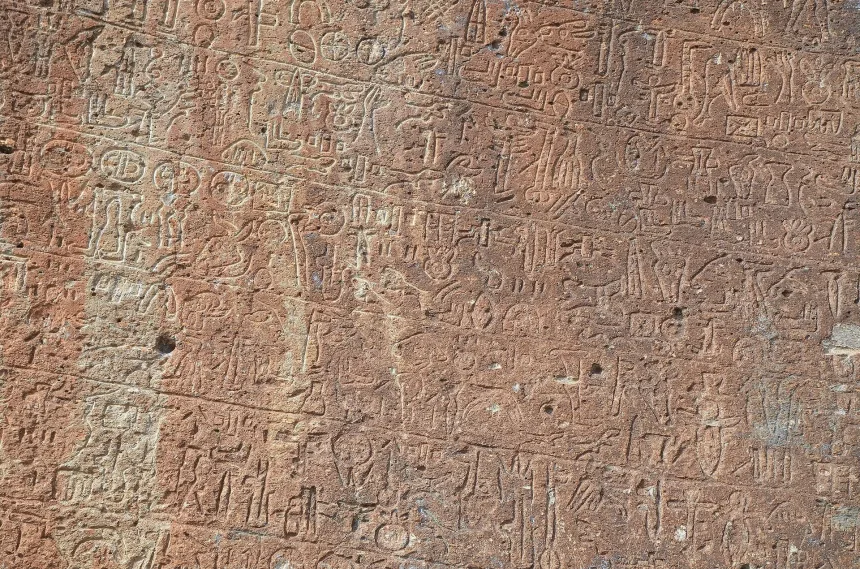
The Topada rock inscription is one of the most important Iron Age monuments in the Nevşehir region.
It is written in Luwian hieroglyphs and is connected with Wasusarma, a ruler of Tabal in the 8th century BC.
The text presents royal authority and describes military conflict involving neighboring rulers and a power associated with the Phrygian world.
Topada is therefore important for understanding political contact between Tabal and Phrygia.
It is not itself a Phrygian inscription. Its language, script and royal context belong to the Luwian and Tabalian political environment.
The inscription also reflects the use of older royal traditions and titles in an Iron Age state that followed the collapse of the Hittite Empire.
How to Interpret the Topada Conflict
The inscription presents events from the perspective of Wasusarma and his political authority.
Like other royal inscriptions, it should not be read as a neutral modern historical report.
Royal texts could emphasize victory, divine support, loyalty and the legitimacy of the ruler.
The monument remains valuable because it names political relationships and conflict within a region where written evidence is limited.
Its reference to a power connected with Phrygia demonstrates contact, but it does not transform the inscription into a Phrygian monument.
Visitors should separate the identity of the author, the script of the inscription and the political opponents mentioned within the text.
Visiting Topada Responsibly
Topada stands in a rural landscape rather than a fully developed museum complex.
Road access, parking conditions and the final approach should be checked locally before an independent visit.
Do not enter cultivated land, open gates or move agricultural equipment without permission.
Do not climb onto the inscription surface or apply water to increase contrast for photographs.
Use side light and a moderate zoom instead of touching or tracing the signs.
Carry offline navigation because map labels and rural roads may not identify the safest final approach.
Suvasa Inscription at Gökçetoprak
The Suvasa inscription is located near Gökçetoprak in the Gülşehir district.
Like Topada, it uses Luwian hieroglyphic writing and belongs to the political environment of Tabal.
The text names officials connected with King Wasusarma.
The monument helps demonstrate that older Hittite royal and administrative traditions continued in altered forms during the Iron Age.
Suvasa should not be labeled as a Phrygian monument simply because it belongs to a century in which Phrygian power was expanding across central Anatolia.
The names of officials and royal titles provide information about hierarchy, service and political identity within the Tabalian world.
Why Suvasa Matters
Suvasa is less familiar to general visitors than Kültepe or Topada, but it adds an important local dimension to Iron Age history.
It shows that the political language associated with Wasusarma was not limited to one monumental victory inscription.
The monument also demonstrates how inscriptions could represent officials and relationships around a ruler, not only the king himself.
Its rural setting makes museum preparation especially valuable. Without basic knowledge of Luwian writing and Tabal, the stone can be difficult to interpret visually.
Access should be confirmed before traveling specifically for the inscription. Agricultural conditions and the final route may change.
Topada and Suvasa Compared
| Feature | Topada | Suvasa |
|---|---|---|
| Historical Setting | Tabal under Wasusarma | Tabalian officials connected with Wasusarma |
| Writing | Luwian hieroglyphs | Luwian hieroglyphs |
| Main Value | Royal authority, military conflict and Phrygian contact | Officials, titles and continuation of royal traditions |
| Visitor Setting | Remote rural monument | Remote rural monument |
| Common Error | Calling it a Phrygian inscription | Calling it Phrygian because of its date |
Both monuments require more preparation than a normal central Cappadocia attraction.
They are most rewarding for visitors interested in epigraphy, Iron Age politics and the transformation of Hittite traditions after the empire.
What Evidence Is There for Phrygians in Cappadocia?
Phrygian influence in Cappadocia is less visually concentrated than it is around Gordion and western central Anatolia.
The evidence is better understood through regional interaction rather than a large group of clearly identified Phrygian monuments around Göreme.
Relevant evidence includes:
- Iron Age pottery and settlement layers
- Political contact with the Tabal kingdoms
- References to conflict in regional inscriptions
- Trade and communication across central Anatolia
- Changes in cultural networks after the Bronze Age
There is no major concentration of securely identified Phrygian temples or monumental facades around Göreme and Ürgüp comparable with the Phrygian heartland.
Recommended Tours for This Page
Popular experiences for this destination
Green TourGreen Tour Cappadocia
Explore Derinkuyu underground city, the beautiful Ihlara Valley, and S…
Blue TourBlue Tour Cappadocia
Explore hidden valleys, ancient churches, and cultural gems on Cappado…
AdventureATV Tour Cappadocia
Ride powerful ATVs through Cappadocia’s unique valleys, fairy chimneys…
AdventureHorseback Riding Tour Cappadocia
Experience Cappadocia on horseback, riding through valleys, hidden tra…
Classic Car Tour Cappadocia
Step into nostalgia with a vintage classic car ride through Cappadocia…
Pottery Workshop Cappadocia
Learn the ancient art of pottery from Avanos masters, try shaping clay…
Wine Tasting Tour Cappadocia
Taste Cappadocia’s finest local wines in ancient vineyards and wine ho…
Cappadocia Rent A Car
Explore Cappadocia freely at your own pace with flexible car rental op…
Nostalgic Electric Car Tour Cappadocia
Ride eco-friendly nostalgic electric cars through Cappadocia’s valleys…
BalloonCappadocia Hot Air Balloon Tour
See Cappadocia from the air at sunrise on a professionally operated ho…
Vip Mix Tour Cappadocia
Experience the ultimate Cappadocia highlights in comfort-historic vall…
Red TourRed Tour Cappadocia
Discover Göreme Open-Air Museum, Avanos pottery workshops, and breatht…
Phrygian contact was real, but contact does not mean direct political control of every site or the replacement of local traditions.
Political Contact Between Tabal and Phrygia
Iron Age central Anatolia contained competing kingdoms and zones of influence rather than modern national borders.
Tabalian rulers interacted with Phrygian power through conflict, diplomacy and regional competition.
The Topada inscription is important because it records this political environment from a Tabalian royal perspective.
Archaeological material can also show exchange or influence without proving that a settlement belonged directly to a Phrygian king.
Pottery style, decorative form or imported object should be interpreted together with excavation context and dating.
Phrygian Myths Commonly Applied to Cappadocia
Claims connecting every rock niche, geometric carpet pattern or mother-goddess image in Cappadocia directly with Phrygian religion should be treated cautiously.
A visual similarity is not enough to prove cultural continuity across several thousand years.
Modern craft patterns can preserve regional traditions, but assigning one ancient origin requires documented historical and archaeological evidence.
The same caution applies to local stories about King Midas, hidden treasure or secret Phrygian tunnels.
Legends can be meaningful parts of modern storytelling, but they should not replace excavation reports, inscriptions and datable material.
Were Cappadocia's Underground Cities Built by the Hittites?
The earliest phases of Derinkuyu Underground City, Kaymaklı Underground City and other subterranean settlements remain debated.
Underground passages were known in ancient Anatolia, and some Cappadocian cavities may have early origins.
This does not provide enough evidence to state that the complete visitor complexes were designed and built by the Hittites.
Many underground settlements were expanded repeatedly. Later communities created storage rooms, ventilation systems, churches, working spaces and defensive passages.
One corridor can be older than adjoining rooms, and one section may preserve several phases of use.
The safest description presents the underground cities as multi-period settlements rather than monuments created by one civilization.
Hittite Poterns and Cappadocian Underground Cities
Hittite settlements are known to have included underground or covered passages often discussed under the term potern.
These passages can support comparisons with defensive and hidden movement in ancient Anatolia.
A general similarity does not prove that Hittite builders created every Cappadocian underground tunnel.
Direct attribution requires archaeological dating, construction relationships and evidence connected with the individual site.
Visitors should be cautious when a tour explanation moves from "the Hittites used underground passages" to "the Hittites built this complete underground city."
The later Christian use of subterranean settlements is covered in the guide to Christian history in Cappadocia.
From Tabal to Persian Cappadocia
After the Iron Age kingdoms, the region became part of larger political systems, including the Achaemenid Persian Empire.
Persian rule connected Cappadocia with an imperial network extending across Anatolia and the Near East.
Local elites, roads, taxation and military organization developed within this wider political environment.
The later name Cappadocia became associated with territories and identities shaped by both Anatolian and Iranian traditions.
This period should not be treated as an empty gap between the Hittites and the Romans.
The Hellenistic Kingdom of Cappadocia
Following the campaigns of Alexander the Great and the fragmentation of his empire, Cappadocia developed under local dynastic rule within the Hellenistic political world.
The kingdom interacted with neighboring powers, Iranian traditions and Greek political culture.
Royal history, coinage, diplomacy and conflict provide important evidence even when large Hellenistic monuments are not prominent in the central tourism landscape.
The borders and political status of the kingdom changed through time.
Later Roman annexation ended the independent kingdom, but it did not erase the region's earlier traditions immediately.
Roman and Byzantine Cappadocia
Cappadocia became a Roman province in the first century AD.
Roads, towns, military organization and rural settlement developed within changing Roman administrative systems.
The Byzantine churches and monastic landscapes visible today belong to later phases and should not be used as direct evidence for Hittite or Phrygian occupation.
A rock-cut church may stand within a landscape occupied much earlier, but the date of the landscape does not determine the date of the building.
This distinction between ancient settlement history and the visible age of a monument is essential throughout Cappadocia.
Where Visitors Can Explore Ancient Cappadocia
Kültepe Archaeological Site
Kültepe is the strongest choice for travelers interested in Bronze Age trade, Assyrian merchants, early writing and the political environment that preceded the Hittite Empire.
It requires a separate journey toward Kayseri from central Cappadocia.
Allow enough time for both the mound and the lower commercial settlement when current access permits.
A guide or museum visit helps explain features that may otherwise appear as low walls and excavation areas.
Kayseri Archaeology Museum
The museum provides essential context for Kültepe, the Assyrian Trade Colonies period, Hittite culture, Tabal and later regional history.
Visit the museum before or after Kültepe according to current schedules and route logic.
Objects, inscriptions and displays can explain the chronology more clearly than the excavation landscape alone.
Topada Inscription
Topada is valuable for visitors interested in Wasusarma, Tabal, Luwian writing and political contact with Phrygia.
Its rural location and limited visitor infrastructure make preparation important.
Suvasa Inscription
Suvasa is suited to specialist visitors interested in officials, royal titles and the continuation of older political traditions in Iron Age Tabal.
It should not be added casually without confirming the approach and access conditions.
Avanos and Northern Cappadocia
Avanos can support a wider route toward Kayseri or northern archaeological sites.
Its pottery tradition should not be described as an unchanged continuation of Hittite craft.
Modern and historical pottery are important in their own contexts, but direct continuity across several millennia requires evidence rather than resemblance.
Suggested Ancient History Itineraries
Kültepe and Kayseri Day
Begin with Kültepe or Kayseri Archaeology Museum according to current opening hours, then complete the second site without adding distant central Cappadocia attractions.
This is the strongest general introduction to Bronze Age trade and early written history.
Tabal Inscriptions Route
Plan Topada and Suvasa only with confirmed road access, offline navigation and enough daylight.
A specialist guide is useful because the monuments are visually difficult to interpret without knowledge of Luwian writing and Iron Age politics.
Avanos and Ancient Trade Context
Use Avanos as a practical base for pottery, riverside walking and a later journey toward Kültepe.
Keep modern craft history separate from claims of direct Hittite continuity.
Ancient and Byzantine Comparison
Use one day for Kültepe and Kayseri, then a separate day for Göreme or Ihlara.
This comparison demonstrates how the surviving evidence changes from tablets and excavation layers to rock-cut churches and frescoes.
Transport and Route Planning
A rental car or private driver is the most practical option for Kültepe, Topada and Suvasa.
Public transport may support travel to Kayseri, but it is less useful for linking remote rural inscriptions in one day.
Share exact map pins with the driver. Village names, inscription names and archaeological locations may appear differently across mapping services.
Download the return route before leaving the main road.
Agree on waiting time and pickup points before entering an excavation area or walking toward a rural monument.
Use the guide to getting to and around Cappadocia when comparing a rental car, taxi and private driver.
Visiting Rural Inscriptions Responsibly
- Do not touch, trace or climb on inscriptions.
- Do not use chalk, water, oil or cleaning products to reveal signs.
- Do not enter cultivated land without permission.
- Do not move stones, fences or agricultural equipment.
- Use side light or zoom rather than physical contact.
- Carry all trash out of the area.
- Leave before darkness when the route is unfamiliar.
- Follow current local restrictions and signs.
Ancient inscriptions can be damaged by methods that appear harmless in one photograph.
Water can change the appearance of the surface and contribute to deterioration. Chalk and tracing material may remain inside carved signs.
Modern graffiti is especially destructive because it can overlap original marks and confuse future documentation.
Review the Cappadocia safety and essentials guide before traveling to remote archaeological locations.
How to Evaluate Ancient History Claims
Ask what type of evidence supports the claim.
- Inscription: Does a readable text identify a ruler, official, place or event?
- Excavation layer: Was the object found in a documented archaeological context?
- Pottery: Is the dating based on established comparison and stratigraphy?
- Architecture: Can construction relationships show which space came first?
- Written source: Is the text contemporary with the event or written much later?
- Local tradition: Is the story cultural memory, tourism interpretation or documented history?
A claim supported only by resemblance should remain a possibility rather than a fact.
Statements such as "this symbol looks Hittite" or "this tunnel resembles a Hittite passage" require additional evidence.
Careful uncertainty does not weaken a guide. It helps visitors understand how archaeology works.
Common Ancient Cappadocia Myths
- Every ancient site was Hittite: Cappadocia contains several periods and cultural traditions.
- Kültepe tablets are Hittite archives: Most famous tablets are Old Assyrian commercial documents.
- Topada is a Phrygian inscription: It is written in Luwian hieroglyphs within a Tabalian royal context.
- Suvasa is Phrygian because it is Iron Age: Date alone does not determine political or linguistic identity.
- All underground cities were built by Hittites: Their development covers several periods and remains debated.
- Every geometric motif is Phrygian: Similarity does not prove direct origin or continuity.
- Modern pottery repeats Hittite craft unchanged: Avanos pottery has its own documented history and development.
- The land of a thousand gods means one thousand Cappadocian temples: The phrase describes the diverse Hittite pantheon.
- One map represents ancient Cappadocia in every century: Political borders changed repeatedly.
Questions Travelers Ask About Hittite and Phrygian Cappadocia
Was Cappadocia part of the Hittite Empire?
Parts of the wider region came under Hittite political and cultural influence, although borders and administrative relationships changed considerably over time.
Are the Kültepe tablets Hittite?
Most of the famous Kültepe tablets are Old Assyrian commercial documents from before the rise of the Hittite Empire.
Why is Kaneš important to Hittite history?
Kaneš, later called Neša, became important in early Hittite political tradition. The Hittite language was called Nešili, meaning the language of Neša.
What did Assyrian merchants trade at Kültepe?
The commercial network is strongly associated with textiles and tin brought into Anatolia in exchange for silver and other valuable goods.
Is the Topada inscription Phrygian?
No. It is written in Luwian hieroglyphs and belongs to the political environment of Tabal under Wasusarma.
Why is Phrygia mentioned in connection with Topada?
The inscription describes conflict involving neighboring rulers and a power associated with the Phrygian world. Political contact does not change the identity of the inscription itself.
What is the Suvasa inscription?
Suvasa is a Luwian hieroglyphic monument near Gökçetoprak that names officials connected with King Wasusarma.
Are there major Phrygian monuments in Göreme?
No major concentration comparable with Gordion is known around Göreme. Phrygian contact is studied mainly through archaeology and regional political history.
Did the Hittites build Derinkuyu?
The earliest phases remain uncertain. The complete underground city cannot be attributed confidently to the Hittites.
What is Tabal?
Tabal is a modern historical term used for an Iron Age political region containing several rulers and kingdoms in south-central Anatolia.
Are Hittians and Hittites the same?
No. Hattian refers to an earlier cultural and linguistic tradition, while the Hittites were an Indo-European-speaking people who later ruled the land called Hatti.
Can Topada and Suvasa be visited independently?
They may be visited with careful planning, but rural access, agricultural land and road conditions should be confirmed locally.
Where is the best place to learn about ancient Cappadocia?
Kültepe and Kayseri Archaeology Museum provide the strongest introduction to Bronze Age trade, early Hittite history and the Iron Age political environment of Tabal.
Is a guide necessary?
A guide is especially useful for Kültepe, Topada and Suvasa because excavation layers and inscriptions are difficult to interpret from appearance alone.
How Ancient History Fits Into a Cappadocia Trip
Cappadocia's ancient past is not represented by one uninterrupted civilization. It is a layered history shaped by trade, migration, political rivalry, cultural exchange and the repeated reuse of settlements.
Kültepe reveals merchants, families, law and communication before the Hittite Empire. Topada and Suvasa reveal the Iron Age political world of Tabal and its contact with Phrygian power.
The underground cities demonstrate why chronological caution matters. Early origins are possible in some sections, but the complete visitor complexes developed through repeated expansion and later use.
For most travelers, one carefully planned Kültepe and Kayseri day provides more value than a rushed attempt to collect several remote monuments.
Specialist visitors can add Topada and Suvasa after confirming access and understanding the difference between Luwian, Tabalian and Phrygian evidence.
Use the Cappadocia trip planning guide to separate central sightseeing routes from archaeological journeys toward Kayseri, Topada and Gökçetoprak.