Uzumlu Church
Üzümlü Church in Red Valley
Carved into the base of a volcanic cone in Kızılçukur, Üzümlü Church is a small but historically important stop on the Red Valley hiking route. Academic studies identify the sanctuary as the Church of Hagios Niketas Stylites, while its modern Turkish name comes from the grape clusters and vine-inspired decoration preserved inside.
The church is valuable not because of a large narrative cycle from the life of Christ, but because its crosses, plant motifs, inscriptions, apostles and stylite figures preserve an important phase of medieval religious art in Cappadocia.
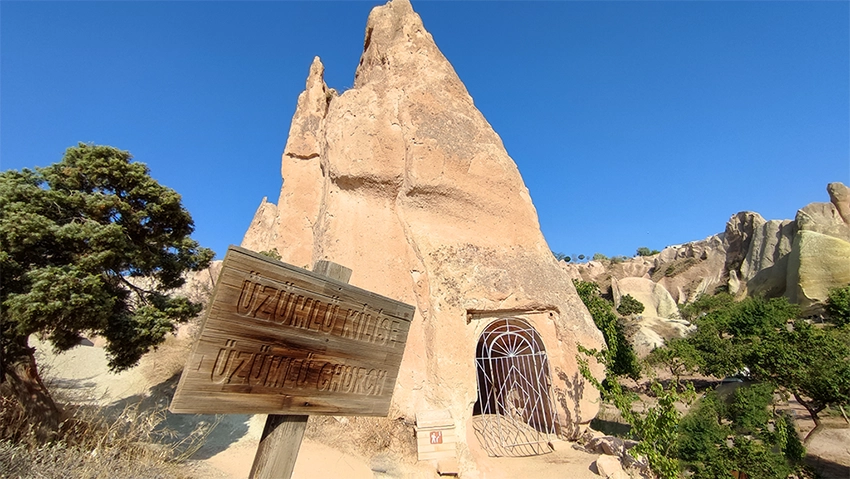
Most visitors should allow approximately 20 to 40 minutes at the church itself. The complete outing requires additional hiking time and depends on the selected trail entrance, current access and the route through Red Valley and Rose Valley.
Access, opening conditions and photography rules can change because of conservation, rock stability and local management. Confirm the current situation before organizing the hike around the interior.
How to Plan a First Visit
Choose the hiking route before setting out. Üzümlü Church can be part of a short return walk or a longer valley crossing, and those two plans require different transport arrangements.
Download an offline map and save the exit point. Mobile reception can become unreliable between valley walls.
Wear shoes with reliable grip. The route may include loose volcanic soil, steep connectors, worn rock and mud after rain.
Carry water and sun protection. Shade is limited on exposed ridges, while the interior of the church may feel considerably cooler.
Leave enough daylight for the return. The route to the church should not be confused with the roadside Red Valley Sunset Point.
Enter only when current signs permit access. An open-looking doorway does not override a barrier or conservation notice.
Üzümlü Church at a Glance
| Feature | Main Importance | What to Notice |
|---|---|---|
| Historical Name | Hagios Niketas Stylites Church | Inscriptions connecting the sanctuary with Niketas and stylite devotion |
| Architecture | Single-nave church with a barrel vault and eastern apse | Narthex, arcosolium niche and three apse niches |
| Decoration | Crosses, grape clusters, foliage, apostles and inscriptions | The relationship between symbolic, plant and figurative imagery |
| Dating | Much of the decoration is associated with the 8th century | Possible differences between carving, painting and later intervention |
The table summarizes the principal visitor themes. It should not be used to claim that every architectural and painted element belongs to one exact year.
Where Is Üzümlü Church?
Üzümlü Church is located in the southeastern part of Kızılçukur, commonly known as Red Valley, near Ortahisar.
It stands within the wider network of walking paths connecting Red Valley, Rose Valley, nearby ridges and agricultural tracks.
The exact hiking distance depends on the selected entrance and exit. A map that provides one distance may be measuring from a different trailhead.
The church is carved into the base of a volcanic cone rather than positioned directly beside the main roadside sunset terrace.
Use the Rose Valley and Red Valley hiking guide when planning the complete route, transport and seasonal walking conditions.
Understanding the Red Valley Setting
Kızılçukur is known for rock surfaces that display red, pink and pale tones according to geology, oxidation and changing light.
The church belongs to this landscape rather than existing as an isolated museum object.
Its location reflects the relationship between religious space, cultivated land, paths and volcanic formations.
A valley church could serve worship, ascetic practice, commemoration or a small local community without being a secret refuge used only during attacks.
The modern hiking path may not reproduce the original route used by worshippers. Erosion, agriculture and collapsed rock can alter access over time.
Why the Church Has Two Names
The Turkish name Üzümlü Kilise means Grape Church and refers to the grape clusters and plant decoration inside.
The historical identification Hagios Niketas Stylites comes from inscriptions and the religious context of the sanctuary.
The two names describe different aspects of the monument. One refers to a recognizable decorative theme, while the other reflects its saintly or devotional association.
Neither name should be transferred automatically to other churches called Üzümlü elsewhere in Cappadocia.
Saint Niketas and the Narthex Inscription
An inscription in the narthex connects the church with Niketas and the stylite tradition.
Academic interpretation presents the sanctuary as a church associated with a stylite named Niketas.
The inscription provides stronger historical evidence than later stories based only on the modern name or local legend.
It does not necessarily prove that Niketas lived permanently inside this exact church or on a column directly above it.
The prayer for Niketas is connected with forgiveness, salvation and withdrawal from worldly pleasures.
This language reflects the ascetic ideals associated with stylite devotion.
Who Were the Stylites?
Stylites were Christian ascetics associated with prolonged prayer, fasting and withdrawal from ordinary social life.
The term is derived from the Greek word for column.
The best-known stylites lived on platforms or columns, where their elevated position became a visible form of religious discipline.
Not every church dedicated to a stylite contained a working column residence.
A painted figure on a column, a dedicatory inscription or a saintly association can connect a church with stylite devotion without proving the complete physical arrangement of the ascetic's life.
The guide to Christian history in Cappadocia explains the broader development of monastic and ascetic traditions in the region.
Related Tours
Popular experiences for this destination
 Adventure
Trekking Tours Cappadocia
Hike Cappadocia’s spectacular valleys, fairy chimneys, and cave dwelli…
Vip Mix Tour Cappadocia
Experience the ultimate Cappadocia highlights in comfort-historic vall…
 Blue Tour
Blue Tour Cappadocia
Explore hidden valleys, ancient churches, and cultural gems on Cappado…
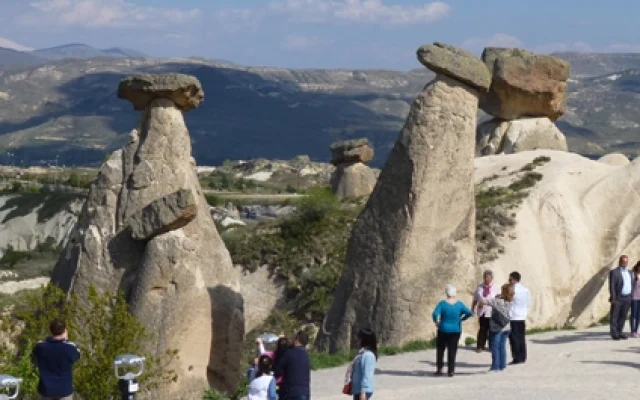 Red Tour
Red Tour Cappadocia
Discover Göreme Open-Air Museum, Avanos pottery workshops, and breatht…
 Adventure
Jeep Safari Tour Cappadocia
Take an off-road jeep adventure across Cappadocia’s rugged landscapes,…
 Adventure
ATV Tour Cappadocia
Ride powerful ATVs through Cappadocia’s unique valleys, fairy chimneys…
 Green Tour
Green Tour Cappadocia
Explore Derinkuyu underground city, the beautiful Ihlara Valley, and S…
 Adventure
Horseback Riding Tour Cappadocia
Experience Cappadocia on horseback, riding through valleys, hidden tra…
Professional Photo Shoot Cappadocia
Capture your Cappadocia moments with a guided professional photo shoot…

Classic Car Tour Cappadocia
Step into nostalgia with a vintage classic car ride through Cappadocia…

Carpet Weaving Experience Cappadocia
Discover the art of Turkish carpet weaving, learn traditional techniqu…

Nostalgic Electric Car Tour Cappadocia
Ride eco-friendly nostalgic electric cars through Cappadocia’s valleys…
Niketas and Simeon Stylites Are Not the Same Figure
The church is associated with Niketas, while the eastern wall includes a representation identified as Simeon Stylites standing on a column.
These names should not be merged into one person.
Simeon Stylites was the most influential model for column-based ascetic devotion, and his image could appear in a church associated with another stylite.
Niketas is connected with the church through inscriptions and prayer.
Simeon provides a recognized saintly example of the wider stylite tradition.
This distinction is important because modern summaries sometimes call the church Saint Simeon Church or treat Niketas as another name for Simeon without supporting evidence.
Stories About a Military Commander
Some local stories connect the church with a military commander, a miraculous victory or a vow fulfilled after battle.
Such stories may form part of the modern cultural memory of the monument.
They should not be presented as established history unless supported by a securely read inscription or a contemporary written source.
The surviving inscriptions relate more directly to Niketas, stylite devotion and named religious figures.
A responsible guide can mention a local story while clearly separating it from documented evidence.
Architecture of Üzümlü Church
The church has a single-nave plan and is entered through a rectangular opening.
The main worship space is covered by a barrel vault.
An eastern apse marks the sanctuary, while a small narthex provides a transitional area before the nave.
The northern side includes an arcosolium niche, a recessed arch-shaped feature often connected with burial or commemoration.
Three niches are carved into the apse wall.
The complete sanctuary was created by removing material from volcanic rock rather than constructing walls from stone or brick.
How the Church Plan Works
The Narthex
The narthex forms the entrance space before the principal worship area.
Its barrel vault carries a large cross and stylized foliage.
The area also preserves inscriptions that help identify the religious context of the church.
The Single Nave
The nave is the main longitudinal worship space.
Its barrel vault provides the largest continuous surface for crosses, grape clusters, painted arches and apostle figures.
The single-nave plan creates a direct visual movement from the entrance toward the eastern apse.
The Eastern Apse
The apse forms the principal sanctuary focus.
A large cross within concentric circles appears above or within the apse area.
The three wall niches contribute to the liturgical and architectural organization of the sanctuary.
The Arcosolium Niche
An arcosolium is an arched recess commonly associated with burial or commemoration.
Its presence may connect the church with prayer for the dead or memorial use.
The exact person or group connected with the niche should not be invented without inscriptional evidence.
Carving the Church Into Volcanic Rock
Cappadocian tuff can be cut more easily than hard masonry stone, but creating a church still required planning and skilled labor.
Builders had to control wall thickness, vault shape and the relationship between the nave, narthex and apse.
The carved surfaces also needed preparation before painting.
Architecture and decoration were therefore connected. The barrel vault created the long fields in which arches, apostles and grape motifs were arranged.
Natural cracks, moisture and erosion can now affect both the structure and its painted surfaces.
Crosses, Grapes and Plant Decoration
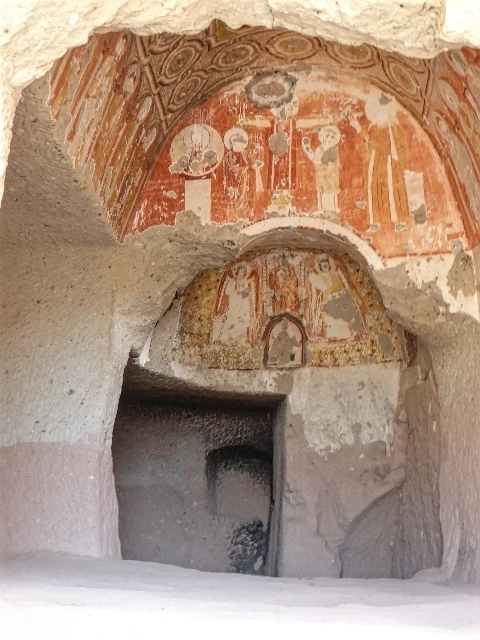
The decoration of Üzümlü Church is dominated by crosses, stylized leaves, vines and grape clusters.
A large cross appears within concentric circles above the apse.
Another cross surrounded by stylized foliage decorates the barrel vault of the narthex.
The nave vault contains cornucopia-like forms from which grape clusters emerge.
These painted grapes gave the church its modern Turkish name.
The complete decorative program also includes Maltese crosses, interlaced borders, geometric frames, painted arches, apostles and inscriptions.
The Large Apse Cross
The cross within concentric circles creates a strong visual focus near the sanctuary.
The surrounding circles separate the sacred sign from the rock surface and increase its prominence.
The design communicates through geometry rather than through a narrative scene.
Its position near the eastern sanctuary strengthens its liturgical importance.
Damage to paint or rock can interrupt the original symmetry, so the surviving form should be examined without assuming every missing line was absent from the first design.
The Narthex Cross and Stylized Leaves
The narthex barrel vault carries a large cross combined with stylized leaves.
The plant forms soften the geometry of the cross and connect the entrance zone with the grape decoration inside the nave.
This relationship between cross and plant motif can express life, growth, salvation and sacred order.
The precise meaning of every leaf form is not documented.
Visitors should distinguish the visible design from later symbolic interpretations.
Grape Clusters and Cornucopia-Like Forms
Grape clusters emerge from forms commonly described as cornucopias or horn-shaped vessels.
The grapes provide the most recognizable decoration in the church.
Within Christian art, grapes and vines can evoke the Eucharist, Christ, spiritual fruitfulness and the community of believers.
They can also reflect the agricultural landscape and long history of viticulture in Cappadocia.
A grape image does not prove that the room functioned as a wine cellar or that wine was produced inside the church.
The strongest interpretation considers both Christian symbolism and the regional importance of vines.
Maltese Crosses and Interlaced Borders
Maltese crosses appear within parts of the interlaced decorative system.
Interlaced borders create repeated visual movement and separate sections of the vault.
Crosses placed inside geometric forms reinforce the Christian identity of the decoration.
The pattern should not be dismissed as a filler between figures.
It organizes the interior and links the symbolic program across several surfaces.
Painted Arches and Apostle Figures
Rows of painted arches extend along the long sides of the barrel vault.
Each arch contains an apostle figure accompanied by a name inscription.
Names recorded on the northern side include Simeon, Thomas, Mark, John, James and Paul.
The names on the southern side are not equally legible.
The arches create a visual architectural frame for the apostles even though they are painted onto the rock surface.
This repeated arrangement transforms the vault into a structured assembly of sacred witnesses.
Simeon Stylites on the Eastern Wall
The eastern wall includes a figure identified as Simeon Stylites standing on a column.
The column is the key attribute linking the figure with stylite asceticism.
Simeon's elevated position expresses physical separation from ordinary life and spiritual concentration through prayer.
The image also helps explain the religious environment in which the prayer for Niketas should be read.
The figure of Simeon does not change the church's association with Niketas. It connects Niketas with a wider ascetic model.
John the Baptist and the Inscribed Scroll
John the Baptist appears on the eastern wall holding a scroll.
The inscription is connected with the biblical statement identifying Christ as the Lamb of God who bears the sin of the world.
The scroll transforms John's portrait into a spoken theological message.
His presence is appropriate within an ascetic environment because John was also understood as a model of wilderness life, discipline and prophetic witness.
Visitors should read the figure, scroll and inscription together rather than treating the writing as a decorative line.
Prayer Inscriptions and Named Patrons
One inscription asks for the forgiveness and salvation of Niketas.
Another records names connected with religious service and protection.
These written elements are valuable because they preserve personal names, prayers and social relationships that images alone cannot provide.
An inscription can identify a patron, cleric, donor or person remembered in prayer.
Its exact role still depends on language, position and the condition of the surviving text.
Incomplete or difficult readings should not be silently expanded into a complete biography.
How Old Is Üzümlü Church?
Academic studies have associated much of the cross and plant decoration with the 8th century.
This dating places the program within the broader artistic environment of the Byzantine Iconoclastic period.
The date should be presented as a scholarly interpretation based on decorative form, architectural comparison and the history of Cappadocian church art.
It does not prove that every painted figure, inscription, repair and carved element was completed in the same year.
Rock-cut churches often preserve several phases of work.
Later interventions may coexist with an earlier symbolic program.
Iconoclasm and the Dating Problem
Byzantine Iconoclasm is generally dated from the 8th century into the middle of the 9th century, with interruptions and regional variation.
Churches associated with this period often emphasize crosses, geometric forms and plant decoration.
Üzümlü Church fits this pattern in important ways.
However, the presence of apostles, John the Baptist and stylite figures requires careful interpretation.
The complete painted interior may reflect more than one campaign, or regional practice may not follow a simplified rule that every iconoclastic interior lacked every human figure.
The safest wording distinguishes the 8th-century dating of much of the decorative program from an unsupported claim that every visible surface belongs to one uniform iconoclastic phase.
Why the Church Is Important for Byzantine Art
Üzümlü Church demonstrates the complexity of early medieval Cappadocian painting.
Crosses and plant motifs dominate the visual field, but inscriptions and saintly figures provide personal and theological context.
Related Tours
Popular experiences for this destination
AdventureTrekking Tours Cappadocia
Hike Cappadocia’s spectacular valleys, fairy chimneys, and cave dwelli…
Vip Mix Tour Cappadocia
Experience the ultimate Cappadocia highlights in comfort-historic vall…
Blue TourBlue Tour Cappadocia
Explore hidden valleys, ancient churches, and cultural gems on Cappado…
Red TourRed Tour Cappadocia
Discover Göreme Open-Air Museum, Avanos pottery workshops, and breatht…
AdventureJeep Safari Tour Cappadocia
Take an off-road jeep adventure across Cappadocia’s rugged landscapes,…
AdventureATV Tour Cappadocia
Ride powerful ATVs through Cappadocia’s unique valleys, fairy chimneys…
Green TourGreen Tour Cappadocia
Explore Derinkuyu underground city, the beautiful Ihlara Valley, and S…
AdventureHorseback Riding Tour Cappadocia
Experience Cappadocia on horseback, riding through valleys, hidden tra…
Professional Photo Shoot Cappadocia
Capture your Cappadocia moments with a guided professional photo shoot…
Classic Car Tour Cappadocia
Step into nostalgia with a vintage classic car ride through Cappadocia…
Carpet Weaving Experience Cappadocia
Discover the art of Turkish carpet weaving, learn traditional techniqu…
Nostalgic Electric Car Tour Cappadocia
Ride eco-friendly nostalgic electric cars through Cappadocia’s valleys…
The church therefore stands between purely geometric description and a fully developed narrative cycle.
Its importance comes from this combination rather than from the number of surviving scenes.
Visitors can see how an interior communicated through repeated symbols, written prayer, saintly models and architectural rhythm.
Damage and Conservation
Academic documentation records deterioration connected with environmental conditions, the rock structure, biological growth and human activity.
Water can enter cracks and weaken painted or plastered surfaces.
Temperature change can expand fractures in the volcanic cone.
Biological growth may affect damp sections.
Touching, scratching, smoke and uncontrolled lighting add avoidable pressure.
Current barriers or closure decisions should be respected even when the church appears stable from the entrance.
Photography and Responsible Visiting
- Do not use flash or strong artificial light close to painted walls.
- Follow current signs when photography is restricted.
- Do not touch crosses, inscriptions or grape decoration.
- Keep bags, coats and hair away from painted surfaces.
- Do not climb the exterior cone.
- Do not enter a closed niche or unstable side area.
- Keep the doorway clear for other visitors.
- Carry all trash out of the valley.
A clearer photograph is not more important than the survival of the painted surface.
Use natural observation and a moderate camera zoom where photography is permitted.
Is This the Same Üzümlü Church as Zelve?
No. Cappadocia contains several churches known as Üzümlü or Grape Church.
| Monument | Location | Main Identification | Important Warning |
|---|---|---|---|
| Red Valley Üzümlü Church | Kızılçukur near Ortahisar | Hagios Niketas Stylites Church | Known for crosses, grape motifs, apostles and inscriptions |
| Zelve Üzümlü Church | Zelve | A separate church in the Zelve landscape | Its frescoes and plan must not be transferred to Red Valley |
| Derinkuyu Üzümlü Church | Near Derinkuyu Underground City | St. Theodoros Trion Church | It is a different monument with a different date and architecture |
Photographs, opening information, dates and fresco descriptions from these churches should never be used interchangeably.
How to Visit Üzümlü Church
The church is normally reached on foot as part of a Kızılçukur or Red Valley route.
A short church visit may take approximately 20 to 40 minutes.
A wider Red Valley and Rose Valley hike can require two to four hours according to the trailhead, walking speed, weather and number of detours.
A guided Cappadocia trekking tour can provide route finding and historical context when several churches and valley branches are included.
Do not assume that every trekking tour enters the church. Confirm the exact route and current access before booking.
Walking Route Options
Short Return Walk
A short return route uses the same entrance and exit.
This is easier when transport is waiting at the starting point or when sunset is not part of the plan.
Confirm that the selected trail actually reaches the church rather than only the upper viewpoint.
Red Valley and Rose Valley Crossing
A longer crossing combines the church with valley paths, ridges and additional rock-cut sites.
This route requires a clear exit plan because the finish may be far from the starting vehicle.
Use the Rose Valley and Red Valley hiking guide to compare trailheads and walking conditions.
Church and Sunset Route
Visit the church earlier in the day, then continue toward the upper Kızılçukur area with enough time for the climb.
The church is not located directly at the roadside sunset viewpoint.
Arrange transport according to the final exit rather than the church entrance.
Transport and Pickup Planning
A private driver, taxi or organized transfer is useful when the hike starts and finishes at different points.
Share the exact pickup map point before entering the valley.
Agree on a realistic time window because hiking pace and church stops can vary.
Do not depend on mobile reception to explain a changed exit after the walk.
Review the guide to getting to and around Cappadocia when arranging a one-way hike.
Visitor Information
| Planning Point | Practical Guidance |
|---|---|
| Location | Southeastern Kızılçukur, commonly known as Red Valley |
| Church Visit | Approximately 20 to 40 minutes |
| Complete Hike | Usually two to four hours depending on route |
| Access | Confirm current opening and conservation conditions |
| Footwear | Walking shoes with reliable grip |
| Facilities | Do not depend on toilets, water or shops beside the church |
No permanent opening schedule, free-access status or fixed ticket rule should be assumed without current confirmation.
Accessibility and Physical Conditions
The church is reached through a natural valley route rather than a fully accessible museum path.
Loose soil, slopes, narrow connectors and uneven rock can affect visitors with mobility or balance concerns.
Full wheelchair access should not be assumed.
Strollers are not practical on most approaches.
Visitors with knee, ankle or balance problems should evaluate the return climb as well as the descent.
A short distance on a map can still involve difficult terrain.
Visiting With Children
Older children may enjoy the grape decoration, crosses and valley setting, but close supervision is essential.
- Keep children beside an adult on narrow paths.
- Do not allow climbing on the volcanic cone.
- Keep hands away from paintings and inscriptions.
- Carry enough water and sun protection.
- Do not enter closed side spaces.
- Leave enough daylight for the return.
The church and surrounding rock are protected heritage, not a climbing area.
Seasonal Planning
Spring
Cooler temperatures suit hiking, but rain can leave mud and slippery rock on shaded paths.
Summer
Begin earlier or hike later in the day. Exposed sections can become very hot, and water requirements increase.
Autumn
Cooler air often provides comfortable walking conditions. Shorter daylight should be considered when sunset is included.
Winter
Snow, ice and freeze-thaw conditions can make the route unsafe.
Do not continue when shaded rock is icy or the trail cannot be identified clearly.
Combining Üzümlü Church With Red Valley Sunset
Üzümlü Church can be included during a daytime hike before continuing toward the upper Kızılçukur viewpoint.
The church visit should occur before the final sunset climb, not after darkness begins.
Allow time for photographs, route finding and the possibility that access to the interior is restricted.
Read the Red Valley Sunset Point guide when arranging the final viewpoint and pickup.
Combining the Church With Other Sites
Rose and Red Valleys
The most natural combination follows the connected Rose and Red Valleys trail network.
Göreme Churches
Tokalı Church provides a useful contrast through its large narrative fresco cycle and connected architectural sections.
El Nazar Church offers another example of a painted sanctuary carved into a volcanic cone.
Zelve
Zelve Open-Air Museum contains a separate Üzümlü Church. The two monuments should be compared carefully without mixing their images or histories.
Common Üzümlü Church Planning Mistakes
- Using the wrong map pin: Several churches in Cappadocia are called Üzümlü.
- Confusing Niketas with Simeon: The church is associated with Niketas, while Simeon Stylites appears as a separate painted figure.
- Calling every decoration one phase: Architecture, symbolic painting and figures may not share one exact date.
- Assuming the church is beside the sunset terrace: Reaching it requires a walking route.
- Presenting military legends as fact: Local stories require documentary support.
- Touching inscriptions: Fragile paint and rock can be damaged by repeated contact.
- Starting too late: Valley paths become difficult to identify after sunset.
- Depending on mobile reception: Save the route and pickup point offline.
- Expecting permanent access: Conservation and rock stability can change entry conditions.
Questions Travelers Ask About Üzümlü Church
Where is Üzümlü Church in Red Valley?
It is located in the southeastern part of Kızılçukur near Ortahisar.
Is it also called Hagios Niketas Stylites Church?
Yes. Academic studies identify the sanctuary with Niketas and the stylite religious tradition.
Why is it called Üzümlü Church?
The modern Turkish name comes from the grape clusters and vine-inspired decoration inside.
How old is the church?
Researchers have associated much of the cross and plant decoration with the 8th century.
Is every visible painting from the 8th century?
That should not be assumed. Carving, decoration, inscriptions, repairs and later interventions may belong to different phases.
Who was Niketas?
Niketas was connected with the church through inscriptions and stylite devotion. The available evidence should not be expanded into an unsupported complete biography.
Is Niketas the same as Simeon Stylites?
No. Simeon appears as a recognized stylite saint, while Niketas is the person associated with the church and its prayer inscriptions.
Why are grapes painted inside?
The grapes can be understood through Christian symbolism, Eucharistic meaning and the regional importance of vines.
Is this the same church as Zelve Üzümlü?
No. The Red Valley and Zelve churches are separate monuments.
Is it the same as St. Theodoros Trion near Derinkuyu?
No. The Derinkuyu Grape Church is another separate monument with a different history and architecture.
How long does the visit take?
Allow approximately 20 to 40 minutes at the church, plus the time required for the hike.
Can visitors drive directly to the church?
The church is normally approached on foot. Vehicle access should not be assumed beside the entrance.
Is the church always open?
No. Access can change because of conservation, safety and local management decisions.
Can visitors take photographs?
Follow current signs and avoid flash or strong artificial lighting near painted surfaces.
Is a guide useful?
Yes. A guide can help with route finding, inscriptions, dating questions and the distinction between Niketas, Simeon and the other churches called Üzümlü.
A Symbolic Church on the Red Valley Trail
Üzümlü Church is important because a compact rock-cut sanctuary preserves architecture, prayer, ascetic identity and symbolic decoration within one valley monument.
The narthex inscription connects the church with Niketas and stylite devotion.
The image of Simeon Stylites and the scroll of John the Baptist place that devotion within a wider Christian visual tradition.
Crosses, grape clusters, foliage, painted arches and apostles organize the barrel-vaulted interior without depending on a long narrative cycle.
The scholarly 8th-century dating helps explain the emphasis on crosses and plant forms, but the complete monument should not be reduced to one painting phase.
For travelers who plan the route carefully and respect current access rules, Üzümlü Church provides one of the most informative historical stops on a Red Valley hike.
Use the Cappadocia trip planning guide and the Cappadocia safety and essentials guide when combining the church with valley walking and sunset transport.