Selime Cathedral
Selime Cathedral and Monastery
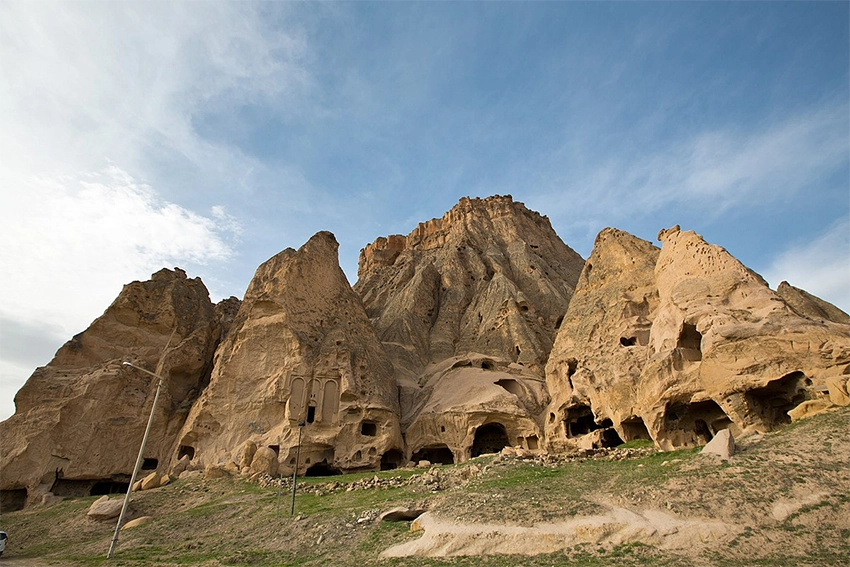
Selime Cathedral is one of the most monumental rock-cut complexes in Cappadocia. Carved into a high volcanic cliff near the northern end of Ihlara Valley, the site contains a large church, interconnected chambers, courtyards, service areas, burial spaces and elevated viewpoints.
The same monument is commonly called Selime Monastery. The word cathedral describes the impressive scale and basilica-like appearance of the principal church, but it does not prove that Selime was the official seat of a bishop.
Most visitors should allow approximately 60 to 90 minutes. A careful visit that includes the church, surrounding rooms, upper passages and landscape views can require closer to two hours.
Opening hours, ticket prices, pass conditions and access to upper sections can change. Check current official information shortly before traveling and follow all barriers and staff instructions.
Why Selime Is Important
Selime is not simply a single church cut into an isolated rock formation.
The complex brings together religious, domestic, agricultural, commemorative and circulation spaces within one large cliff settlement.
The principal church imitates monumental constructed architecture through rock-cut supports, arches and vaulted sections.
Surrounding rooms demonstrate that worship depended on storage, food preparation, accommodation, water management and daily work.
The elevated setting also connects the complex with the northern Ihlara landscape, Yaprakhisar, Selime village and the routes crossing this part of Central Anatolia.
Its importance comes from the complete relationship between cliff, church, rooms and movement rather than from one surviving fresco or one dramatic viewpoint.
How to Plan a First Visit
Begin with the exterior and observe how openings are distributed across the cliff before starting the climb.
Wear shoes with reliable grip and keep both hands free. Smooth volcanic rock, worn steps and loose dust can make short sections more difficult than they appear from below.
Visit the main church before exploring distant side rooms. The church provides the architectural reference needed to understand the rest of the complex.
Allow your eyes time to adjust inside. Bright exterior light can make painted fragments, niches and carved details difficult to see during the first moments.
Do not follow every opening automatically. Some chambers end at exposed edges or include unstable surfaces.
Leave enough time to descend before closing or darkness. The return can be slower when paths are crowded.
Selime Cathedral at a Glance
| Feature | Main Importance | Visitor Focus |
|---|---|---|
| Principal Church | Large basilica-like rock-cut sanctuary | Supports, arches, vaults, apses and surviving paint |
| Wider Complex | Interconnected religious and practical spaces | Courtyards, halls, storage and circulation |
| Cliff Setting | Northern end of Ihlara Valley | Relationship with Selime village and Yaprakhisar |
| Physical Conditions | Steep and uneven rock surfaces | Grip, balance, daylight and weather |
This table provides a planning framework. The exact function and date of every chamber remain open to archaeological interpretation.
Where Is Selime Cathedral?
Selime Cathedral rises above Selime village near the northern end of the Ihlara Valley system in Aksaray Province.
The site is connected geographically with Yaprakhisar and the northern continuation of the Melendiz River corridor.
It is not close to central Göreme, despite being included in many Cappadocia itineraries.
Travelers should calculate the complete road journey and the time needed for Ihlara, lunch and any underground city included on the same day.
The monument can be reached by road, but the internal visit still requires a steep climb through the rock-cut complex.
Selime Cathedral or Selime Monastery?
Both names are widely used for the same large complex.
Selime Cathedral usually refers to the monumental principal church or to the site as a whole.
Selime Monastery emphasizes the surrounding rooms and the interpretation of the complex as a religious community.
Neither modern label should be treated as a complete medieval institutional title without inscriptional evidence.
The term monastery can also create the impression that every chamber belonged to monks. Archaeological research on Cappadocia has shown that large rock-cut settlements could combine religious, domestic, agricultural and funerary functions.
Was Selime Really a Cathedral?
A cathedral is formally the church containing a bishop's official seat.
The scale and architecture of Selime's main church explain why visitors use the word cathedral.
However, size alone does not demonstrate episcopal status.
A securely identified bishop's seat, diocesan documentation or an inscription would provide stronger evidence.
Until such evidence is established, the name should be understood as a modern descriptive title rather than a proven administrative function.
Was Selime Only a Monastery?
The interpretation of Cappadocian rock-cut complexes as monasteries has a long history in travel writing and scholarship.
Modern research treats the subject more cautiously because carved settlements often contain several types of space and may have changed function over time.
Selime certainly contains a major church and rooms compatible with organized communal activity.
That evidence does not prove that every resident was a monk or that the entire cliff operated under one unchanging monastic rule.
The most accurate description presents Selime as a large rock-cut complex with strong religious and communal components.
Historical Development
Selime developed within the medieval Christian landscape surrounding Ihlara Valley.
The rooms, churches, passages and service spaces were carved and adapted in several phases rather than completed through one single building project.
Architectural relationships suggest that some chambers were expanded, connected or reused after the original carving.
Later occupation could alter doorways, floors, fireplaces, storage niches and access routes.
Painted decoration and repairs may also belong to periods different from the first excavation of the church.
The monument should therefore be read as a changing settlement rather than a frozen moment from one century.
Dating Selime
Different parts of Selime may belong to different medieval and later periods.
Architecture, painting style, inscriptions, tool marks and the relationship between spaces provide the main evidence for dating.
One general date should not be applied to every room.
The main church can belong to a major Byzantine phase while service rooms, partitions or access routes reflect later use.
Damage and erosion have removed some of the physical evidence that once connected these phases.
Responsible interpretation should state when a date applies to one church, one fresco layer or the wider settlement.
Selime Within Christian Cappadocia
The wider Ihlara and Selime region supported Christian communities, churches and rock-cut living spaces across many centuries.
The Melendiz River, agricultural land and routes across the plateau made the area suitable for settled life rather than only temporary refuge.
Religious communities depended on food, water, storage, labor and relationships with surrounding villages.
This setting helps explain why Selime includes both sacred architecture and practical rooms.
The guide to Christian history in Cappadocia provides wider context for worship, monasticism and changing political conditions.
The Cliff and Volcanic Rock
Selime was created within volcanic rock formed from the geological history of the Cappadocian region.
The material could be excavated more easily than hard building stone, allowing large interiors to be created by removing rock.
The same material remains vulnerable to erosion, cracking and surface loss.
Related Tours
Popular experiences for this destination
 Green Tour
Green Tour Cappadocia
Explore Derinkuyu underground city, the beautiful Ihlara Valley, and S…
 Red Tour
Red Tour Cappadocia
Discover Göreme Open-Air Museum, Avanos pottery workshops, and breatht…

Classic Car Tour Cappadocia
Step into nostalgia with a vintage classic car ride through Cappadocia…
 Blue Tour
Blue Tour Cappadocia
Explore hidden valleys, ancient churches, and cultural gems on Cappado…
 Adventure
Trekking Tours Cappadocia
Hike Cappadocia’s spectacular valleys, fairy chimneys, and cave dwelli…

Cappadocia Rent A Car
Explore Cappadocia freely at your own pace with flexible car rental op…

Nostalgic Electric Car Tour Cappadocia
Ride eco-friendly nostalgic electric cars through Cappadocia’s valleys…
 Balloon
Cappadocia Hot Air Balloon Tour
See Cappadocia from the air at sunrise on a professionally operated ho…
Vip Mix Tour Cappadocia
Experience the ultimate Cappadocia highlights in comfort-historic vall…
 Adventure
ATV Tour Cappadocia
Ride powerful ATVs through Cappadocia’s unique valleys, fairy chimneys…
 Adventure
Horseback Riding Tour Cappadocia
Experience Cappadocia on horseback, riding through valleys, hidden tra…
Turkish Night Show Cappadocia
Enjoy a traditional Turkish dinner with live music, folk dances, and w…
Vertical openings, exposed faces and water paths can weaken sections over time.
The cliff is therefore both the monument's building material and one of its main conservation challenges.
Creating Architecture by Removing Rock
Conventional buildings are assembled from foundations, walls, columns and roofs.
Rock-cut architecture is formed in the opposite direction.
Builders remove material while preserving enough rock to create walls, supports, vaults and upper floors.
A mistake in excavation cannot be corrected by placing the removed rock back into its original position.
Large interiors such as the Selime church required careful control of spacing, ceiling thickness and support placement.
This method explains why architecture and geology cannot be separated when interpreting the complex.
The Main Rock-Cut Church
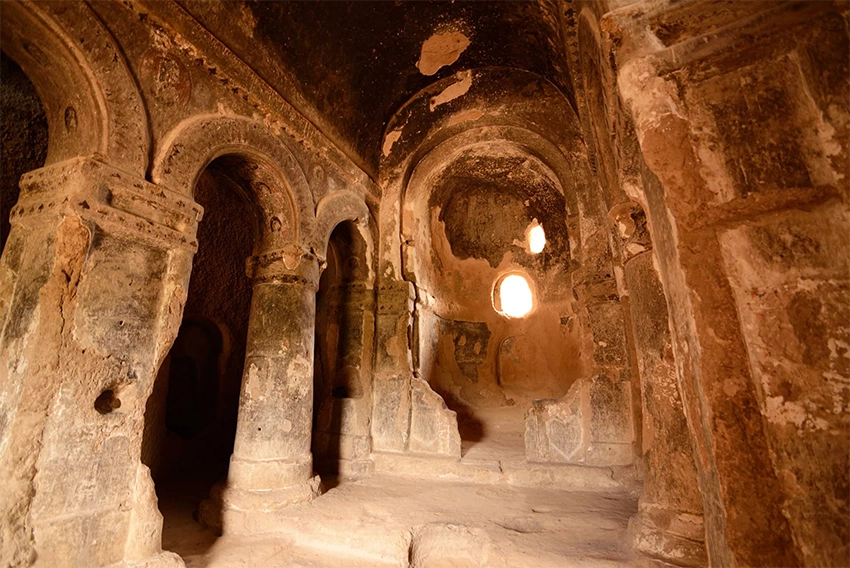
The principal church has a monumental basilica-like arrangement divided by two rows of rock-cut supports.
The supports create several longitudinal sections and direct attention toward the eastern sanctuary.
Arches connect the supports and help organize the vaulted ceiling surfaces.
The church imitates forms familiar from constructed Byzantine architecture even though it was excavated inside the cliff.
Its large scale creates a very different spatial experience from the compact churches near the southern Ihlara entrance.
How the Basilica-Like Plan Works
Central Section
The broad central section creates the principal visual route toward the sanctuary.
Its width and height give the interior the monumental character associated with the cathedral name.
Side Sections
The rows of supports divide the church into a central area and narrower side zones.
These spaces allow movement and create additional surfaces for niches, painted decoration and architectural detail.
Rock-Cut Supports
The supports remain part of the living rock.
They imitate columns or piers used in masonry basilicas while also preserving the rock needed between adjoining spaces.
Visitors should not climb or lean against them.
Arches and Vaults
Arches connect the supports and frame views through the church.
Vaulted ceilings create continuous upper surfaces where painted decoration once formed a stronger visual program.
Eastern Sanctuary
The eastern end contains the sanctuary and apsidal focus.
Its position organizes the liturgical direction of the church even where furnishings and painted details have been lost.
What the Rock-Cut Supports Tell Us
The supports are not decorative copies added after excavation.
They form part of the planning system used to divide and stabilize the interior.
Their spacing creates rhythm and guides movement.
They also imitate the visual language of prestigious constructed churches.
This combination of practical carving and architectural symbolism is central to Selime's importance.
Surviving Frescoes
Fragments of painted decoration survive on walls, arches and ceiling surfaces.
Their condition is more damaged than the protected frescoes inside several Göreme churches.
Moisture, smoke, erosion, human contact and lost plaster have interrupted the original program.
Individual biblical scenes may be difficult to identify without inscriptions or complete figures.
A dark or empty surface should not automatically be interpreted as an area that was never painted.
How to Examine Damaged Paintings
Use Architectural Position
An image in the sanctuary, upper vault or side section may have served a different role.
Position provides context but does not identify a damaged figure by itself.
Look for Halos and Inscriptions
A cross-inscribed halo commonly identifies Christ.
Greek letters may identify saints or scenes, although incomplete words require caution.
Follow Gesture and Grouping
The direction of faces and hands can reveal the central event.
A group arranged around one figure may indicate worship, healing, judgement or narrative action.
Separate Soot From Pigment
Dark deposits can cover original color.
Visitors should never rub or wet a surface to test what lies beneath.
Why the Frescoes Are Damaged
The church's large openings expose the interior to stronger air movement and changing moisture.
Water entering cracks can weaken plaster and carry minerals across painted surfaces.
Smoke from later use can darken ceilings and walls.
Scratching and repeated touching remove fragile pigment.
Structural loss can destroy complete painted fields at the same time as the rock beneath them.
Current barriers and photography rules should be understood within this conservation context.
Rooms and Courtyards
Paths around the main church lead to chambers of different sizes and shapes.
Some open toward courtyards or terraces, while others connect through narrow passages.
The complex includes spaces that may have supported gathering, storage, food preparation, accommodation and burial.
The organization suggests repeated daily use rather than an isolated sanctuary visited only for occasional ceremonies.
Not every chamber has a securely proven function.
How to Interpret a Rock-Cut Room
Room function should be based on several types of evidence.
- The position within the complex
- The shape and size of the room
- Benches, niches or shelves
- Smoke deposits and ventilation
- Channels, basins or storage pits
- Relationship with courtyards and passages
- Burials or inscriptions
One blackened ceiling can suggest fire use, but it does not prove that every dark room was a kitchen.
A large hall may support gathering without being a formal refectory.
Large Halls
Several larger spaces could support gathering, communal work or organized religious activity.
Their size distinguishes them from small storage chambers or individual rooms.
Benches, niches and circulation routes can provide clues about use.
Later occupation may have changed the original floor or entrance.
The term hall is often safer than assigning one exact medieval function without excavation evidence.
Food Preparation Areas
Blackened ceilings and fire-related features can suggest cooking or heating.
A working kitchen would also require ventilation, storage and access to water or food supplies.
Rock-cut hearths or tandır-like features should be identified through their complete form rather than soot alone.
Later shepherds or residents may also have used fire inside rooms after the religious community changed.
Cooking interpretations should therefore remain tied to architectural evidence.
Storage Areas
Niches, cool chambers and carved pits could support the storage of grain, tools, vessels and other supplies.
Rock interiors can maintain relatively stable temperatures compared with exposed exterior spaces.
Some rooms may have had wooden shelves or doors that no longer survive.
A niche does not identify the stored material by itself.
Storage was essential to any long-term community living within the cliff.
Living Spaces
Smaller rooms may have provided accommodation, rest or private work.
Evidence can include benches, sleeping platforms, cupboards and controlled access.
Not every small chamber was necessarily a monk's cell.
Residents, workers, visitors, clergy or later occupants could use similar spaces.
The safest interpretation considers how each room relates to the church and practical areas.
Burial Spaces
Rock-cut graves appear in parts of the wider complex.
Burial close to a church connected the dead with prayer and sacred memory.
The graves may have belonged to clergy, patrons, community members or later users.
Identity should not be invented without inscriptions or archaeological evidence.
Visitors should not step into graves, sit inside burial recesses or place objects in them.
Courtyards and Open Areas
Open spaces bring light and air into rooms cut deeply into the cliff.
They also provide circulation between chambers that do not connect directly inside the rock.
A courtyard can support preparation, gathering and practical work without having one single function.
Some open areas visible today may have been enlarged by collapse and erosion.
The present shape should therefore be compared with surviving wall lines and thresholds.
Passages and Vertical Movement
Narrow corridors and rock-cut steps connect different elevations.
The route followed by modern visitors may not reproduce the complete medieval circulation system.
Collapsed sections, restoration and safety barriers can redirect movement.
Some passages were designed for a smaller population and do not handle modern visitor groups comfortably.
Wait in wider areas rather than forcing past other visitors on a narrow step.
The Upper Complex
The upper sections provide views across Selime village, Yaprakhisar and the northern Ihlara landscape.
These areas also contain additional openings, rooms and traces of movement through the cliff.
The viewpoint should not distract from the archaeological character of the upper spaces.
Do not climb beyond the marked route for a wider photograph.
Exposed edges, smooth rock and sudden gusts can make a short movement dangerous.
Views and Landscape Interpretation
The view helps explain why the site developed at this location.
From the upper areas, visitors can observe the relationship between village, river corridor, volcanic formations and routes across the plateau.
The complex was connected with a working landscape rather than separated from settlement and agriculture.
Its elevated position could support visibility and controlled access without proving that Selime functioned primarily as a fortress.
The landscape should be read historically as well as photographed.
Was Selime a Fortress?
The cliff position and controlled approaches give Selime a defensible appearance.
Some spaces may have provided protection during periods of danger.
However, the main church, burial areas, storage and domestic rooms demonstrate a broader purpose.
Defensive potential does not make every chamber military.
The strongest interpretation recognizes security as one possible aspect of a large religious and residential complex.
Was Selime a Caravan Stop?
Selime lies within a region crossed by routes connecting settlements and agricultural zones.
Travelers and animals may have used spaces in or near the settlement during later periods.
This possibility should not be expanded into a claim that the main church was constructed as a caravanserai.
Formal caravanserais have recognizable architectural and documentary contexts.
Later accommodation or storage does not erase the complex's Christian religious history.
Selime and the Northern Ihlara Route
The valley continues north from Belisırma through Yaprakhisar toward Selime.
This northern section differs from the famous staircase route near Ihlara village.
It includes river scenery, village connections, cultivated land and longer walking distances.
Travelers should distinguish between hiking the northern valley and driving from Belisırma to Selime.
Both plans can include the same places but require very different time and transport arrangements.
Can You Hike From Ihlara to Selime?
A long route through the valley toward Selime is possible for experienced walkers when current paths are open.
The complete journey requires several hours, suitable weather, enough daylight and transport arranged at the finish.
Church detours, lunch and photography add substantial time.
Many visitors walk only a selected section and continue to Selime by vehicle.
This is usually more practical when the itinerary also includes an underground city.
Belisırma to Selime
Belisırma is the practical middle point for a northern Ihlara plan.
Visitors can begin or end a selected walk near the village and continue to Selime by road.
A full walking connection requires a one-way transport arrangement.
Do not depend on mobile reception to arrange the pickup after entering the valley.
Share the exact meeting point and approximate arrival window before starting.
Related Tours
Popular experiences for this destination
Green TourGreen Tour Cappadocia
Explore Derinkuyu underground city, the beautiful Ihlara Valley, and S…
Red TourRed Tour Cappadocia
Discover Göreme Open-Air Museum, Avanos pottery workshops, and breatht…
Classic Car Tour Cappadocia
Step into nostalgia with a vintage classic car ride through Cappadocia…
Blue TourBlue Tour Cappadocia
Explore hidden valleys, ancient churches, and cultural gems on Cappado…
AdventureTrekking Tours Cappadocia
Hike Cappadocia’s spectacular valleys, fairy chimneys, and cave dwelli…
Cappadocia Rent A Car
Explore Cappadocia freely at your own pace with flexible car rental op…
Nostalgic Electric Car Tour Cappadocia
Ride eco-friendly nostalgic electric cars through Cappadocia’s valleys…
BalloonCappadocia Hot Air Balloon Tour
See Cappadocia from the air at sunrise on a professionally operated ho…
Vip Mix Tour Cappadocia
Experience the ultimate Cappadocia highlights in comfort-historic vall…
AdventureATV Tour Cappadocia
Ride powerful ATVs through Cappadocia’s unique valleys, fairy chimneys…
AdventureHorseback Riding Tour Cappadocia
Experience Cappadocia on horseback, riding through valleys, hidden tra…
Turkish Night Show Cappadocia
Enjoy a traditional Turkish dinner with live music, folk dances, and w…
Ağaçaltı and Selime in One Day
Ağaçaltı Church lies near the main staircase at the southern Ihlara village entrance.
Selime is near the northern end of the wider valley system.
They can be combined by visiting a selected southern section and then continuing by vehicle.
Walking between every major church and Selime is a much longer plan.
Allow realistic time for the staircase, church visit, lunch, road journey and Selime climb.
How Long a Selime Visit Takes
| Visit Style | Approximate Time | Best For | Main Limitation |
|---|---|---|---|
| Quick Visit | 35 to 45 minutes | Main church and one exterior viewpoint | Little time for side rooms or interpretation |
| Standard Visit | 60 to 90 minutes | Most first-time visitors | Crowds can slow narrow passages |
| Detailed Visit | 90 to 120 minutes | Architecture, rooms and landscape study | Requires good mobility and schedule flexibility |
Add parking, ticketing and waiting time separately.
A short tour stop may not allow visitors to examine both the church and upper settlement carefully.
How to Get to Selime From Göreme
Selime lies on the longer southern Cappadocia route and is not close to central Göreme.
Transport options include a rental car, private driver, organized tour or a more complex combination of public transport and taxi.
Use the guide to getting to and around Cappadocia when comparing the complete travel time.
By Rental Car
A rental car provides flexibility for Ihlara Valley, Belisırma, Güzelyurt and Selime.
Choose the valley entrance and exit before driving because one-way walks require vehicle coordination.
Do not leave the vehicle at one trailhead without a return plan.
By Private Driver
A private driver is practical when the itinerary includes an underground city, a selected Ihlara walk and Selime.
Agree on waiting time, lunch location and final pickup before the walk.
A private route should still limit the number of distant stops to preserve enough time at Selime.
By Green Tour
Selime is commonly included in the Cappadocia Green Tour after an underground city, an Ihlara walk and lunch near Belisırma.
The exact order and time at Selime vary between operators.
Ask whether the program allows enough time to enter the main church and climb to the approved upper section.
By Taxi
A taxi can work for a one-way connection from a nearby town or valley exit.
Arrange the return or waiting time before entering the complex.
Finding an immediate taxi at closing time should not be assumed.
Green Tour Route Logic
A typical Green Tour covers a large geographic area.
The day may include Derinkuyu Underground City or Kaymaklı Underground City, Ihlara Valley, lunch around Belisırma and Selime.
Because the route contains several major stops, time at each site is limited.
Travelers primarily interested in rock-cut architecture should ask how many minutes are allocated to Selime.
Tour inclusion does not guarantee access to every chamber or upper viewpoint.
Visitor Information
| Planning Point | Practical Guidance |
|---|---|
| Location | Above Selime village near the northern end of Ihlara Valley |
| Standard Visit | Approximately 60 to 90 minutes |
| Physical Effort | Steep, uneven and sometimes slippery rock surfaces |
| Opening Hours | Check the current official schedule and final admission |
| Tickets | Confirm current admission and pass conditions |
| Photography | Follow current signs and avoid obstructing passages |
Final admission can occur before the listed closing time.
Weather, restoration and rock stability can affect access to upper sections.
Physical Difficulty
Selime is more physically demanding than a level museum visit.
The route includes smooth rock, irregular steps, short steep climbs and narrow transitions.
Some surfaces become slippery with dust even in dry weather.
Visitors should be able to control both the ascent and descent without depending on painted or fragile walls for support.
The upper route may not be suitable for everyone who can reach the lower entrance.
Accessibility
Full wheelchair access should not be assumed.
Strollers are not practical through the upper complex.
Visitors with limited mobility, knee problems, vertigo or balance concerns should evaluate the route from below and ask staff which sections are currently accessible.
A partial visit to the lower church area may still be possible when the upper route is unsuitable.
Do not continue because other members of a group are climbing quickly.
Visiting With Children
Children require close adult supervision throughout the site.
- Keep children beside an adult near exposed edges.
- Do not allow running on smooth rock.
- Keep hands free during steep climbs.
- Do not allow entry into closed chambers.
- Keep children away from graves and painted surfaces.
- Return before tiredness affects balance.
A carrier may be difficult to manage on steep sections, while a stroller is unsuitable for the upper complex.
Weather and Seasonal Planning
Spring
Mild temperatures suit the climb, but rain can make rock surfaces slippery.
Do not continue into an upper section when the stone is wet.
Summer
The ascent is exposed to strong sun.
Carry water, use sun protection and avoid rushing immediately after lunch.
Autumn
Cooler air often provides comfortable visiting conditions.
Shorter daylight should be considered when Selime follows a long valley walk.
Winter
Ice and snow can make the upper route unsafe.
Shaded surfaces may remain frozen after nearby roads appear clear.
Wind and Exposed Edges
Upper openings and terraces can experience stronger wind than the village below.
A sudden gust can affect balance, hats, scarves and lightweight equipment.
Keep phones and cameras secured.
Do not approach an edge for an unobstructed panorama.
Follow current closures during strong wind even when the lower route remains open.
Photography Tips
Photograph the complete cliff from below before entering.
Inside the church, use the rows of supports to create depth without stepping onto restricted surfaces.
Allow the camera to adjust to low light rather than using strong artificial lighting.
Keep tripods out of narrow routes.
From the upper section, include village and valley context rather than focusing only on exposed edges.
Do not climb an unmarked ledge to recreate a social media photograph.
Conservation and Visitor Pressure
Rock-cut heritage in Cappadocia is threatened by continuing erosion, structural weakness and visitor pressure.
Atmospheric effects, nearby traffic, repeated foot movement and changing loads can increase risk.
At Selime, the same routes used for access cross the historic rock surface.
Visitors can reduce additional damage by staying on the marked route, avoiding climbing and respecting limits on room entry.
A chamber that appears empty can still contain fragile floor, wall or structural evidence.
Why Barriers Matter
A barrier may protect an unstable edge, a damaged ceiling, a grave or a painted surface.
The reason may not be visible from the public route.
Moving a rope for a photograph creates risk for both the monument and the visitor.
Access decisions can change as cracks and weather conditions are monitored.
Current instructions should always take priority over older travel descriptions.
Combining Selime With Ihlara Valley
Selime and Ihlara Valley are commonly included in one day because they belong to the same broad route.
The most efficient plan usually combines a selected valley section with road transport to Selime.
Attempting the complete valley, several churches, a long lunch and a full Selime visit can create an unrealistic schedule.
Choose the walking section according to daylight, fitness and the other major stops.
The Ihlara Valley hiking guide explains the principal entrance and route options.
Combining Selime With Belisırma
Belisırma provides road access, restaurants and a practical middle-valley stopping point.
Visitors can complete a short walk, eat lunch and continue to Selime by vehicle.
A church-focused route can include selected Belisırma churches, but this requires more time than a standard riverside lunch stop.
Do not assume that every Green Tour enters Kırkdamaltı or Direkli before Selime.
Combining Selime With Güzelyurt
Güzelyurt can be included in a dedicated southern Cappadocia route with Selime.
This combination suits travelers interested in architecture, Christian heritage and historic settlements.
It is less practical when the same day already includes a long underground city visit and an extended Ihlara hike.
Prioritize fewer sites with enough time rather than collecting distant map points.
Combining Selime With an Underground City
Many organized routes include an underground city before Ihlara and Selime.
This creates a varied day but also substantial driving and walking.
Underground cities involve narrow tunnels and stairs, while Selime requires exposed climbing.
Travelers with mobility, balance or claustrophobia concerns should evaluate both activities together.
A private itinerary can reduce unnecessary stops and adjust the order according to energy.
Selime and Göreme Churches Compared
| Feature | Selime Cathedral | Göreme Painted Churches |
|---|---|---|
| Main Experience | Large cliff settlement with monumental church and practical rooms | Several concentrated painted churches along a managed route |
| Painting Condition | Fragmentary and exposed in many areas | Stronger preservation in selected protected interiors |
| Architecture | Basilica-like church and extensive interconnected spaces | Several plan types across separate monuments |
| Physical Route | Steep exposed climb | Managed paths with steps between churches |
The comparison shows why Selime should not be judged only by fresco preservation.
Its strongest value lies in scale, spatial organization and the relationship between worship and settlement.
Visiting With a Guide
A knowledgeable guide can explain the main church, uncertain room functions and the difference between cathedral, monastery and settlement interpretations.
A guide is also useful for identifying painted fragments without inventing complete scenes.
Ask how much time the itinerary allows at Selime.
Detailed explanations should be given in wider spaces rather than on narrow steps.
A guided Cappadocia trekking tour can support a longer Ihlara and Selime route when transport is arranged at the finish.
Common Selime Planning Mistakes
- Calling it a proven episcopal cathedral: Monumental scale does not establish a bishop's official seat.
- Calling every room a monk's cell: The complex supported several functions and periods.
- Assigning one date to the entire cliff: Carving, painting, reuse and repair occurred in phases.
- Treating every blackened room as a kitchen: Soot may come from different periods of use.
- Ignoring the return descent: Going down smooth rock can be harder than climbing up.
- Combining too many distant stops: Selime requires enough time for the climb and church.
- Assuming Green Tour schedules are identical: Time and route vary between operators.
- Crossing barriers for photographs: Restricted areas may contain unstable rock or exposed edges.
- Visiting upper sections in ice or strong wind: Weather can change the safety of the route quickly.
Questions Travelers Ask About Selime Cathedral
Where is Selime Cathedral?
It is located above Selime village near the northern end of Ihlara Valley in Aksaray Province.
Is Selime Cathedral the same as Selime Monastery?
Both names commonly refer to the wider rock-cut complex and its principal church.
Was it definitely a cathedral?
The name describes the scale of the church, but a proven episcopal seat should not be assumed without stronger evidence.
Was the whole site a monastery?
The complex has strong religious and communal features, but not every chamber can be identified as a monastic room.
Is it the largest church in Cappadocia?
It is one of the region's largest and most monumental rock-cut church complexes. Exact comparisons depend on what is measured and whether connected spaces are included.
How long should you spend there?
Allow approximately 60 to 90 minutes, or up to two hours for a detailed visit.
Is the visit difficult?
Yes for some travelers. The route includes steep, uneven and sometimes slippery rock surfaces.
Can visitors see frescoes?
Fragments of painted decoration survive, although many areas are damaged and individual scenes can be difficult to identify.
Can Selime and Ihlara be visited together?
Yes. Most visitors walk a selected Ihlara section and continue to Selime by vehicle.
Can you hike from Belisırma to Selime?
A longer one-way route is possible when current paths are open and transport is arranged at the finish.
Is Selime included in Green Tour?
It is commonly included, but route order and visit duration vary between operators.
Is Selime wheelchair accessible?
Full access should not be assumed because the route contains steep rock, steps and narrow passages.
Can children visit?
Yes, with continuous adult supervision near smooth slopes, narrow passages and exposed edges.
Can visitors take photographs?
Photography is subject to current site rules. Do not block passages, use restricted ledges or touch painted surfaces.
Is a guide useful?
Yes. A guide can explain the architecture, room functions, historical uncertainty and relationship with Ihlara Valley.
A Monumental Rock-Cut Complex at the End of Ihlara Valley
Selime Cathedral is important because a high volcanic cliff was transformed into a church, settlement and organized network of rooms.
The basilica-like principal church demonstrates the ambition and technical control of Cappadocian rock-cut builders.
Courtyards, halls, storage rooms, burial spaces and passages reveal the practical life that supported worship.
The fragmentary frescoes show the effects of exposure and later use, while the upper views explain the complex's relationship with village, valley and regional routes.
Selime should be approached neither as one isolated church nor as a fully understood monastery in which every room has a certain name.
For travelers who allow enough time, respect the marked route and examine the complete settlement rather than only the panorama, Selime provides one of the strongest architectural experiences in southern Cappadocia.
Use the Cappadocia trip planning guide and the Cappadocia safety and essentials guide when organizing the wider Ihlara and Selime route.