Church of the Virgin Mary
Church of the Virgin Mary in Göreme
The Church of the Virgin Mary, also known in Turkish as Meryem Ana Kilisesi, is a rock-cut Christian sanctuary near Göreme and the Kılıçlar Valley area. Its secluded setting, carved interior and surviving wall paintings connect it with the wider Byzantine religious landscape of Cappadocia.
The exact construction date, original dedication and complete fresco inventory are not securely established in the material available for this page. The church should therefore be approached as a partially preserved monument whose surviving architecture and paintings provide important evidence without answering every historical question.
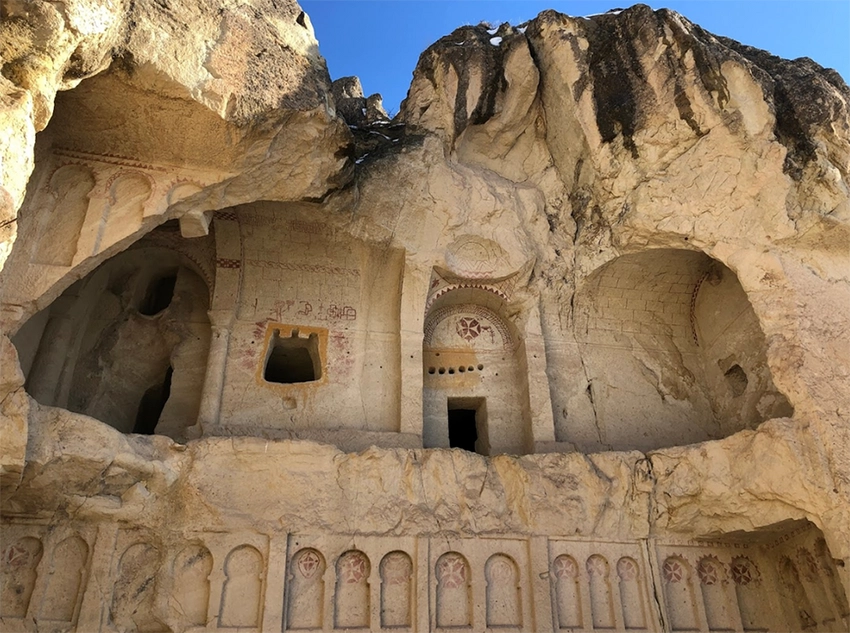
Most visitors should allow approximately 30 to 60 minutes for the church and its immediate setting. The complete outing may take longer because the approach can involve uneven valley paths, navigation stops and changing access conditions.
This is not a managed museum interior on the same scale as the Göreme Open-Air Museum. Visitors should confirm the current route, respect any barriers and avoid assuming that an old photograph proves the church is open.
How to Plan a First Visit
Confirm the current access route before leaving Göreme. Trail lines, local restrictions and the safest approach can change because of erosion, conservation work and seasonal conditions.
Save the correct map point and the return direction before entering the valley. Similar paths and rock formations can make orientation harder than the short distance suggests.
Wear shoes with secure grip and carry water. Loose volcanic soil, worn rock and short steep sections can become slippery after rain, snow or repeated foot traffic.
Enter only when the interior is clearly accessible. A doorway without a physical gate should not be treated as permission when signs, ropes or local instructions indicate a restriction.
Allow your eyes time to adjust before examining painted surfaces. Strong sunlight outside can make a dim interior appear almost empty during the first moments.
Carry only compact equipment. Large backpacks, tripods and loose straps can strike fragile rock or painted walls inside a small sanctuary.
Location and Landscape Setting
The church is associated with the Kılıçlar Valley area near Göreme.
Its position within a rock-cut landscape is important. The sanctuary belongs to a network of valleys containing churches, chapels, burial spaces, agricultural features and former living areas.
A remote position does not automatically prove that the church was a secret refuge or an isolated hermitage. Some valley churches served settled communities, monastic groups, landowners or people traveling between cultivated areas.
The modern trail does not necessarily reproduce the original route used by worshippers. Erosion, collapsed rock, agricultural change and later footpaths can alter how the site is approached.
Visitors should look at the relationship between the entrance, valley floor, nearby rock surfaces and lines of movement rather than treating the church as an object separated from its landscape.
Historical Context and Dating
The church belongs to the wider Byzantine Christian heritage preserved around Göreme.
Rock-cut sanctuaries in Cappadocia developed across several centuries and cannot be dated simply because they were carved into volcanic tuff.
Architecture, painting style, inscriptions, plaster layers and construction relationships normally provide the strongest dating evidence.
In this case, the exact construction date and the full sequence of alterations are not presented as securely established.
The church may contain more than one phase of carving, painting, repair or reuse. A damaged wall can conceal the relationship between an earlier worship space and a later alteration.
For the wider regional development of Christian communities, monastic life and Byzantine painting, see the guide to Christian history in Cappadocia.
Why the Original Name May Be Uncertain
Meryem Ana Kilisesi is a modern identifying name connected with the Virgin Mary.
A modern name does not always preserve the original Byzantine dedication.
Churches can receive local names from a surviving fresco, nearby landscape feature, later tradition or practical need to distinguish one monument from another.
Without a complete dedicatory inscription or reliable historical record, the original liturgical title should remain uncertain.
This caution does not reduce the importance of the Marian association. It prevents a modern name from being presented as a documented medieval dedication.
Rock-Cut Architecture
The interior was created by removing volcanic tuff rather than constructing walls from separate stone blocks.
Vaults, arches, wall surfaces and the sanctuary were therefore shaped within the same rock mass.
The surviving space includes a worship area and an eastern sanctuary section, although damage and erosion make parts of the original arrangement difficult to reconstruct.
Rock-cut builders could imitate forms familiar from masonry churches, including apses, vaults, arches, niches and liturgical divisions.
These carved features were not merely decorative. They organized worship, movement, visual hierarchy and the placement of paintings.
The modest scale creates a more concentrated experience than the larger painted complexes in Göreme Open-Air Museum.
How to Read the Surviving Plan
The Main Worship Space
The principal interior area provided space for worshippers and for the viewing of painted religious images.
Damage can make the original boundaries appear less clear than they were during active use.
Visitors should avoid assigning a precise plan type when the surviving evidence does not support a complete reconstruction.
Related Tours
Popular experiences for this destination
 Red Tour
Red Tour Cappadocia
Discover Göreme Open-Air Museum, Avanos pottery workshops, and breatht…
 Adventure
ATV Tour Cappadocia
Ride powerful ATVs through Cappadocia’s unique valleys, fairy chimneys…
 Adventure
Horseback Riding Tour Cappadocia
Experience Cappadocia on horseback, riding through valleys, hidden tra…
 Adventure
Trekking Tours Cappadocia
Hike Cappadocia’s spectacular valleys, fairy chimneys, and cave dwelli…
Pottery Workshop Cappadocia
Learn the ancient art of pottery from Avanos masters, try shaping clay…
 Green Tour
Green Tour Cappadocia
Explore Derinkuyu underground city, the beautiful Ihlara Valley, and S…
 Blue Tour
Blue Tour Cappadocia
Explore hidden valleys, ancient churches, and cultural gems on Cappado…
Vip Mix Tour Cappadocia
Experience the ultimate Cappadocia highlights in comfort-historic vall…

Classic Car Tour Cappadocia
Step into nostalgia with a vintage classic car ride through Cappadocia…
 Adventure
Jeep Safari Tour Cappadocia
Take an off-road jeep adventure across Cappadocia’s rugged landscapes,…

Cappadocia Rent A Car
Explore Cappadocia freely at your own pace with flexible car rental op…

Nostalgic Electric Car Tour Cappadocia
Ride eco-friendly nostalgic electric cars through Cappadocia’s valleys…
The Eastern Sanctuary
Cappadocian churches normally place the principal sanctuary toward the east.
The apse and surrounding liturgical area marked the religious focus of the interior.
Even when the altar or screen no longer survives, the shape and orientation of the eastern section can help identify its function.
Vaults and Wall Surfaces
Curved ceilings and carved walls provided surfaces for figures, crosses, narrative scenes and inscriptions.
A damaged vault can remove both architecture and painting, making the original visual sequence difficult to follow.
Niches and Recesses
Small niches may have supported liturgical, storage, commemorative or practical functions.
Shape alone does not prove one exact use. Interpretation should consider location, size and relationship with the sanctuary.
Architecture and Religious Use
The church was not simply an empty cave decorated with Christian images.
Its carved plan organized worship and separated the sanctuary from the main interior.
Paintings reinforced this organization by placing sacred figures and events on surfaces connected with the religious use of the space.
The church may also have supported commemoration, prayer for the dead or limited monastic activity, but those functions should not be asserted without church-specific evidence.
A small scale does not mean the monument was unimportant. Compact chapels could serve a focused community or a particular devotional purpose.
Surviving Frescoes
The church takes its modern name from its association with the Virgin Mary.
Surviving painted sections reflect the importance of Mary, Christ and other sacred figures within Byzantine devotional art.
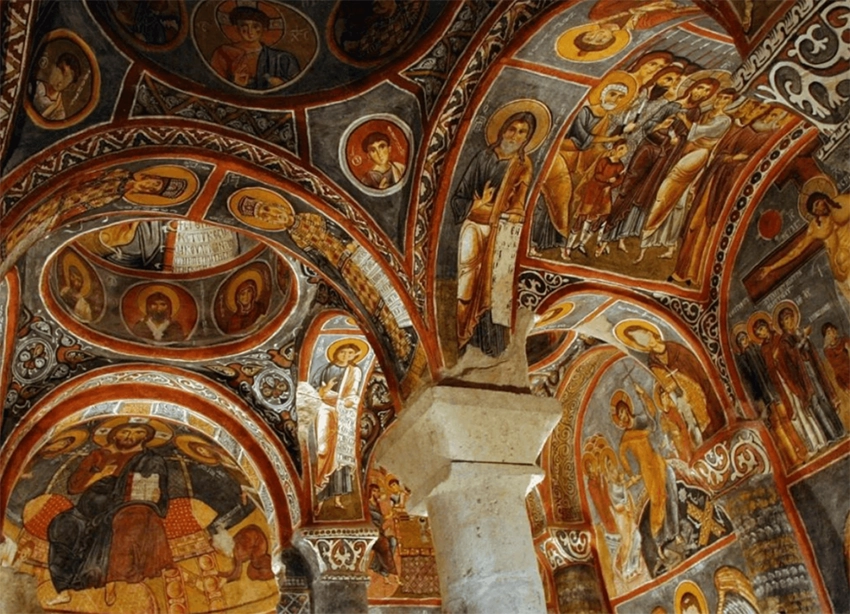
Not all paintings remain complete or clearly identifiable.
Paint loss, broken plaster, smoke, moisture, scratching and erosion can remove the attributes or inscriptions needed to identify a figure.
A damaged halo, garment or face should not be used alone to name a saint or biblical scene.
The available material does not provide a complete church-specific inventory of the surviving frescoes.
Scenes documented in other Cappadocian churches should not automatically be transferred to this monument.
How to Examine a Damaged Fresco
Begin With the Architectural Position
A figure in an apse, vault, entrance wall or side recess may have had a different liturgical role.
Position can narrow the interpretation but does not prove identity by itself.
Look for Inscriptions
Greek letters may identify Christ, the Virgin Mary, a saint or a scene.
Incomplete letters should be read cautiously. One surviving mark may support several possibilities.
Follow Halos and Gestures
A cross-inscribed halo commonly identifies Christ.
Raised hands, blessing gestures, prostration and the direction of gaze can clarify the relationship between figures.
Separate Original Paint From Damage
Dark deposits, scratches and later marks can overlap the original painting.
A blank patch may indicate lost plaster rather than an intentionally undecorated section.
Avoid Reconstruction by Imagination
Visitors can compare the remains with documented Cappadocian iconography, but a comparison should remain a comparison unless the church-specific evidence confirms the subject.
The Virgin Mary in Byzantine Tradition
In Byzantine Christianity, Mary is honored as the Theotokos, a Greek title commonly translated as Mother of God or God-bearer.
The title emphasizes the Christian belief that the child born from Mary is both human and divine.
Mary frequently appears in apses, domes and narrative cycles connected with the birth, ministry, Passion and divine identity of Christ.
Her image can also express prayer and intercession, especially when she turns toward Christ with raised hands.
Marian imagery is therefore not limited to scenes of motherhood. It includes prophecy, innocence, visitation, birth, intercession, grief and transition to eternal life.
Common Marian Image Types
| Image Type | Main Visual Idea | Interpretive Caution |
|---|---|---|
| Theotokos With Christ Child | Mary presents or holds Christ | Gesture and inscriptions help distinguish specific variants |
| Orans Virgin | Mary appears in prayer with raised hands | A damaged praying figure is not automatically Mary |
| Visitation | Mary and Elizabeth greet or embrace | The two figures require narrative context |
| Nativity | Mary appears with the newborn Christ | The scene includes several supporting figures and episodes |
| Dormition | Mary lies in death while Christ receives her soul | Do not confuse it with an ordinary burial scene |
This table explains the wider Byzantine tradition. It is not a list of frescoes confirmed inside Meryem Ana Kilisesi.
Proof of the Virgin at Çavuşin Church
A documented fresco at Çavuşin Church depicts the scene known as the Proof of the Virgin.
This example belongs to Çavuşin Church and is included here only to explain the wider Marian iconographic tradition of Cappadocia.
Mary and Joseph stand before the high priest Zachariah.
Mary drinks water from a vessel presented by the priest, while Joseph, shown behind her, also drinks from the vessel in his hands.
The story comes from the Protevangelium of James.
The trial is intended to demonstrate the innocence of Mary and Joseph after both pass through it without suffering harm.
Why the Scene Is Unusual
The Proof of the Virgin does not belong to the canonical Gospel accounts normally read in the New Testament.
Its presence demonstrates the influence of apocryphal traditions on Byzantine visual storytelling.
The vessel, priest and sequence of drinking provide the visual clues needed to distinguish the scene from the Annunciation or Visitation.
Why It Must Not Be Assigned to This Church
The existence of the scene at Çavuşin proves that Cappadocian artists used this Marian subject.
It does not prove that the same scene survives in the Church of the Virgin Mary near Kılıçlar Valley.
A church name alone is not enough to reconstruct its original painting program.
The Visitation at Cambazlı Church
Another important Marian subject documented in Cappadocia is the Visitation, the meeting of Mary and Elizabeth.
The example used for comparison is from Cambazlı Church in Ortahisar, not from the Church of the Virgin Mary.
According to the Gospel of Luke, Mary visits Elizabeth after the Annunciation.
Mary is pregnant with Jesus, while Elizabeth is pregnant with John the Baptist.
In Christian art, the women are usually shown greeting or embracing one another.
The scene represents recognition, blessing and the relationship between Christ and John the Baptist before their births.
How to Recognize the Visitation
Two women occupy the central action rather than Mary and an angel.
Their movement toward one another and the gesture of greeting distinguish the scene from the Annunciation.
Architectural elements may indicate a house or town setting.
Inscriptions can identify Mary or Elizabeth when their facial types and clothing are not enough.
Comparison, Not Attribution
The Cambazlı example helps explain how Marian narratives were represented in the wider region.
It should not be described as a surviving fresco inside Meryem Ana Kilisesi unless church-specific evidence confirms it.
The Dormition of the Virgin
The Dormition of the Virgin, also called Koimesis, represents Mary's falling asleep in death and her transition to eternal life.
The documented comparative example supplied for this subject is located in Yılanlı Church in Ihlara Valley.
In the traditional composition, Mary lies on a couch surrounded by apostles and prominent members of the Church.
Christ stands behind her and holds her soul in the form of a small swaddled child.
Saint Peter is normally placed near Mary's head and Saint Paul near her feet.
Angels wait to receive her soul and carry it toward heaven.
The Reversed Mother and Child Image
The composition reverses the familiar relationship between mother and child.
Mary once carried the infant Christ.
In the Dormition, Christ carries Mary's soul into eternal life.
This reversal gives the scene its strongest theological and emotional structure.
How to Distinguish the Dormition
The reclining body of Mary forms the horizontal center.
Christ normally stands vertically behind the couch and holds the smaller swaddled soul.
Apostles and angels gather around the two central figures.
A damaged burial scene should not be called the Dormition unless these relationships remain visible.
Related Tours
Popular experiences for this destination
Red TourRed Tour Cappadocia
Discover Göreme Open-Air Museum, Avanos pottery workshops, and breatht…
AdventureATV Tour Cappadocia
Ride powerful ATVs through Cappadocia’s unique valleys, fairy chimneys…
AdventureHorseback Riding Tour Cappadocia
Experience Cappadocia on horseback, riding through valleys, hidden tra…
AdventureTrekking Tours Cappadocia
Hike Cappadocia’s spectacular valleys, fairy chimneys, and cave dwelli…
Pottery Workshop Cappadocia
Learn the ancient art of pottery from Avanos masters, try shaping clay…
Green TourGreen Tour Cappadocia
Explore Derinkuyu underground city, the beautiful Ihlara Valley, and S…
Blue TourBlue Tour Cappadocia
Explore hidden valleys, ancient churches, and cultural gems on Cappado…
Vip Mix Tour Cappadocia
Experience the ultimate Cappadocia highlights in comfort-historic vall…
Classic Car Tour Cappadocia
Step into nostalgia with a vintage classic car ride through Cappadocia…
AdventureJeep Safari Tour Cappadocia
Take an off-road jeep adventure across Cappadocia’s rugged landscapes,…
Cappadocia Rent A Car
Explore Cappadocia freely at your own pace with flexible car rental op…
Nostalgic Electric Car Tour Cappadocia
Ride eco-friendly nostalgic electric cars through Cappadocia’s valleys…
Comparative Marian Scenes in Cappadocia
| Scene | Documented Comparison Site | Main Subject | Relationship to This Page |
|---|---|---|---|
| Proof of the Virgin | Çavuşin Church | Mary and Joseph demonstrate innocence before Zachariah | Regional comparison only |
| Visitation | Cambazlı Church, Ortahisar | Mary and Elizabeth greet one another | Regional comparison only |
| Dormition | Yılanlı Church, Ihlara Valley | Christ receives Mary's soul | Regional comparison only |
These examples demonstrate how Mary's life and spiritual role were represented across Cappadocia.
They provide iconographic context without pretending that the Church of the Virgin Mary preserves every subject shown in the table.
Why Comparative Iconography Matters
A damaged church can be difficult to interpret in isolation.
Documented scenes from other churches help explain the visual language available to Cappadocian painters.
Comparison can identify common gestures, clothing, inscriptions and narrative structures.
It can also reveal what is missing from a damaged composition.
The method has limits. Similarity does not prove that two churches shared an identical painting program, artist, date or patron.
The strongest interpretation states clearly whether a scene belongs to the monument being discussed or is used only as regional context.
Mary, Christ and the Apse
Images of Mary and Christ frequently appear in or near the sanctuary of Byzantine churches.
The apse provides a prominent position connected with worship, altar ritual and the sacred focus of the building.
Mary may appear holding Christ, presenting him to the viewer or praying with raised hands.
Prophets, angels, bishops or apostles can appear in surrounding zones according to the painting program.
This regional pattern can guide observation at Meryem Ana Kilisesi, but the damaged state of the monument requires caution before assigning a complete apse composition.
Greek Inscriptions and Figure Identification
Greek inscriptions can identify Christ, Mary, saints and narrative scenes.
Common abbreviations in Byzantine art include IC XC for Jesus Christ and MP XY for the Mother of Christ.
Names may appear beside halos, above figures or within a larger composition.
Paint loss can remove one or more letters, leaving an identification uncertain.
Visitors should not touch, wet or trace an inscription to make it easier to read.
A photograph taken from a safe distance can be enlarged later without placing the original surface at risk.
Damage, Erosion and Conservation
The church and its paintings are vulnerable to natural erosion and human contact.
Water can enter cracks, weaken plaster and carry material across painted surfaces.
Temperature change and frost can widen fractures in exposed rock.
Dust, smoke, scratching and touching can damage pigments and carved details.
A restricted entrance may respond to structural monitoring or conservation concerns that are not visible to a casual visitor.
Do not cross barriers, remove stones or enter a closed side space because an old photograph shows access.
Photography and Responsible Visiting
- Do not use flash near wall paintings.
- Follow current signs when photography is prohibited.
- Do not touch frescoes, plaster or carved walls.
- Keep bags, coats and hair away from painted surfaces.
- Do not wet, clean or trace inscriptions.
- Do not block the entrance with a tripod or photography setup.
- Keep voices controlled inside the sanctuary.
- Carry all trash out of the valley.
A bright photograph is not more important than the survival of a fragile painted surface.
Use natural observation and a moderate camera zoom where photography is permitted.
Visitor Information
| Planning Point | Practical Guidance |
|---|---|
| Location | Near Göreme in the Kılıçlar Valley area |
| Typical Time | Approximately 30 to 60 minutes at the church, plus approach time |
| Access | Confirm the current valley route and any conservation restrictions |
| Admission | Do not assume permanent free access or one fixed entrance arrangement |
| Footwear | Shoes with grip for loose rock, uneven paths and worn surfaces |
| Photography | Follow current signs and avoid flash |
No fixed ticket price, opening schedule or permanent access status should be presented without current confirmation.
Remote church access can change even when nearby valleys remain open.
Accessibility and Physical Conditions
The surrounding route may include narrow paths, loose volcanic soil, uneven rock and short steep sections.
Full wheelchair access should not be assumed.
Strollers are not practical on rough valley paths or inside a compact rock-cut sanctuary.
Visitors with limited mobility, balance concerns or visual difficulties should confirm the current approach before setting out.
Low interior light can make changes in floor level harder to see.
Older visitors should allow time for their eyes to adjust before moving inside.
Visiting With Children
Older children may find the rock-cut setting and painted remains interesting, but close supervision is essential.
- Keep children beside an adult on narrow paths.
- Do not allow climbing on fragile rock or church walls.
- Keep hands away from paintings and carved surfaces.
- Do not enter closed side chambers.
- Carry enough water and sun protection.
- Return before darkness when the route is unfamiliar.
A quiet sanctuary is not a play area. Running and shouting can endanger visitors and disturb the site.
Seasonal Planning
Spring
Cooler temperatures can suit the walk, but rain may leave mud and slippery rock on the approach.
Summer
Begin earlier or visit later in the day. Exposed valley paths provide limited shade.
Autumn
Cooler air often provides comfortable walking conditions. Shorter daylight should be considered when combining several valleys.
Winter
Snow and ice can make worn stone and shaded paths unsafe even when the road into Göreme is clear.
Do not continue when the approach is icy or when the return route cannot be completed before darkness.
Combining the Church With Nearby Heritage
The Church of the Virgin Mary can be considered alongside other rock-cut sanctuaries in and around Göreme.
Tokalı Church preserves one of Cappadocia's most extensive painted narrative programs.
Dark Church is known for its well-preserved later Byzantine frescoes, including the Deisis and Anastasis.
The Elmalı, Yılanlı and Çarıklı Churches provide useful comparisons of architecture, narrative painting and saintly portraits.
The Göreme Open-Air Museum guide explains the main managed church route and current ticket planning.
Do not combine every church and valley automatically. The Kılıçlar area requires walking time, while the museum rewards a slower examination of several interiors.
Suggested Visit Combinations
Short Göreme Heritage Walk
Visit the Church of the Virgin Mary only when the current route is confirmed, then return to Göreme without adding a long valley circuit.
Church and Museum Day
Use the morning for Göreme Open-Air Museum and reserve a separate period for the Kılıçlar area according to daylight and energy.
Marian Iconography Focus
Compare documented Marian scenes in major churches through a guide or museum interpretation rather than assuming they all survive in one monument.
Photography and Landscape Route
Focus on the relationship between church entrance, valley rock and natural light. Do not build the route around interior photography when current rules or access are uncertain.
Common Planning Mistakes
- Assuming the church is always open: Conservation and route conditions can change.
- Assigning every Marian scene to this monument: The Çavuşin, Cambazlı and Ihlara examples are comparisons.
- Inventing a precise date: The available material does not establish one secure construction year.
- Assuming the modern name is the original dedication: Meryem Ana may be a later identifying name.
- Using a map pin without checking the path: The final approach may differ from the direct line shown on a screen.
- Touching damaged paintings: Fragile pigment and plaster can be lost through repeated contact.
- Walking in unsuitable shoes: Loose tuff and worn rock require grip.
- Returning after darkness: Valley paths become difficult to read quickly.
- Treating comparison as proof: Similar iconography does not establish an identical church program.
Questions Travelers Ask About the Church of the Virgin Mary
Where is Meryem Ana Kilisesi?
It is associated with the Kılıçlar Valley area near central Göreme.
Is it inside Göreme Open-Air Museum?
No. It should not be treated as one of the managed interiors on the standard museum route.
How long should you allow?
Allow approximately 30 to 60 minutes at the church, plus the time required for the approach and return.
Is the original construction date known?
The exact date is not presented as securely established in the available material.
Why is it called the Church of the Virgin Mary?
The modern name reflects its Marian association, but it does not automatically prove the original Byzantine dedication.
Which frescoes survive inside?
Painted remains connected with Mary, Christ and sacred figures survive, but a complete church-specific inventory is not available for this page.
Does it contain the Proof of the Virgin?
The documented comparative example discussed here belongs to Çavuşin Church, not to Meryem Ana Kilisesi.
Does it contain the Visitation?
The example discussed here belongs to Cambazlı Church in Ortahisar and is used only for regional context.
Does it contain the Dormition?
The documented example discussed here belongs to Yılanlı Church in Ihlara Valley.
Is there an entrance fee?
No fixed price or permanent free-access status should be assumed. Check current local conditions.
Can visitors take photographs?
Follow current signs and local instructions. Avoid flash around wall paintings.
Is the route wheelchair accessible?
Full accessibility should not be assumed because the approach may include narrow and uneven valley paths.
Can children visit?
Yes, with close supervision on the path and inside the church.
Is a guide useful?
Yes. A knowledgeable guide can help with navigation, architectural interpretation and the distinction between confirmed frescoes and regional comparisons.
A Quiet Monument of Byzantine Cappadocia
The importance of the Church of the Virgin Mary lies in the relationship between landscape, carved architecture and surviving traces of Byzantine devotion.
Its damaged state requires a different approach from a well-preserved museum church.
Visitors gain more by observing orientation, sanctuary form, paint layers and the valley setting than by trying to identify every fragment as a famous biblical scene.
The comparative examples from Çavuşin, Cambazlı and Ihlara demonstrate the range of Marian iconography used across Cappadocia without being presented as paintings confirmed inside this church.
This separation between evidence and comparison protects the historical accuracy of the page while preserving the wider religious meaning of the monument.
Use the Cappadocia trip planning guide and the Cappadocia safety and essentials guide when combining the church with valley walking and the wider Göreme heritage route.